Colin Wright’s Experience with University DEI Departments

Colin Wright is a biologist who wanted to teach at a university.  He explains his interview process in this video. The universities only cared about two types of diversity:  1. Physical appearance and 2. Sex and gender identity.  They did not care about viewpoint diversity.  They did not care about equality, but only about equity (guarantying equal outcomes).  Wright believes in hiring the best person for the job, not what they looked like. He believes that it is dehumanizing to deal with others based on their physical appearance or their sexual or gender ideology because this insists that we should reduce human complexity to a single trait. The DEI statements he encountered required him to give assent to segregation based on physical traits.

Wright gave up on his dream of teaching at a university. He hears from many teachers who are self-censoring or lying in order to keep their jobs.  His conclusion: Diversity, Equity and Inclusion orthodoxy prevents diversity of thought.

Eric Weinstein's reaction to Wright's video:

Continue ReadingColin Wright’s Experience with University DEI Departments

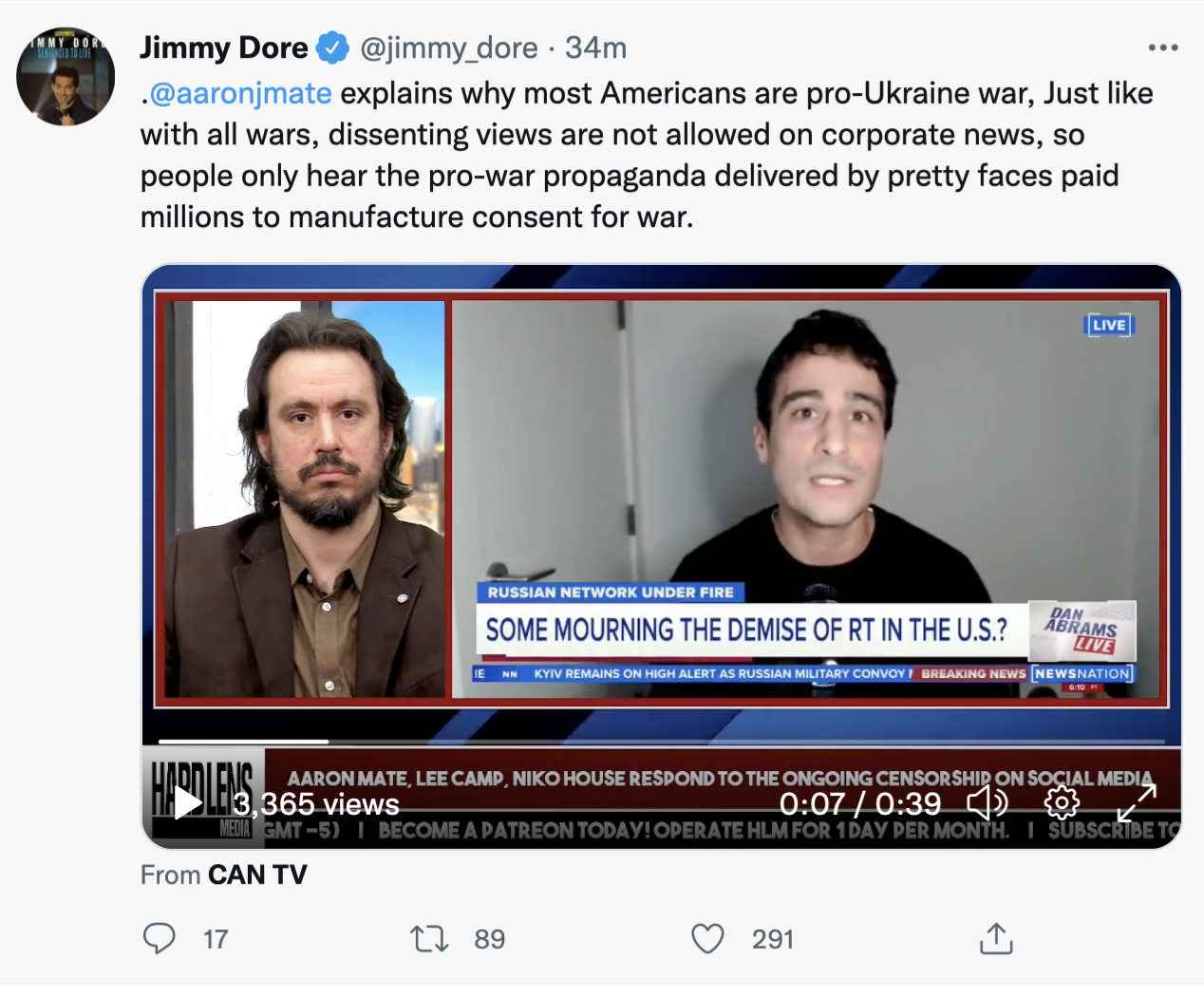
Aaron Mate: The United States Abandoned the Ukrainian Peace Project in 2019

Aaron Mate offers some historical context:

On a warm October day in 2019, the eminent Russia studies professor Stephen F. Cohen and I sat down in Manhattan for what would be our last in-person interview (Cohen passed away in September 2020 at the age of 81)...

At that point, Ukraine's Volodymyr Zelensky was just months into an upstart presidency that he had won on a pledge to end the Donbas conflict. Instead of supporting the Ukrainian leader's peace mandate, Democrats in Congress were impeaching Trump for briefly impeding the flow of weapons that fueled the fight. As his Democratic allies now like to forget, President Obama refused to send these same weapons out of fear of prolonging the war and arming Nazis). By abandoning Obama’s policy, the Democrats, Cohen warned, threaten to sabotage peace and strengthen Ukraine's far-right.

Continue ReadingAaron Mate: The United States Abandoned the Ukrainian Peace Project in 2019

Bill Maher: “Colleges: Where Comedy Goes to Die.”

Bill Maher explaining Jokes to idiots: Oscar Edition. This is not just about Will Smith. This is about elite intolerance of comedians. Elite colleges are where students go "to lose their sense of humor."

Maher's ending line:

For all those who are constantly demanding an apology for jokes maybe it's you who should apologize to us for all the great jokes that we never got to hear, the brilliant thoughts that were never uttered those are the invisible scars of cancel culture. let's have a moment of silence for that . . .

Continue ReadingBill Maher: “Colleges: Where Comedy Goes to Die.”

Free Speech: A Shield Against Oppression

Historically speaking, free speech has primarily served as a shield against oppression. Jacob Mchangama, who has written Free Speech: A History from Socrates to Social Media, also wrote an article at the Heterodox Academy blog. Here is an excerpt that I will have ready the next time I hear the free speech is a "problem" or that it is a tool of "oppression" or "violence."

A global look at the history of free speech suggests that free speech is in fact a shield against oppression. White supremacy, whether in the shape of American slavery and segregation, British colonialism, or South African apartheid, relied heavily on censorship and repression. Conversely, advocates of human equality like Frederick Douglass, Ida B. Wells, Mahatma Gandhi, Martin Luther King, and Nelson Mandela all championed the principle and practice of free speech to great effect and at huge personal cost. In the words of the late Congressman John Lewis, “Without freedom of speech and the right to dissent, the civil rights movement would have been a bird without wings.” Tragically, several countries, not least India, still use hate speech laws, with roots stretching back to the era of British colonialism, to silence dissenters as well as the minorities these laws were supposed to protect. Moreover, the current tsunami of Republican-sponsored bills aimed at censoring “divisive” teachings on issues such as race, gender, sexual orientation, and even American history, are often uncomfortably close to their anti-racist speech code counterparts when it comes to wording and the underlying philosophy that words constitute, or are comparable with, tangible physical harms. Far from serving as a remedy against “cancel culture,” such bills are likely to increase partisan and ideological policing of nonconformist speech to the detriment of free and open discourse without which higher education becomes stale and ultimately meaningless.

Continue ReadingFree Speech: A Shield Against Oppression

Adversarial Collaboration: An Idea Whose Time has Come

I first heard of this phrase, adversarial collaboration, from this presentation by Daniel Kahneman at Edge.org.

This seems like an excellent idea with broad application in many fields.

I see that the University of Pennsylvania has an Adversarial Collaboration Project. Here is an excerpt from its description page:

As originally conceived by Economics Nobel Prize Laureate, Daniel Kahneman, adversarial collaborations call on scholars to: (1) make good faith efforts to articulate each other’s positions (so that each side feels fairly characterized, not caricatured); (2) work together to design methods that both sides agree constitute a fair test and that they agree, ex ante, have the potential to change their minds; (3) jointly publish the results, regardless of “who wins, loses or draws” on which topics. Each collaborator serves as a check on their adversary to confirm that the hypotheses are falsifiable, the scientific tests are fair, and the interpretations accurately characterize the findings. Because adversarial collaborations restrict scholars’ abilities to rig methods in favor of their own hypothesis and to dismiss unexpected results, adversarial collaborations are likely to advance debates faster and generate more reliable knowledge than traditional approaches.

Through this initiative, we hope to discover best practices for participating in adversarial collaborations and to normalize such practices in order to improve the accuracy and efficiency of the social sciences and its reputation among policy makers and the public.

Continue ReadingAdversarial Collaboration: An Idea Whose Time has Come