Newly Racist Things
Titania McGrath offers us a look at more than 100 things that have now been declared to be "racist."
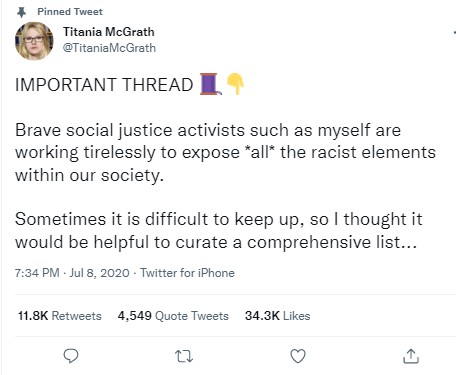
Note about Titania: This is a parody account by Andrew Doyle, a serious and fearless thinker.

Titania McGrath offers us a look at more than 100 things that have now been declared to be "racist."
Note about Titania: This is a parody account by Andrew Doyle, a serious and fearless thinker.
This is the latest installment of a fascinating exchange of ideas at FIRE's First Amendment News. This installment was written by Ira Glasser, former Executive Director of the ACLU. This conversation was provoked by Florida's repeal of Disney's special tax status in response to Disney's criticism of Florida's Parental Rights in Education bill, misnamed the “Don’t Say Gay” law by many on the left.
I'm repeatedly struck by the ill-thought tactics of many people who try to mess with the First Amendment. These tactics usually amount to "Free speech for me, but not for thee." The First Amendment is a boomerang, however. It is an equal-opportunity provision that doesn't (and shouldn't) care about who is speaking or the content of particular speech. Your well-intended tweaks and restrictions of the First Amendment (here, in the form of Citizens United) can come back and hit you upside your head. What follows is an excerpt of Glasser's latest comment:
But two liberal law professors who had spent 12 years vigorously opposing the Citizens United decision — my longtime colleagues Burt Neuborne and Erwin Chemerinsky — leaped into the fray supporting the First Amendment right of the Disney corporation to express its views on that legislation and opposed the state’s attempt to retaliate. When I chided them for it in light of their long opposition to Citizens United, they responded with a blizzard of legal distinctions that, however interesting and important, were disconnected from the political realities that resulted in the broad law that Citizens United struck down, and unresponsive to my question.
Buried in that blizzard, however, was the answer to my question, almost as an aside: “Citizens United,” they now declare, “was rightly decided on its facts.”
Floyd Abrams then replied, saying he was startled to discover that they now said they believed that “Citizens United was rightly decided on its facts” because for 12 years, or ever since Citizens United was decided, they had vigorously and consistently criticized that decision as having been wrongly decided.
I, too, was startled. What had changed? Certainly, the facts of that case hadn’t changed since the case was decided. Moreover, if Burt and Erwin had ever before proclaimed that Citizens United had been rightly decided in the many public fora where they discussed that decision, I missed it, and apparently, Floyd Abrams did, too.
So if the facts of the case haven’t changed, what has?
We can only speculate.
But in any case, we now have two accomplished liberal law professors saying: 1) that Citizens United was rightly decided; and 2) that a business corporation like Disney has a First Amendment right to express its views on a contentious law.
I need to fall on the sword here too. I got caught up in the anti-Citizens United wave years ago and posted several regrettable posts (at this site) indicating positions I no longer hold. The turning point for me was a very slow and careful read of the Citizens United opinion combined with sober consideration of impossible real world challenges we would have faced had Citizens United had been decided the opposite way.
I posted a Tweet of Glenn Greenwald on Facebook today (and see here):
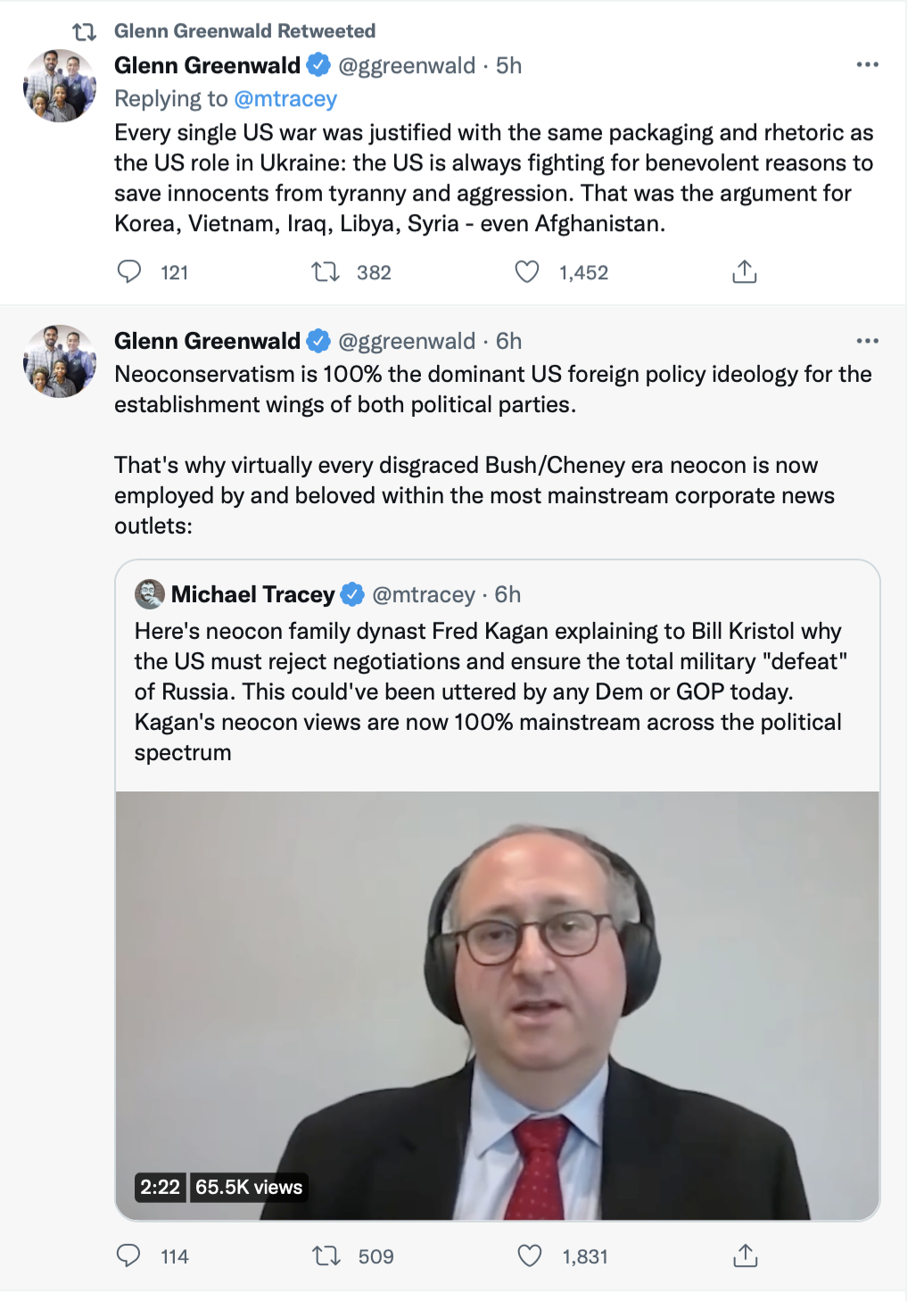
I added some additional commentary by Glenn Greenwald:
The amazing thing is it's the same people, it's David Frum and Nicolle Wallace and Matthew Dowd and Bill Kristol and Max Boot," Greenwald said. "All these neocons back then who were doing this and made themselves the enemy of the country. They ended up in complete disrepute by the end of the second Bush-Cheney term, are now back in the saddle doing it on behalf of Democrats on their cable networks, on their newspapers' op-ed pages. And it's like people have no historical memory, they cheer for these people because they rehabilitated themselves by opposing Trump and that's all they know.
Right on cue, I received this comment:
The invasion of Ukraine is NOT like Vietnam,Korea, etc. and equating it with that is aPutin-friendly talking point. Do you work for FOX now?
To which I responded:
Are you suggesting that because I'm against a war with no stated end-game and no stated benefit to ordinary Americans, a war that is enriching America's vast military-industrial complex, a war that pushes us ever closer to the trigger point of an already extremely dangerous risk of nuclear holocaust, and a war that is sucking up massive financial resources that should be helping desperate Americans,, that I'm pro-Putin and that I work for FOX?
[More . . . ]
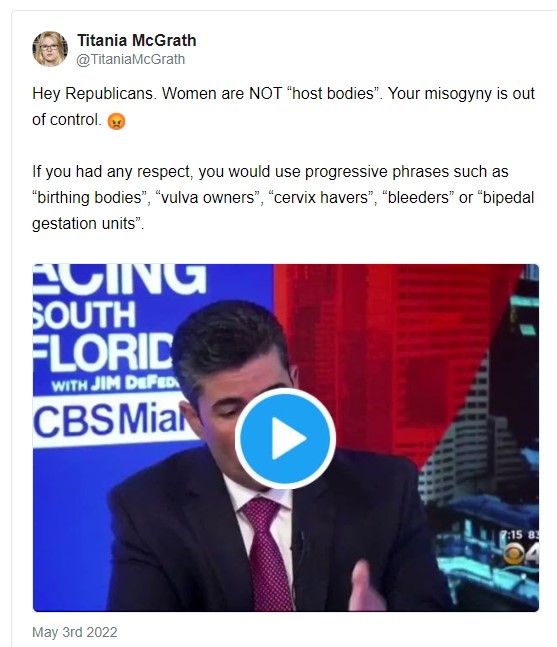
I'm pro-choice. My preference is to see Roe v Wade upheld. That said, if you're up for a challenge, try to find the word "women" in any recent article or tweet about abortion by the Washington Post, NYT, ACLU, NARAL or MSNBC.
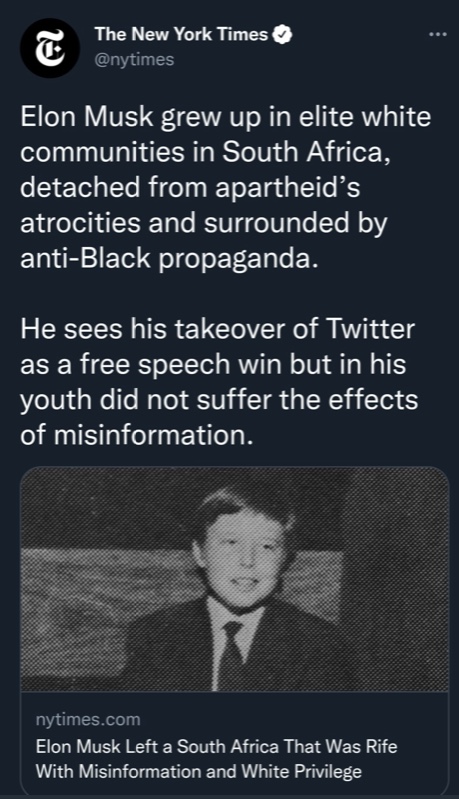
Nellie Bowles, writing at Common Sense points out one of many deranged articles about Elon Musk, this one at the New York Times (image of the NYT headline below). Nellie's comments:
Pretty bad that baby Elon Musk didn’t solve apartheid: The Times has a new profile of Musk, who grew up in apartheid South Africa until he was 17, then emigrated to Canada so he wouldn’t have to serve in the military.
No matter, the Times’ effort is to smear him literally because he happened to be born into a country with a reprehensible government. Here’s what the reporter wrote: “Elon Musk grew up in a South Africa that saw the dangers of unchecked speech: Apartheid government propaganda fueled violence against Black people. Musk didn't experience that. He grew up in a bubble of white privilege.”
The word the Times was searching for to describe information flow in apartheid-era South Africa the exact opposite of “unchecked speech. It’s censorship. Newspapers blacked out their own columns in protest of government censorship. So determined are these writers to smear Musk and jam history into our modern language, they are literally rewriting apartheid as a problem of misinformation and too much free speech.