COVID Origins Conspiracy of Silence Included UNC’s Ralph Baric

For several years, I have assumed that this was going on, but now we know and I've reached an even higher level of disgust with U.S. Public Health Establishment.

Linked article from the Washington Free Beacon, "

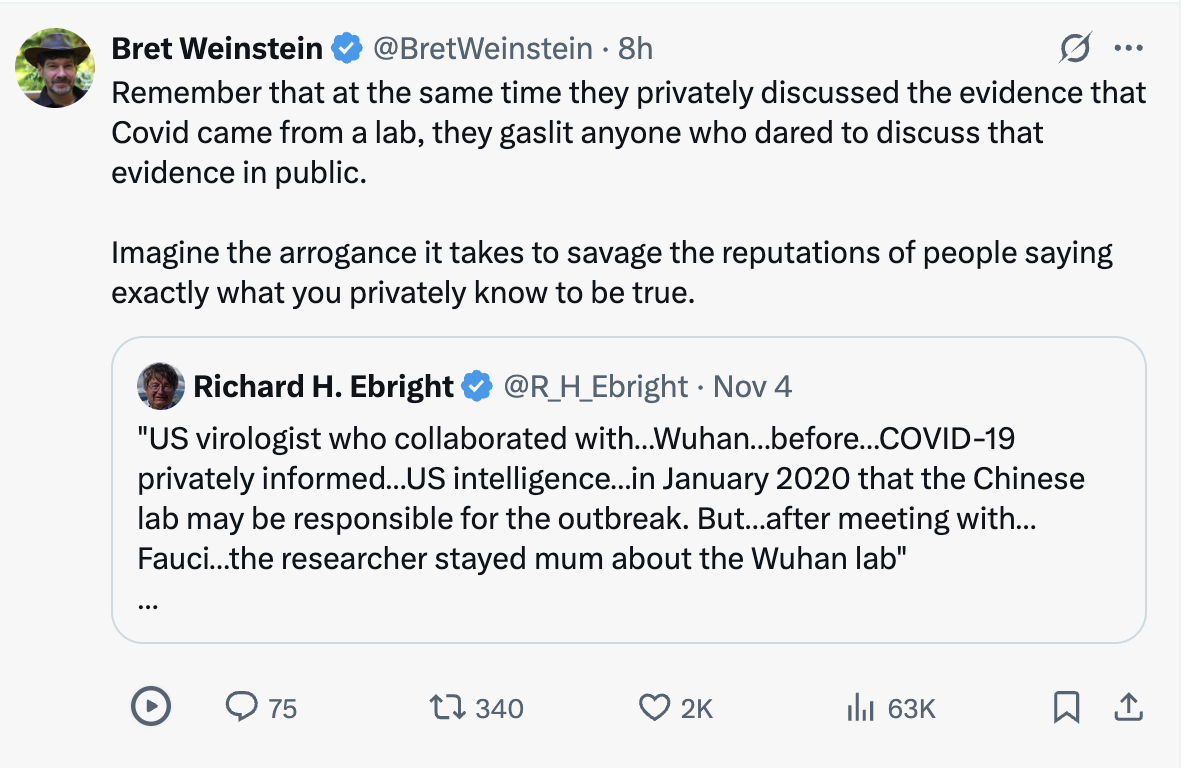
Prominent Virologist Warned Intelligence Community COVID-19 Could Have Leaked From Wuhan Lab. Then He Met With Fauci and Changed His Tune: The researcher, UNC professor Ralph Baric, also privately downplayed the wet market theory but publicly lent it credit."

A prominent U.S. virologist who collaborated with the Wuhan Institute of Virology before the COVID-19 pandemic privately informed the U.S. intelligence community in January 2020 that the Chinese lab may be responsible for the outbreak. But in his public remarks to congressional staffers one month later—and after meeting with former White House health adviser Anthony Fauci—the researcher stayed mum about the Wuhan lab and lent credence to the discredited wet market theory.

Continue ReadingCOVID Origins Conspiracy of Silence Included UNC’s Ralph Baric

Whence Copyright Prosecutions?

It wasn't too long ago that we all had to walk on eggshells to make sure we did not overuse quotations from copyrighted material. We need to make sure that we fell within the fair use doctrine.  Four years ago, I was tagged by Getty (to the tune of $600) for using one photo in a powerpoint I created to illustrate a point (they didn't buy my fair use argument and I didn't want to risk a much higher potential fee (and attorneys' fees) by challenging them in court.

Fast forward, in this day and age of AI, what ever happened to copyright?  Is it, as Balzac wrote: ""Laws are spider webs through which the big flies pass and the little ones get caught"?

And consider [with help from Grok here] some of the surreal scenes along the way, especially the "suicide" of Suchir Balaji, a 26-year-old former OpenAI researcher and whistleblower who publicly criticized the company's use of copyrighted data to train AI models like ChatGPT. He was found dead in his San Francisco apartment on November 26, 2024, in what authorities initially ruled a suicide with no evidence of foul play. Balaji had left OpenAI in August 2024 after four years, citing ethical concerns over potential violations of U.S. copyright law in the firm's data practices, and he was reportedly being considered as a witness in ongoing lawsuits against the company, including those from The New York Times. His death sparked controversy when his parents questioned the suicide determination, filing a lawsuit against San Francisco in February 2025 to challenge the police investigation and seek further details, amid persistent doubts from the family and public figures like Elon Musk and Tucker Carlson, who speculated on podcasts and interviews that it might have been murder despite official findings. No conclusive evidence supporting foul play has emerged, and the case remains a point of debate in tech and AI ethics circles.

Must watch video: Tucker Carlson interviewing OpenAI's Sam Altman on this "suicide" (start at min 19):

And now, Lee Fang asks what happened to copyright enforcement in this age of AI. Excerpt from "What Happened to Piracy? Copyright Enforcement Fades as AI Giants Rise."

Much has changed since advances in artificial intelligence have made the technology the focal point of Silicon Valley innovation. Smith is now president of Microsoft, and the company and its partner OpenAI—which exclusively runs on Microsoft’s Azure cloud computing network and was backed with $13.75 billion in investment funds from Microsoft—are at the center of a very different type of copyright dispute. This time, as the power of the tech industry still looms over Washington, D.C., prosecutors are less interested in going after those suspected of engaging in illegal downloads of copyrighted work.

That is because it is now the tech giants that are accused of exploiting pirated content on an industrial scale. Meta, Anthropic, Microsoft, Google, xAI, and OpenAI are competing to vacuum up as much data as humanly possible in a race to develop their respective AI models. The most prized training data, it turns out, are vast quantities of copyrighted material, largely in the form of published works such as academic articles, novels, and nonfiction books.

After decades of FBI warnings about copyright violations and the dangers of piracy, suddenly the federal government is no longer interested in such crimes. That has left law enforcement in the hands of civil litigation class actions, many of which have been filed by authors and writers noting that tech giants are now plundering their works for AI training without authorization, payment, or notification.

The court cases have cast a spotlight on a stratospheric level of hypocrisy.

Continue ReadingWhence Copyright Prosecutions?

John Brennan Flips and Flops on the Hot Seat

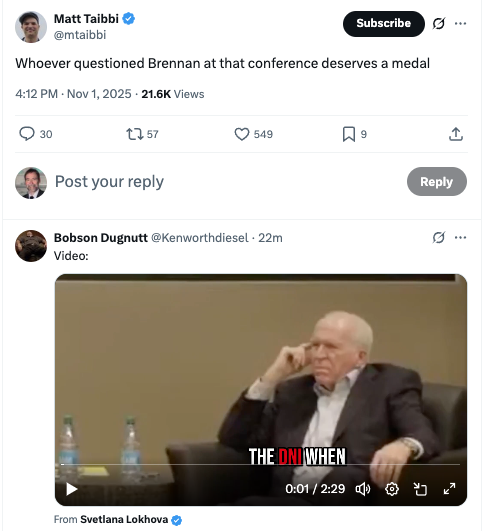
This is what happens when someone (I wish I knew who, because he DOES deserve a medal) puts a powerful corrupt deep state partisan on the spot in front of a live audience (with the cameras recording this for potential future criminal prosecution). Notice that John Brennan's go-to response is not to answer the spot-on question, but rather to quickly try to figure out how to smear the questioner.

On FB, I added this: "Those of you who inhabit only the corporate news ecosystem won't have any fucking idea why this video is critically important."

Continue ReadingJohn Brennan Flips and Flops on the Hot Seat

Elon Musk Explains the Origin of OpenAI

OpenAI was supposed to be open source and non-profit. That's not how it turned out.

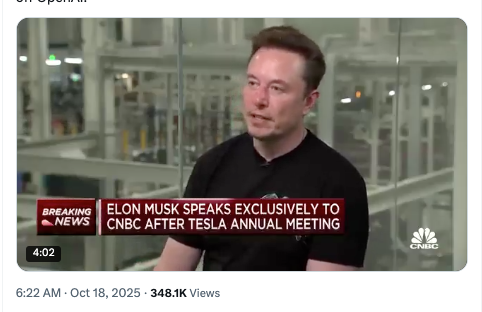
Musk explains the history (transcribed by Eva Fox on X).

“I am the reason OpenAI exists.”

“I used to be a close friend with Larry Page, and I was staying at his house, and we'd have these conversations long into the evening about AI, and I would be constantly urging him to be careful about the danger of AI. And he was really not concerned about the danger of AI and was quite cavalier about it. And at the time, Google, especially after the acquisition of DeepMind, had three-quarters of the world's AI talent; they had a lot of computers, a lot of money, so it was a unipolar world for AI. And we got a unipolar world, but the person who controls that does not, or at least did not seem to be concerned about AI safety. That sounded like a real problem.

The final straw was Larry calling me a speciest for being a pro-human consciousness instead of machine consciousness, and I like, 'Well, yes, I guess I am a speciest.'

I came up with the name [OpenAI], which refers to open source. The intent was to what is the opposite of Google, would be an open source non-profit, because Google is closed source profit, and that profit motivation could be dangerous...

It does seem weird that something can be a nonprofit, open source, and somehow transform itself into a for-profit, closed source. I mean, this would be like, let's say you founded the organization to save the Amazon rainforest, but instead, they became a lumber company and chopped down the forest and sold it for money. And you'd be, therefore, like, 'Wait a second, that's the exact opposite of what I gave the money for. Is that legal?' That doesn't seem legal. And if, in general, it is legal to start a company as a non-profit and then take the IP and transfer it to a for-profit that then makes tons of money, shouldn't everyone start? Shouldn't that be the default?

And I also think it is important to understand, like when push comes to shove, let's say they do create some digital super intelligence, almost Godlike intelligence, well, who is in control, and what is exactly the relationship between OpenAI and Microsoft? And I do worry that Microsoft actually may be more in control than the leadership team at OpenAI realizes. I mean, Microsoft, as part of Microsoft Investment, has rights to all of the software, all of the model weights, and everything necessary to run the inference system. At any point, Microsoft could cut off OpenAI.”

Continue ReadingElon Musk Explains the Origin of OpenAI

Barack Obama Openly Advocates for Censorship by the Elites to Help the Unwashed Masses

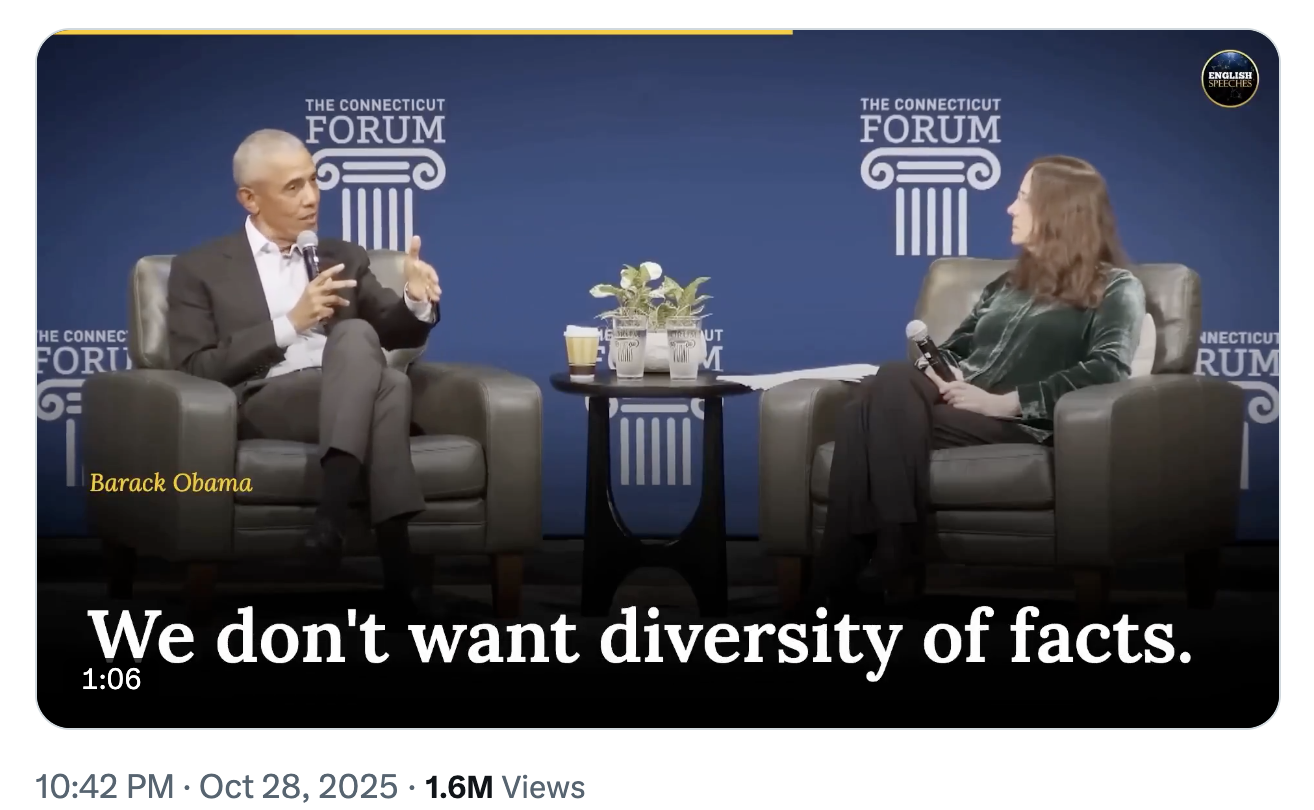
Obama is clearly advocating the need for censorship in this video:

Part of what we’re going to have to do is to start experimenting with new forms of journalism and how we use social media in ways that reaffirm facts and separate facts from opinion. We want diversity of opinion. We don’t want diversity of facts. That, I think, is one of the big tasks of social media. By the way, it will require some government regulatory constraints…

I'll paraphrase: "We," (the pre-ordained elites) will be in charge of what you can say and hear. We're helping you and you need our help because you're too dumb to think for yourself. You'll love it!

This is no one-off for Obama. Despite being a former professor of law, who taught constitutional law, Obama considers himself one of the elite leaders of the censorship industrial complex.  Consider this brand new article by Michael Shellenberger: "Obama-Linked Stanford Center Held Secret Meeting With Foreign Governments To Plot Global Internet Censorship: Top EU, UK, Brazil, and Australian officials met in September with US censorship advocates to combine and coordinate efforts." Excerpt:

In the spring of 2022, former President Barack Obama gave a major policy address at Stanford University’s Cyber Policy Center, where he laid out a sweeping proposal for government censorship of social media platforms through the Platform Accountability and Transparency Act. Six days later, President Joe Biden’s Department of Homeland Security announced that it had created a “Disinformation Governance Board” to serve as an Orwellian Ministry of Truth with the clear goal of controlling the information Americans could access online.

At the heart of Obama’s vision for Internet censorship was legislation that would have authorized the US government’s National Science Foundation to authorize and fund supposedly independent NGOs to censor the Internet. The DHS and Stanford Internet Observatory, which was part of the Stanford Cyber Policy Center, pioneered this censorship-by-proxy strategy as a way to get around the First Amendment in 2020 with posts raising concerns about the 2020 elections and in 2021 with “narratives” expressing concern about the Covid vaccine.

The 2024 election of President Donald Trump significantly reduced the threat of Obama, DHS, and NSF censoring the American people. Trump defunded much of the Censorship Industrial Complex. The Platform Accountability Act is going nowhere in Congress.

To be fair, Trump is no saint on free speech. As FIRE's Will Creely testified recently, Trump has been bludgeoning numerous entities to curtail free speech:

To be sure, the government may speak for itself, and the public has an interest in hearing from it. But it may not wield that power to censor. As Judge Richard Posner put it: The government is “entitled to what it wants to say — but only within limits.” Under no circumstances may our public servants “employ threats to squelch the free speech of private citizens.”

So the law is clear: Government actors cannot silence a speaker by threatening “we can do this the easy way or we can do this the hard way,” as the chairman of the Federal Communications Commission did last month. Nevertheless, recent examples of jawboning abound: against private broadcasters, private universities, private social media platforms, and more. The First Amendment does not abide mob tactics.

Democrats, however, are more on board with Obama's approach to censorship than republicans:

[More ...]

Continue ReadingBarack Obama Openly Advocates for Censorship by the Elites to Help the Unwashed Masses