
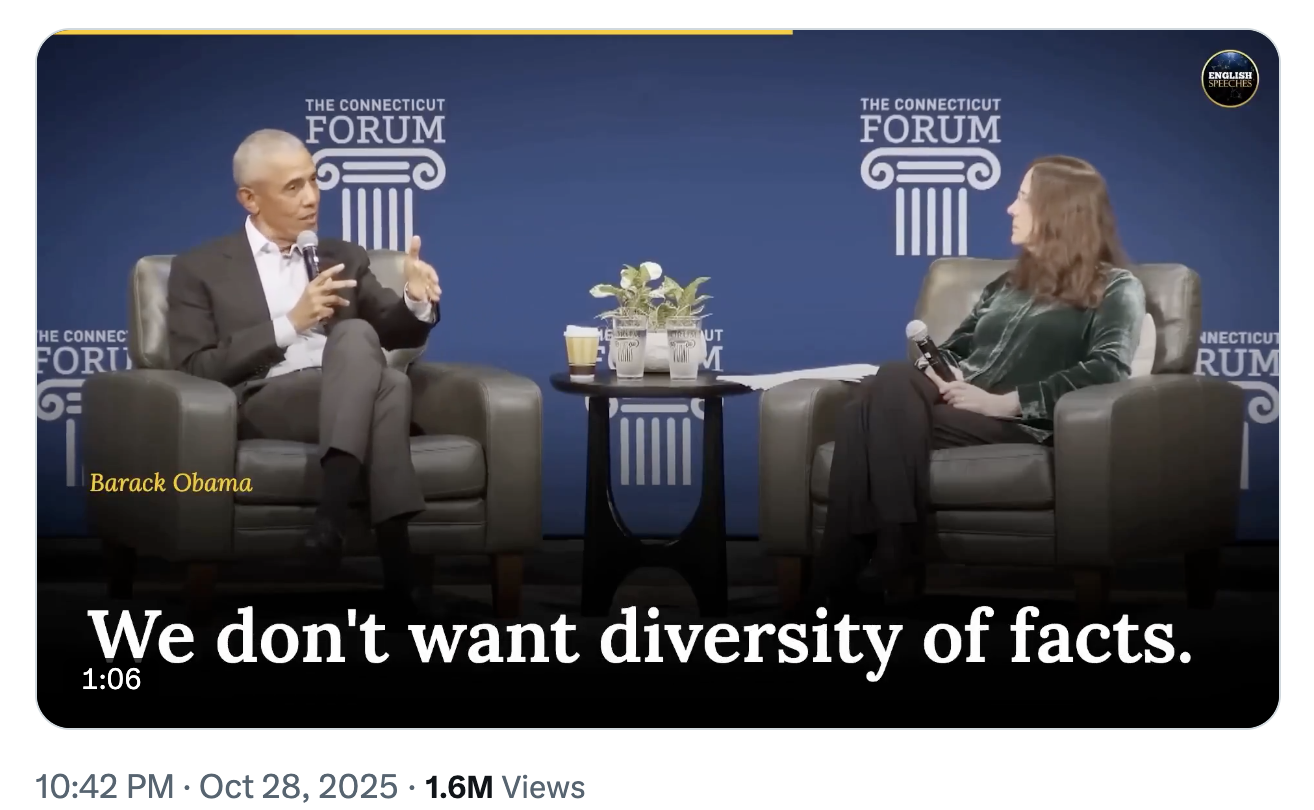
Obama is clearly advocating the need for censorship in this video:
Part of what we’re going to have to do is to start experimenting with new forms of journalism and how we use social media in ways that reaffirm facts and separate facts from opinion. We want diversity of opinion. We don’t want diversity of facts. That, I think, is one of the big tasks of social media. By the way, it will require some government regulatory constraints…
I’ll paraphrase: “We,” (the pre-ordained elites) will be in charge of what you can say and hear. We’re helping you and you need our help because you’re too dumb to think for yourself. You’ll love it!
This is no one-off for Obama. Despite being a former professor of law, who taught constitutional law, Obama considers himself one of the elite leaders of the censorship industrial complex. Consider this brand new article by Michael Shellenberger: “Obama-Linked Stanford Center Held Secret Meeting With Foreign Governments To Plot Global Internet Censorship: Top EU, UK, Brazil, and Australian officials met in September with US censorship advocates to combine and coordinate efforts.” Excerpt:
In the spring of 2022, former President Barack Obama gave a major policy address at Stanford University’s Cyber Policy Center, where he laid out a sweeping proposal for government censorship of social media platforms through the Platform Accountability and Transparency Act. Six days later, President Joe Biden’s Department of Homeland Security announced that it had created a “Disinformation Governance Board” to serve as an Orwellian Ministry of Truth with the clear goal of controlling the information Americans could access online.
At the heart of Obama’s vision for Internet censorship was legislation that would have authorized the US government’s National Science Foundation to authorize and fund supposedly independent NGOs to censor the Internet. The DHS and Stanford Internet Observatory, which was part of the Stanford Cyber Policy Center, pioneered this censorship-by-proxy strategy as a way to get around the First Amendment in 2020 with posts raising concerns about the 2020 elections and in 2021 with “narratives” expressing concern about the Covid vaccine.
The 2024 election of President Donald Trump significantly reduced the threat of Obama, DHS, and NSF censoring the American people. Trump defunded much of the Censorship Industrial Complex. The Platform Accountability Act is going nowhere in Congress.
To be fair, Trump is no saint on free speech. As FIRE’s Will Creely testified recently, Trump has been bludgeoning numerous entities to curtail free speech:
To be sure, the government may speak for itself, and the public has an interest in hearing from it. But it may not wield that power to censor. As Judge Richard Posner put it: The government is “entitled to what it wants to say — but only within limits.” Under no circumstances may our public servants “employ threats to squelch the free speech of private citizens.”
So the law is clear: Government actors cannot silence a speaker by threatening “we can do this the easy way or we can do this the hard way,” as the chairman of the Federal Communications Commission did last month. Nevertheless, recent examples of jawboning abound: against private broadcasters, private universities, private social media platforms, and more. The First Amendment does not abide mob tactics.
Democrats, however, are more on board with Obama’s approach to censorship than republicans:
For instance, A 2025 Pew Research Center survey found that 58% of Democrats supported the U.S. government taking steps to restrict false information online, compared to 39% of Republicans.
consider Hillary Clinton, fretting that unless social media companies censor users, “we lose total control.” I would say that’s a good thing, but then again I do have great respect for the First Amendment.
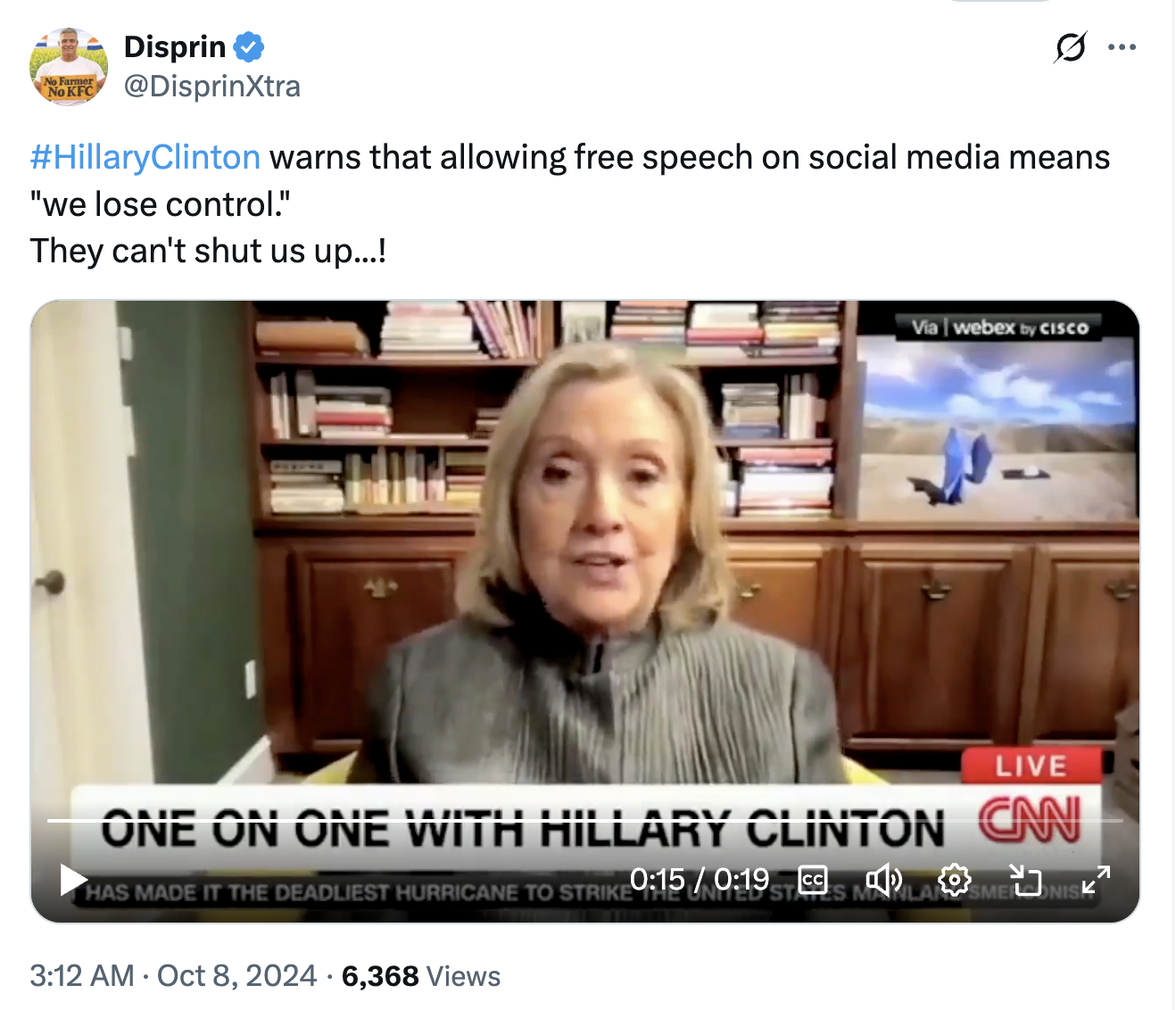
Compare the statements by Obama and Hillary Clinton to the following statement by John F. Kennedy. The contrast reveals the lack of respect that Obama and Clinton have for ordinary Americans:
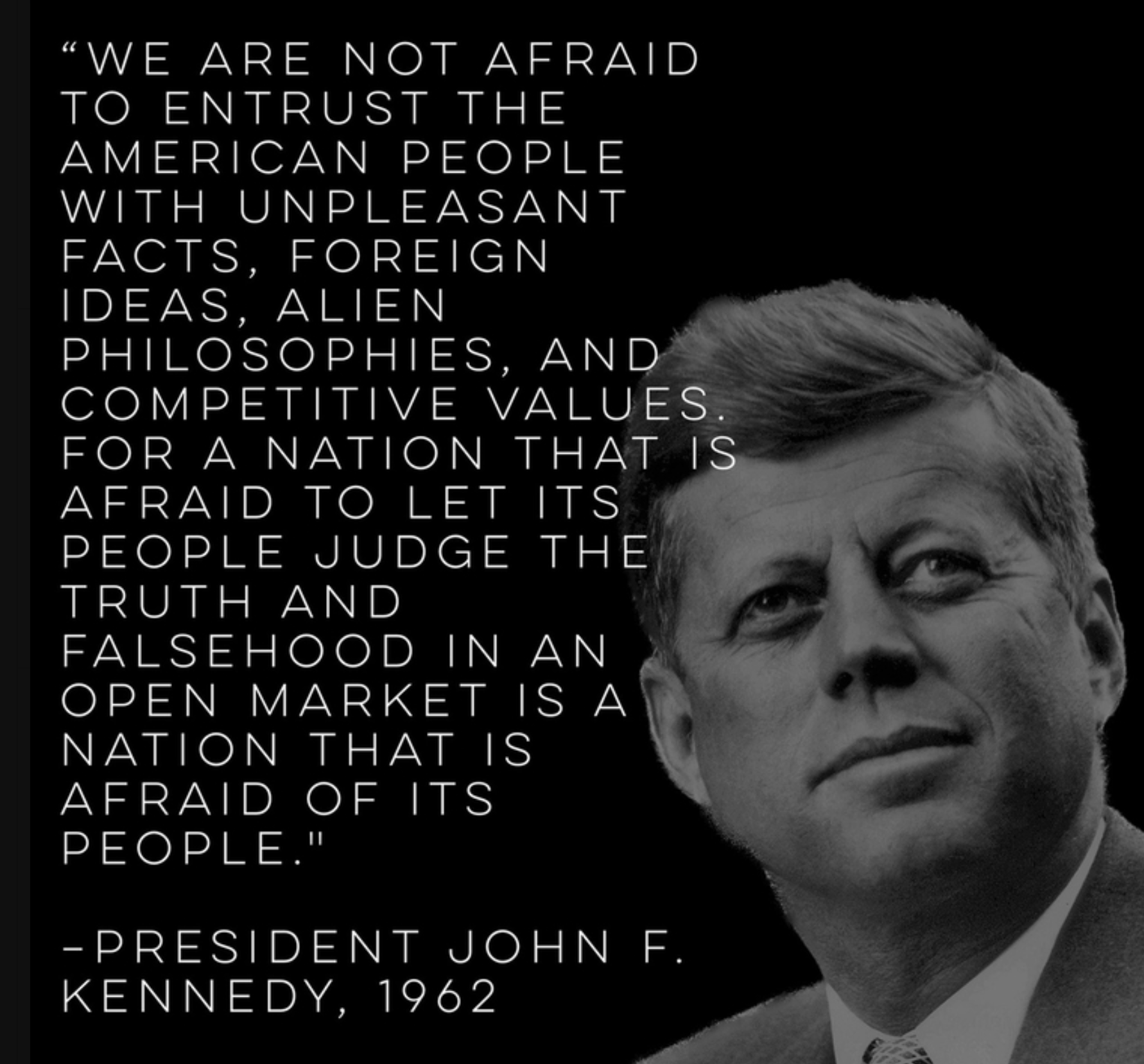
We are not afraid to entrust the American people with unpleasant facts, foreign ideas, alien philosophies, and competitive values. For a nation that is afraid to let its people judge the truth and falsehood in an open market is a nation that is afraid of its people.
And of course there is this problem with the approach of Obama and Clinton, pointed out by RFK, Jr:
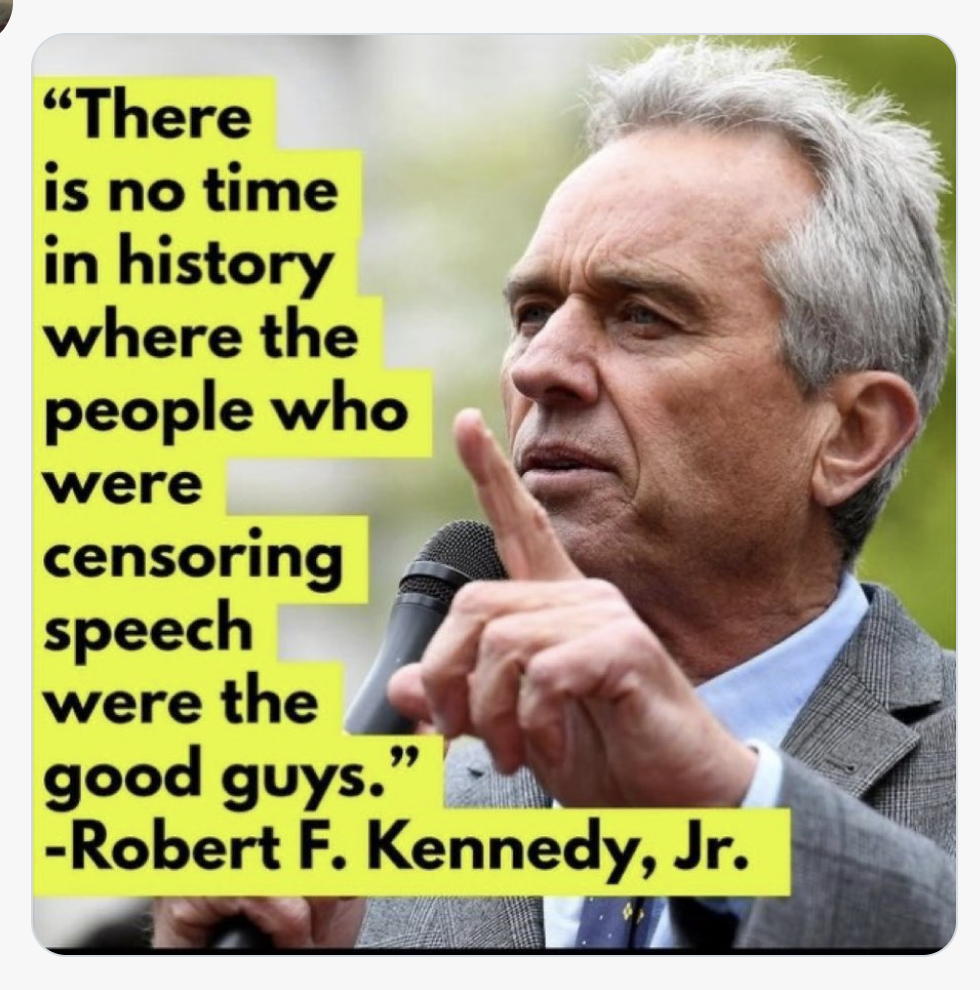
[From Robert F. Kennedy, Jr.’s speech to the Libertarian National Convention during his presidential run]
Hamilton, Madison, and Adams said that they had put the right of free expression into the First Amendment because all of the other rights depended on it. A government that has the capacity to silence its critics has license for any kind of atrocity.
I grew up reading Aldous Huxley and Robert Heinlein and Arthur Koestler and Franz Kafka and Alexander Solzhenitsyn and George Orwell. And the consistent theme in all of those works was the presumption that censorship of speech was always wrong, that it was always the first step down on the slippery slope toward tyranny and totalitarianism. There is no time when we look back at history and we say that the people who were censoring speech were the good guys. They’re always the bad guys.
The Framers didn’t write the First Amendment to protect convenient or desirable speech. They wrote it to protect the kind of speech that nobody wants to hear. They wrote it to protect incendiary speech. They wrote it to protect insults. They wrote it to protect misinformation and disinformation and malinformation and even lies. All of those are protected by the First Amendment. There were no exceptions. The Constitution doesn’t have exemptions for wars or resurrections or financial crises or pandemics. The Framers wrote the Constitution for hard times.
Thomas Sowell gets the last words in this post. In The Vision of the Anointed: Self-Congratulation as a Basis for Social Policy, Sowell, contrasts the “vision of the anointed” (held by self-proclaimed intellectual elites) with the “tragic vision” (a more constrained view of human nature and society). The anointed see themselves as morally and intellectually superior, viewing ordinary people (the “benighted”) as flawed, irrational, or misguided, which justifies their interventions. They often prioritize intentions over empirical outcomes, ignoring or reinterpreting the negative real-world consequences of their policies to preserve their vision. From Chapter 5, Sowell describes the anointed’s view of ordinary people.
The presumed irrationality of the public is a pattern running through many, if not most or all, of the great crusades of the anointed in the twentieth century.
He elaborates on how this allows the anointed to attribute societal problems to the flaws of the masses while evading self-scrutiny:
Without a sense of the tragedy of the human condition, and of the painful trade-offs implied by inherent constraints, the anointed are free to believe that the unhappiness they observe and the anomalies they encounter are due to the public’s not being as wise or as virtuous as themselves.
Sowell contrasts this with the “tragic vision,” which accepts human flaws universally:
The vision of the anointed may stand out in sharper relief when it is contrasted with the opposing vision, a vision whose reasoning begins with the tragedy of the human condition…. There are no ‘solutions’ in the tragic vision, but only trade-offs that still leave many desires unfulfilled and much unhappiness in the world.
The vision of those who consider themselves to be annointed, offers no accountability. Bad decisions are swept away of blithly justified. From Chapter 2:
A very distinct pattern has emerged repeatedly when policies favored by the anointed turn out to fail… No matter what happens, the vision of the anointed always succeeds, if not by the original criteria, then by criteria extemporized later—and if not by empirical criteria, then by criteria sufficiently subjective to escape even the possibility of refutation.

