
Canadian Language Police Legislate How We Talk

An excerpt from Heather Heying article today:

This week, the Canadian province of British Columbia announced its fealty to a naked emperor, when it introduced new modernizing legislation to correct outdated language by amending more than 2,300 instances of outdated gendered and binary terms from 21 ministries across 210 provincial statutes.

The reason for this is that:

Trans and non-binary people, particularly youth, can be erased by laws that use only he and she…[and] this change signals to those people that they are important, and that they are included and protected by the law.

Nope. In fact, this legislative change signals to women that we shall continue to lose protections under the law, to children that the adults are missing in action, and to everyone that the government has utterly lost the plot.

Sex is binary and fixed, “non-binary” is a fiction that serves nobody, and claiming that “he and she” are outdated terms reveals deep confusion about reality. Rigid adherence to these new rules and causes comes hand-in-hand with the belief that this is the newest civil rights crusade, and that if you don’t follow along you have outed yourself as being one of them—one of those people who are neither fundamentally decent nor caring.

This misses the point, or rather several points, among them:

- Pronouns are about sex, not gender.

- It is neither kind nor respectful to cater to the fantasies of the very young or very confused.

- Language doesn’t change by brute force.
Continue ReadingCanadian Language Police Legislate How We Talk

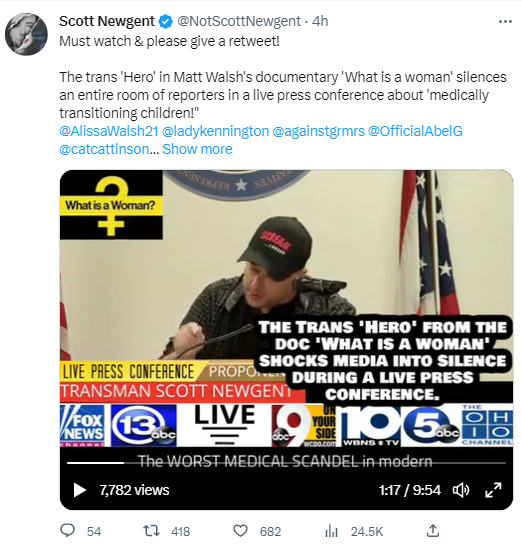
Scott Nugent, Featured in “What is a Woman,” Challenges the News Media to Ask Real Questions on Transgender Issues

Scott Nugent, mother, lesbian and trans man, giving an impassioned scolding to a room filled with reporters. Scott is challenging them to ask real questions about the claims of profit-seekers to help struggling children instead of naively accepting the rhetoric of trans activists.

Continue ReadingScott Nugent, Featured in “What is a Woman,” Challenges the News Media to Ask Real Questions on Transgender Issues

Stanford Law School Earns an “F” in Student (and DEI Administrator) Behavior

FIRE's letter to Stanford Law School, based on behavior as bad as what we saw last year at Yale Law School and see here.

Dear President Tessier-Lavigne:

FIRE is once again deeply concerned about the state of free expression at Stanford University after a student-organized Stanford Law School speech by U.S. Circuit Judge Stuart Kyle Duncan was disrupted last night,2 with at least one report that his remarks ended some 40 minutes earlier than planned as a result. The apparently successful exercise of the heckler’s veto by attendees determined to disrupt Judge Duncan’s remarks, at a Federalist Society- sponsored event, is troubling enough. But FIRE must also express our deep concern regarding Associate Dean for Diversity, Equity, and Inclusion Tirien Steinbach’s temporary removal of Duncan from the podium—against his wishes—to offer commentary appearing to promote censorship. Dean Steinbach pinballs between praising free speech, accusing Judge Duncan of “harm,” and asking him if what he has to say is important enough to justify upsetting students. She ultimately suggests Stanford may wish to consider abandoning its free expression commitments altogether to prevent the “harm” allegedly inherent in hearing views with which one may disagree in the future . . .

[added March 11, 9pm CT]

Stanford issues a not-very-serious apology to Judge Duncan. Obvious step #1 would be to fire the DEI representative of Stanford. It is my suspicion that this is the kind of behavior that DEI departments promote, totally in line with what occurred at Judge Duncan's lecture. How about looking into that? How about suspending/expelling numerous law students?

Continue ReadingStanford Law School Earns an “F” in Student (and DEI Administrator) Behavior

The Mental Health Challenges of Liberal Girls

Janathan Haidt, writing at his new Substack:

In conclusion, I believe that Greg Lukianoff was exactly right in the diagnosis he shared with me in 2014. Many young people had suddenly—around 2013—embraced three great untruths:

They came to believe that they were fragile and would be harmed by books, speakers, and words, which they learned were forms of violence (Great Untruth #1).

They came to believe that their emotions—especially their anxieties—were reliable guides to reality (Great Untruth #2).

They came to see society as comprised of victims and oppressors—good people and bad people (Great Untruth #3).

Liberals embraced these beliefs more than conservatives. Young liberal women adopted them more than any other group due to their heavier use of social media and their participation in online communities that developed new disempowering ideas. These cognitive distortions then caused them to become more anxious and depressed than other groups. Just as Greg had feared, many universities and progressive institutions embraced these three untruths and implemented programs that performed reverse CBT on young people, in violation of their duty to care for them and educate them.

See also, this article discussing (among other things) The Coddling of the American Mind, by Haidt and Lukianoff.

Continue ReadingThe Mental Health Challenges of Liberal Girls