
Camille Paglia: How Postmodernism (Woke ideology) is Destroying Education

I just finished reading Camille Paglia's essay, "Free Speech and the Modern Campus," from a collection of her prior writings, a book titled Provocations."  This essay takes aim at practices that were once called "Political Correctness," which now fall under the description of excesses of the Woke or Wokeness.  Paglia begins her essay by recounting how and why many colleges and universities founded niche studies departments, such as women's studies. Colleges made the mistake of allowing these departments to serve as singularities, unengaged with traditional core studies of, for example, history or psychology. These departments

were so hastily constructed in the 1970s, a process that not only compromised professional training in those fields over time but also isolated them in their own worlds and thus ultimately lessened their wider cultural impact.. . . Working on campus only with the like-minded, they treat dissent as a mortal offense that must be suppressed, because it threatens their entire career history and world-view. The ideology of those new programs and departments, predicated on victimology, has scarcely budged since the 1970s.

These new departments confused scholarship with ideology. They became like churches:

Teaching and research must strive to remain objective and detached. The teacher as an individual citizen may and should have strong political convictions and activities outside the classroom, but in the classroom, he or she should never take ideological positions without at the same time frankly acknowledging them as opinion to the students and emphasizing that all students are completely free to hold and express their own opinions on any issue, no matter how contested, from abortion, homosexuality, and global warming to the existence of God . . .

A familiar trio of Continental philosophers was carted into these niche curricula:

The Derrida and Lacan fad was followed by the cult of Michel Foucault, who remains a deity in the humanities but whom I regard as a derivative game-player whose theories make no sense whatever about any period preceding the Enlightenment. The first time I witnessed a continental theorist discoursing with professors at a Yale event, I said in exasperation to a fellow student, “They’re like high priests murmuring to each other.”

At p. 379, Paglia explains the main problem with poststructuralism:

Post-structuralism, in asserting that language forms reality, is a reactionary reversal of the authentic revolutionary spirit of the 1960s, when the arts had turned toward a radical liberation of the body and a reengagement with the sensory realm. By treating language as the definitive force in the world—a foolish thesis that could easily be refuted by the dance, music, or visual arts majors in my classes—poststructuralism set the groundwork for the present campus impasse where offensive language is conflated with material injury and alleged to have a magical power to create reality. Furthermore, poststructuralism treats history as a false narrative and encourages a random, fragmented, impressionistic approach that has given students a fancy technique but little actual knowledge of history itself.

Another problem with political correctness is the inability to interpret the significance of events in the context of the time period in which they occurred (see here for a recent example):

The problem of political correctness is intensified by the increasing fixation of humanities and even history departments on “presentism,”that is, a preoccupation with our own modem period.

What are the solutions? Paglia offers three:

[E]ducators must first turn away from the sprawling cafeteria menu of over-specialized electives and return to broad survey courses based in world history and culture, proceeding chronologically from antiquity to modernism. Students desperately need a historical framework to understand both past and present.

Second, universities should sponsor regular public colloquia on major topics where both sides of sensitive, hot-button controversies are frilly discussed. Any disruptions of free speech at such forums must be met with academic sanctions.

[C]olleges and universities must stay totally out of the private social lives of students.The intrusive paternalism o f American colleges in this area is an unacceptable infringement of student rights.If a crime is committed on campus, it must be reported to the police.There is no such thing as a perfectly “safe space” in real life. Risk and danger are intrinsic to human existence.
Continue ReadingCamille Paglia: How Postmodernism (Woke ideology) is Destroying Education

San Francisco Schools Will No Longer be Named After Racists Like Abraham Lincoln and George Washington

This is "progress" for San Francisco Board of Education." Per the article, it will cost $10,000 to rename each school. Excerpt from the NYT:

Following the unrest in Charlottesville, Va., in 2017, which led to the killing of a protester by a white supremacist, the board moved in 2018 to establish a commission to evaluate renaming schools to “condemn any symbols of white supremacy and racism,” said Gabriela López, the board president.

The commission had decided that schools named after figures who fit the following criteria would be renamed: “engaged in the subjugation and enslavement of human beings; or who oppressed women, inhibiting societal progress; or whose actions led to genocide; or who otherwise significantly diminished the opportunities of those amongst us to the right to life, liberty, and the pursuit of happiness.”

My question: How many of members of the SF BD of Educ thought this was a ridiculous idea, yet sat on their hands in silence, afraid to speak out?

Continue ReadingSan Francisco Schools Will No Longer be Named After Racists Like Abraham Lincoln and George Washington

Inconvenient Statistics Regarding Urban Homicides and Race, Including Comparison of 2019 and 2020

Soon after George Floyd's death, thousands of people peacefully marched in American streets protesting police violence. As the sun went down in those cities, however, multitudes of people rioted and looted, causing more than $1 billion in damage.

The damage from riots and looting across the U.S. following the death of George Floyd is estimated to be the costliest in insurance history – between $1 billion and $2 billion. Insurance Information Institute (or Triple-I) compiles information from a company called Property Claim Services (PCS), which has tracked insurance claims related to civil disorder since 1950, and other databases.
Yet we have millions of people in the U.S. and major newspapers who will not call $1 billion in damages "rioting" or "looting." That is a repeated phenomenon these days on both the political right and political left: people making strong arguments by ignoring contradictory evidence.  This article focuses on denialism on the political left.  My topic is police violence and race. It's important that we gather the facts, whether it be the existence of riots and of police violence, especially violence toward African American people. Many people would rather not look at actual crime statistics, however, and this has led to an untethered and dysfunctional conversation regarding police violence. Sam Harris experienced harsh pushback (and also praise) when he released a podcast titled, "Can We Pull Back From the Brink?" His "sin" is that his podcast contained actual crime statistics:

Again, cops kill around 1000 people every year in the United States. About 25 percent are black. About 50 percent are white. The data on police homicide are all over the place. The federal government does not have a single repository for data of this kind. But they have been pretty carefully tracked by outside sources, like the Washington Post, for the last 5 years. These ratios appear stable over time. Again, many of these killings are justifiable, we’re talking about career criminals who are often armed and, in many cases, trying to kill the cops. Those aren’t the cases we’re worried about. We’re worried about the unjustifiable homicides.

Now, some people will think that these numbers still represent an outrageous injustice. After all, African Americans are only 13 percent of the population. So, at most, they should be 13 percent of the victims of police violence, not 25 percent. Any departure from the baseline population must be due to racism.

Ok. Well, that sounds plausible, but consider a few more facts:

Blacks are 13 percent of the population, but they commit at least 50 percent of the murders and other violent crimes. If you have 13 percent of the population responsible for 50 percent of the murders—and in some cities committing 2/3rds of all violent crime—what percent of police attention should it attract? I don’t know. But I’m pretty sure it’s not just 13 percent. Given that the overwhelming majority of their victims are black, I’m pretty sure that most black people wouldn’t set the dial at 13 percent either.

Continue ReadingInconvenient Statistics Regarding Urban Homicides and Race, Including Comparison of 2019 and 2020

Chloé Valdary’s Kind, Gentle and Honest Diversity Program

Are you tired of hearing about the bullying, divisiveness and unvarnished bigotry pushed by many players in the diversity, equity, and inclusion industry? Players like Robin DiAngelo and Ibram X. Kendi, who freely misrepresent the facts and statistics and hide behind abstruse terminology?

Are you frustrated that many so-called programs in the booming diversity industry completely fill the time of their sessions with preaching and refuse to leave any time for questions and criticisms from the audience? That is what I've noticed about two recent mandated continuing education diversity programs I attended (now required for all lawyers in Missouri).

I'm not claiming that all diversity programs are deficient. I don't know enough about all diversity programs. Based on many programs about which I am familiar, however (including programs like this), this is an industry that needs to be vigorously investigated for its numerous lapses in integrity. No doubt we live in a country that includes racists, but the extent to which these increasingly popular "diversity" programs solve the problem (rather than making things worse) is a troubling question.

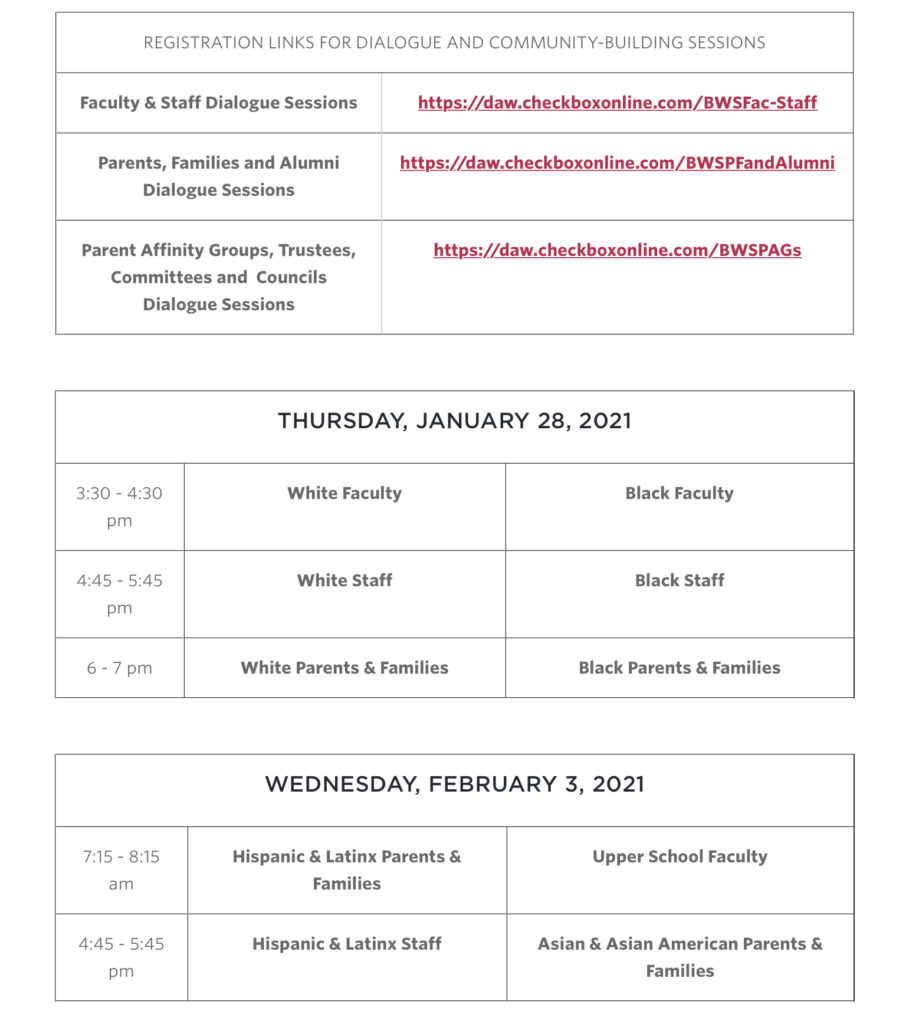
Are you dismayed that today's social justice warriors and critical race theorists have abandoned and ridiculed Martin Luther King's dream for a color blind society? So am I, and many "diversity" programs also ridicule MLK's dream. I've learned of several programs that explicitly segregate the participants by skin color. Here is a recent instance, the Brentwood School in Los Angeles:

And especially if you have had your fill of the types of "diversity" programs exposed by Christopher Rufo, you'll find this article in The Atlantic to be a breath of fresh air: "Can Chloé Valdary Sell Skeptics on DEI? Valdary’s Theory of Enchantment elicits unusual openness, trust, and engagement from ideologically diverse observers." Here is an excerpt:

Chloé Valdary is the founder of Theory of Enchantment, a diversity and resilience training company that the 27-year-old African American entrepreneur runs from Downtown Brooklyn. Its website lists clients including TikTok, WeWork, the Federal Aviation Administration, and Greenwich High School, and asks potential customers a loaded question: “Looking for an antiracism program that actually fights bigotry instead of spreading it?” . . .

Three principles guide all of the coursework [Chloé Valdary's] company offers:

    • Treat people like human beings, not political abstractions.
    • Criticize to uplift and empower, never to tear down, never to destroy.
    • Root everything you do in love and compassion.

Continue ReadingChloé Valdary’s Kind, Gentle and Honest Diversity Program

Coleman Hughes Speaks in Favor of Color Blindness

Excellent discussion by Coleman Hughes.  The introduction ends at Minute 2:25.  Here's the key take-away (4:25):

"The point isn't to avoid noticing race, which is impossible. The point is to notice race and then disregard it as a reason to treat people differently and as a category on which to base public policy."

I'll conclude with a few more excerpts from the video:

Another source of confusion that I try to avoid and will avoid in this talk is the misleading word post-racial. The “post” in post-racial suggests that there are two separate eras: a racial era characterized by the presence of racism and a post-racial era characterized by its absence, and the only question is which era we are currently living in, because colorblindness in this framework would only make sense during the second racism-free era.

Many critics of colorblindness have dismissed it on the grounds that we're not there yet which is to say we have not yet eliminated racial prejudice and they're right about that. Racism still exists. Racial prejudice still exists and probably will always exist, to some extent. But they frame the issue upside down. Colorblindness is not a synonym for the absence of racism. I's an ideology created to fight racism.

--

It would appear that virtually everyone has unanimously rejected color blindness as a backwards value, an old-fashioned out-of-date way of maintaining the white supremacist status quo. Yet even as it has become virtually taboo among elites colorblind policies continue to dominate in the court of public opinion especially on the issues of hiring and college admissions. In 2019, the pew research center asked people whether employers should only take a person's qualifications into account even if it results in less racial diversity and 74 percent of Americans agreed that agreed with that statement. Not only did a majority of Americans as a whole agree with this statement of colorblind hiring even at the expense of diversity, a majority of each individual racial group, whites, Blacks and Hispanics, also agreed with this message. Roughly the same percentage agreed that colleges should not consider race in admissions.

--

The extent of the attacks on color blindness is sometimes surprising. For example, the best-selling author Ibram X. Kendi in his latest book, “How to be an Anti-Racist,” says “the most threatening racist movement is not the alt-right's unlikely drive for a white ethnostate but the regular Americans’ drive for a race neutral one.” So yeah, to say that colorblindness is wrong-headed is one thing. To say it is worse than the alt-right is quite another. It's impossible to understand the hatred directed at colorblindness without first understanding critical race theory this was an intellectual movement that originated at Harvard Law School in the 1980s.

--

[Min 41]

If you take a Martin Luther King quote and you just say it verbatim you may get cancelled if you're white, even if you're Black, frankly. The strange thing about Dr King is we all venerate him--nobody ever speaks ill of him--but also he's basically ignored. He's in this uncanny valley where he is not exactly canceled but he's also not listened to, which is a strange place to be in. It speaks to the moral authority and credibility that we feel his message has. The awkwardness of acknowledging that, the main thrust of anti-racist activism, is exactly the opposite of what he stood for. That's a very awkward thing for the anti-racist movement to acknowledge, because they would lose some moral credibility if they outright said what is true, which is that we reject Dr King's goal. That's the truth but that can't be said out loud.

--

[Min 44]

I've read hundreds of pages of Martin Luther King’s speeches and writings and virtually every three or four pages there is something that if said today you would be cancelled for. That's just the truth. It’'s trivially easy to find 20 Martin Luther King quotes expressing the colorblind ethic in the simplest terms and very difficult to find any quotes of him expressing that race is a crucial aspect of your identity to dwell upon and affirm.

Continue ReadingColeman Hughes Speaks in Favor of Color Blindness