Coleman Hughes Speaks in Favor of Color Blindness

Excellent discussion by Coleman Hughes.  The introduction ends at Minute 2:25.  Here's the key take-away (4:25):

"The point isn't to avoid noticing race, which is impossible. The point is to notice race and then disregard it as a reason to treat people differently and as a category on which to base public policy."

I'll conclude with a few more excerpts from the video:

Another source of confusion that I try to avoid and will avoid in this talk is the misleading word post-racial. The “post” in post-racial suggests that there are two separate eras: a racial era characterized by the presence of racism and a post-racial era characterized by its absence, and the only question is which era we are currently living in, because colorblindness in this framework would only make sense during the second racism-free era.

Many critics of colorblindness have dismissed it on the grounds that we're not there yet which is to say we have not yet eliminated racial prejudice and they're right about that. Racism still exists. Racial prejudice still exists and probably will always exist, to some extent. But they frame the issue upside down. Colorblindness is not a synonym for the absence of racism. I's an ideology created to fight racism.

--

It would appear that virtually everyone has unanimously rejected color blindness as a backwards value, an old-fashioned out-of-date way of maintaining the white supremacist status quo. Yet even as it has become virtually taboo among elites colorblind policies continue to dominate in the court of public opinion especially on the issues of hiring and college admissions. In 2019, the pew research center asked people whether employers should only take a person's qualifications into account even if it results in less racial diversity and 74 percent of Americans agreed that agreed with that statement. Not only did a majority of Americans as a whole agree with this statement of colorblind hiring even at the expense of diversity, a majority of each individual racial group, whites, Blacks and Hispanics, also agreed with this message. Roughly the same percentage agreed that colleges should not consider race in admissions.

--

The extent of the attacks on color blindness is sometimes surprising. For example, the best-selling author Ibram X. Kendi in his latest book, “How to be an Anti-Racist,” says “the most threatening racist movement is not the alt-right's unlikely drive for a white ethnostate but the regular Americans’ drive for a race neutral one.” So yeah, to say that colorblindness is wrong-headed is one thing. To say it is worse than the alt-right is quite another. It's impossible to understand the hatred directed at colorblindness without first understanding critical race theory this was an intellectual movement that originated at Harvard Law School in the 1980s.

--

[Min 41]

If you take a Martin Luther King quote and you just say it verbatim you may get cancelled if you're white, even if you're Black, frankly. The strange thing about Dr King is we all venerate him--nobody ever speaks ill of him--but also he's basically ignored. He's in this uncanny valley where he is not exactly canceled but he's also not listened to, which is a strange place to be in. It speaks to the moral authority and credibility that we feel his message has. The awkwardness of acknowledging that, the main thrust of anti-racist activism, is exactly the opposite of what he stood for. That's a very awkward thing for the anti-racist movement to acknowledge, because they would lose some moral credibility if they outright said what is true, which is that we reject Dr King's goal. That's the truth but that can't be said out loud.

--

[Min 44]

I've read hundreds of pages of Martin Luther King’s speeches and writings and virtually every three or four pages there is something that if said today you would be cancelled for. That's just the truth. It’'s trivially easy to find 20 Martin Luther King quotes expressing the colorblind ethic in the simplest terms and very difficult to find any quotes of him expressing that race is a crucial aspect of your identity to dwell upon and affirm.
Continue ReadingColeman Hughes Speaks in Favor of Color Blindness

Bullying Wokesters at UIC John Marshall Law School Pretend that they Don’t Understand the Difference Between Using an Offensive Word and Merely Mentioning it.

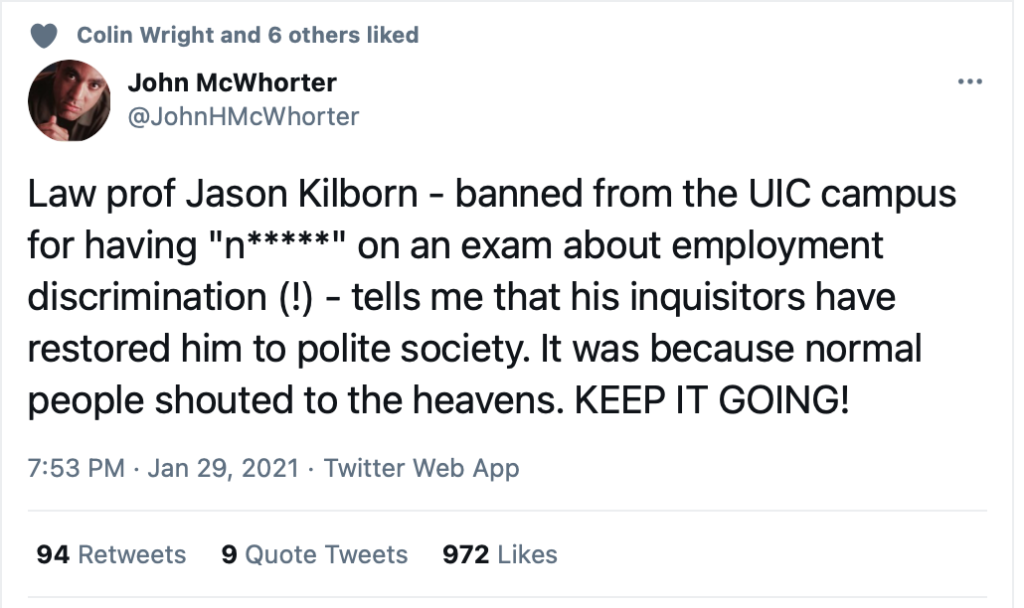
Woke bullies have reached ever new levels of intolerance and decency.  John McWhorter explains in this tweet:

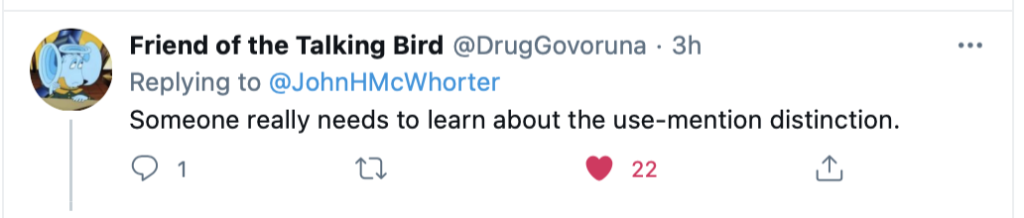
You need to read the above tweet carefully. Professor Kilborn was unfairly attacked by the 250 students who signed a petition requiring many dramatic actions, including a demand that "Professor Kilborn should immediately step down as the chair of the academic affairs committee and from all other committee appointments he holds." What was Professor Kilborn's crime? As part of a law school exam, he used only the sanitized version of the offensive word, exactly this: "N*****". This is the reason he was attacked by a mob of hypersensitive students.  The following comment to McWhorter's tweet was thus spot on:

After Professor Kilborn was unfairly attacked by the students, he was left twisting in the wind by the University of Illinois - Chicago (UIC) administration, which issued the following statement:

The Law School recognizes the impact of this issue. Before winter break, Dean Dickerson apologized to the students who expressed hurt and distress over the examination question. The Law School acknowledges that the racial and gender references on the examination were deeply offensive. Faculty should avoid language that could cause hurt and distress to students. Those with tenure and academic freedom should always remember their position of power in our system of legal education.

This pathetic defense of its own professor and other details regarding this incident can be found at Above the Law.  Here's an excerpt:

The petition is a call to action for “Insensitive and Racist Content” on the exam, and when I initially read the petition, my impression was that the professor had used the full slur on the exam. (And I bet a lot of other people that read — and potentially signed — the petition thought that too.) But that petition does not “summarize[]” the exam as it purports to do — it provides a direct quote. By that I mean the exam did not use the full n-word (or the b-word for that matter), opting instead for the euphemism. Which is… the exact sort of adaptation and awareness of potentially traumatic racial issues that folks have historically asked for when professors claim the right to drop the full n-word just because it’s an academic setting.

Will any lessons be learned from this incident?  We shall see . . .

Continue ReadingBullying Wokesters at UIC John Marshall Law School Pretend that they Don’t Understand the Difference Between Using an Offensive Word and Merely Mentioning it.

Alan Sokal Bemoans the Damage Wrought by the Woke Edition of Post-Modernism

Alan Sokal knows a thing or two about bullshit. He single-handedly made a mockery of Social Text, an academic journal of postmodern cultural studies. His 1996 article,

"Transgressing the Boundaries: Towards a Transformative Hermeneutics of Quantum Gravity," was published in the journal's spring/summer 1996 "Science Wars" issue. It proposed that quantum gravity is a social and linguistic construct. At that time, the journal did not practice academic peer review and it did not submit the article for outside expert review by a physicist.Three weeks after its publication in May 1996, Sokal revealed in the magazine Lingua Franca that the article was a hoax.

The reemergence of post-modernism, now in the form of Woke culture concerns Sokal in a big way, as he writes in ARC:

What postmodernist relativism has wrought is, rather, something more insidious: by devaluing the concept of objective truth, it has undermined our own ability to combat objective untruths—to develop herd immunity to a pandemic of viral disinformation, as one writer eloquently put it. Now the genie is out of the bottle, and I honestly don't know how to put it back in.

Continue ReadingAlan Sokal Bemoans the Damage Wrought by the Woke Edition of Post-Modernism

Ninth Circuit Court of Appeals to Decide Who Qualifies as a “Woman” Athlete in Idaho

Is a particular person was a "woman"? For most of my life, everyone I knew would say that the question is answered by considering what kind of genitals that person had. For many people, the answer to that question is no longer answered purely by biology. And to make the discussion all-the-more confusing, transgender activists insist that "intersex" conditions are relevant to this discussion while others consider intersex a red herring.

Lindsay Hecox v Bradley Little [Governor of Idaho] will weigh in on this issue.  This appeal is pending in the Ninth Circuit (and perhaps headed to the United States Supreme Court). The context is transgender sports competition involving students in Idaho. A new Idaho statute is the focus of this lawsuit. The following excerpt is a description of Idaho law taken from the appellate brief of Idaho (the Defendant):

The statute at issue is the Fairness in Women’s Sports Act, Idaho Code §§ 33-6201 through -6206. The Act excludes members of the male sex from participating in sports designated for athletes of the female sex due to males’ physiological advantages, consistent with settled Ninth Circuit law . . . . The Act also permits male and co-ed teams, both of which are open to members of either sex. See Idaho Code § 33-6203.

To ensure the Act’s protections for female athletes, the Act provides that if a dispute arises over a student’s sex and eligibility for female sports, the student may establish female sex in one of three ways: through a high school health examination and consent form signed by a health care provider, which all student-athletes must submit; through another written statement signed by the student’s health care provider; or through a sports physical examination, in which the health care provider relies on one of three specified criteria to determine sex. See Idaho Code § 33-6203(3). See also ER 417-19 (Idaho High School Activities Association Health Examination and Consent Form); IHSAA Rule 13 (requiring high school athletes to submit form). The Act does not provide any sex-verification procedures for male or co-ed sports, because they are open to all, regardless of sex. In support of the bill, the Idaho Legislature made a number of findings based on court decisions, scholarly publications, and scientific studies recognizing the physiological advantages members of the male sex have over their female counterparts. Idaho Code § 33-6202(8)-(11). The Legislature also described the Act’s purpose:

Having separate sex-specific teams furthers efforts to promote sex equality. Sex-specific teams accomplish this by providing opportunities for female athletes to demonstrate their skill, strength, and athletic abilities while also providing them with opportunities to obtain recognition and accolades, college scholarships, and the numerous other long-term benefits that flow from success in athletic endeavors. Id. § 33-6202(12).

Plaintiffs describe the Idaho law at page 8ff of their brief.

A federal trial court granted an injunction, holding that the above law violates federal law. See the Idaho Brief at pp 6-7 and the Plaintiffs' brief, pp. 2-4 for more detail. This is a fascinating set of briefs for many reasons, one of them being that if you read both briefs, it is often hard to believe that they are describing the same lawsuit. That is because the crux of the case is whether one of the two plaintiffs, Lindsay Hecox, is more accurately described as male versus female. Consider Hecox's descriptions in the two briefs:

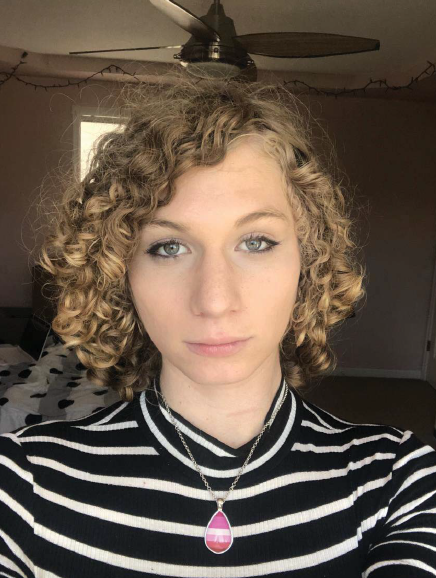
[From the Plaintiffs' Brief, p. 15: "Lindsay is a woman athlete living in Idaho who is transgender." Plaintiffs' brief includes a photo of Lindsay:

[From Defendant Idaho's Brief] "One plaintiff is Lindsay Hecox, who is transgender, and whose sex is male but whose gender identity is female."

Both sides agree that Lindsay is "transgender." As you can see, Plaintiffs claim she is "a woman" while Idaho states that the "sex is male."

I haven't yet read every word of every brief, but I have reviewed a lot of the filings.  In case anyone is interested in following along to see exactly what is being claimed as far as the "facts" or the law, you are welcome to click on the links below.  My focus is biology, but the Plaintiffs claim that biology does is not determinative.

Continue ReadingNinth Circuit Court of Appeals to Decide Who Qualifies as a “Woman” Athlete in Idaho

Keira Bell’s Case is Unfreezing News Media that Have Been Reluctant to Discuss Rampant Transgendering of Teenaged Girls

The legal proceedings regarding Keira Bell are forcing the reluctant news media to begin discussing this serious issue regarding a vulnerable population of teenage girls being cajoled into harsh medical treatment for undiagnosed gender dysphoria. The silence of the news media has found synergy with bad science and dangerous medical practices.  Here's an excerpt from Quillette article titled "Like It Or Not, Keira Bell Has Opened Up a Real Conversation About Gender Dysphoria":

The policy reckoning we are now beginning to observe has been a long time coming. And Ms. Bell’s role is an important one, as trans activists have long sought to discredit or ignore the growing ranks of desisters—those, such as Ms. Bell, who once presented sincerely as trans, but later reverted to an identity consistent with their real biological sex. Even media that formerly had toed the progressive line on the issue of gender dysphoria are now finding the courage to run articles about vulnerable girls—many of them autistic, depressed, or socially insecure—who suffer regret after a period of trans self-identification.

Continue ReadingKeira Bell’s Case is Unfreezing News Media that Have Been Reluctant to Discuss Rampant Transgendering of Teenaged Girls