
Marty Makary Counts the Many Ways the Federal Government Failed Us During COVID
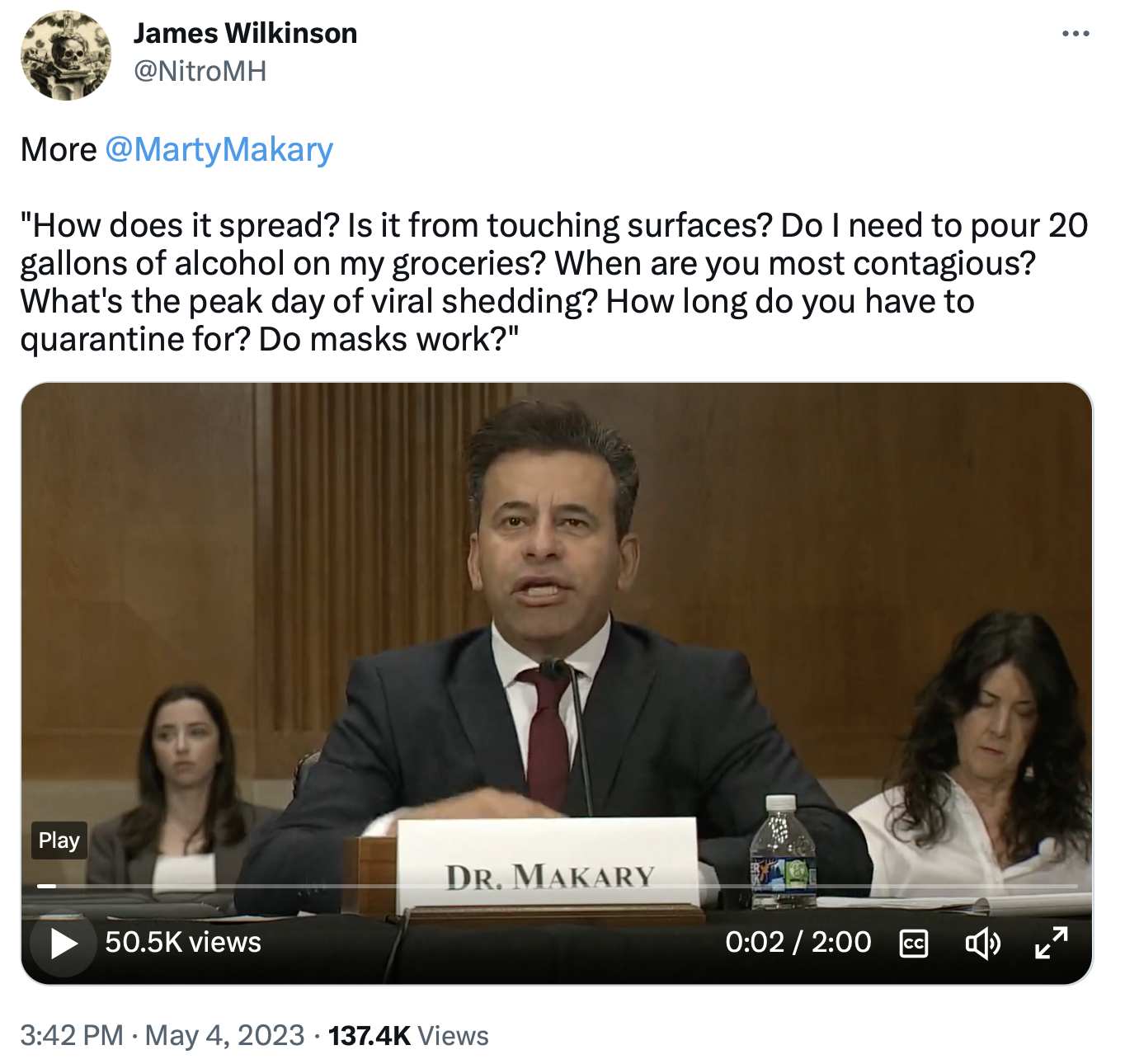
Marty Makary, MD, testifying before Congress:

More tragically, the NIH has $42 billion. BARDA, which is part of the PAHPA Act, has another billion dollars and they couldn't do the most basic clinical research we needed done quickly to answer the basic questions to end the controversies and the conspiracy theories to finally get up the questions Americans were asking us: How does it spread? Is it from touching surfaces? Do I need to pour 20 gallons of alcohol on my groceries? Fauci was telling teachers in July to wear gloves and goggles. Or was it spread airborne? That could have been answered in 24 hours in one of our BSL4 labs? Or in one week of clinical research to answer the question: When are you most contagious? What's the peak day of viral shedding? How long do you have you have to quarantine for? Do masks work? We could have answered these with definitive basic clinical research early. They didn't.

And so I think it's fair to ask how did they do in preparing us? For the pandemic? We've spent over $20 billion on PAHPA over the last 20 years. What has that done for us? How many lives were saved during the COVID pandemic because of investments by PAHPA or BARDA? Now, they've done some good work. I've seen it. But regardless of one's political affiliation, they've got to acknowledge that we doctors in the public were flying blind. We had opinion ruling the day on what we should do or not do when we could have been governed by evidence. Policy driven by good basic clinical research. We didn't have that. And so we had a void of clinical research. And guess what filled that void over half a year? A year? Two years? What filled that void were political opinions. Those controversies could have been ended early. We had the money.

Continue ReadingMarty Makary Counts the Many Ways the Federal Government Failed Us During COVID

About the “M” Word: “Merit”

Pamela Paul writes in the NYT:

Is a gay Republican Latino more capable of conducting a physics experiment than a white progressive heterosexual woman? Would they come to different conclusions based on the same data because of their different backgrounds?

For most people, the suggestion isn’t just ludicrous; it’s offensive.

Yet this belief — that science is somehow subjective and should be practiced and judged accordingly — has recently taken hold in academic, governmental and medical settings. A paper published last week, “In Defense of Merit in Science,” documents the disquieting ways in which research is increasingly informed by a politicized agenda, one that often characterizes science as fundamentally racist and in need of “decolonizing.” The authors argue that science should instead be independent, evidence-based and focused on advancing knowledge.

This sounds entirely reasonable.

Yet the paper was rejected by several prominent mainstream journals, including The Proceedings of the National Academy of Sciences. Another publication that passed on the paper, the authors report, described some of its conclusions as “downright hurtful.” The Proceedings of the National Academy of Sciences took issue with the word “merit” in the title, writing that “the problem is that this concept of merit, as the authors surely know, has been widely and legitimately attacked as hollow as currently implemented.”

Instead, the paper has been published in a new journal called — you can’t make this up — The Journal of Controversial Ideas.

Here is the abstract to the excellent article to which Paul was referring, co-authored by 29 scientists, "In Defense of Merit in Science":

Merit is a central pillar of liberal epistemology, humanism, and democracy. The scientific enterprise, built on merit, has proven effective in generating scientific and technological advances, reducing suffering, narrowing social gaps, and improving the quality of life globally. This perspective documents the ongoing attempts to undermine the core principles of liberal epistemology and to replace merit with non-scientific, politically motivated criteria. We explain the philosophical origins of this conflict, document the intrusion of ideology into our scientific institutions, discuss the perils of abandoning merit, and offer an alternative, human-centered approach to address existing social inequalities.

Continue ReadingAbout the “M” Word: “Merit”

About Countries that Irreversibly Lose Their Way

I increasingly think of Chesterson's Fence:

Chesterton's Fence is a principle that says change should not be made until the reasoning behind the current state of affairs is understood. It says the rash move, upon coming across a fence, would be to tear it down without understanding why it was put up.

Peter McCullough, M.D. was censored during COVID and he has since been proven correct on many of his positions. Yet he didn't become bitter (at least that I could see in public). Rather, he keep trying to communicate where we, as a society, have lost our way. McCullough keeps trying to shed light on the problems he detects, but I detect an ominous undertone in his writings, a sense that we are sustaining too much damage as a society and that we might no longer have the tools, as a society, to repair the damage. I increasingly detect that same feelings in myself. In a recent article, McCullough writes:

Once the belief in a country and institution has been lost, it is very difficult to rejuvenate it. This is the principle reason why most conservative commentators often come off as sounding staid and uninspiring to the young. It’s as though the spirit has departed from the body that no amount of edifying rhetoric can reanimate. As Hegel pointed out in the preface to his Elements of the Philosophy of Law:
Philosophy always arrives too late to teach the world how it should be. As the thought of the world, philosophy appears only in the period after reality has been achieved and has completed its formative process. This lesson, also taught by history, is that only in the late stage of reality does the ideal appear in opposition to this reality, grasping it in the form of an intellectual construct.

When philosophy paints its gray in gray, then a form of life has grown old, and cannot be rejuvenated, but only recognized; the Owl of Minerva takes flight only as the dusk begins to fall.

That feeling that we might have crossed the event horizon has increasingly been expressed by people who inspire me, including (now deceased) George Carlin and Jonathan Haidt.

Excerpt from The Australian --

"'I am now very pessimistic,' Haidt said. 'I think there is a very good chance American democracy will fail, that in the next 30 years we will have a catastrophic failure of our democracy.'"

We might have fucked things up too much to ever fix them. George Carlin gets the last word here.:

Continue ReadingAbout Countries that Irreversibly Lose Their Way