Stereotypes are Generally Accurate

We tell each other to avoid using stereotypes, but more than 50 studies have assessed the accuracy of demographic, national, political, and other stereotypes. Consider this article, for example: "Stereotype Accuracy is One of the Largest and Most Replicable Effects in All of Social Psychology.". Excerpts:

Stereotype accuracy is one of the largest and most replicable effects in all of social psychology. Richard et al (2003) found that fewer than 5% of all effects in social psychology exceeded r’s of .50. In contrast, nearly all consensual stereotype accuracy correlations and about half of all personal stereotype accuracy correlations exceed .50.

The evidence from both experimental and naturalistic studies indicates that people apply their stereotypes when judging others approximately rationally. When individuating information is absent or ambiguous, stereotypes often influence person perception. When individuating information is clear and relevant, its effects are “massive” (Kunda & Thagard, 1996, yes, that is a direct quote, p. 292), and stereotype effects tend to be weak or nonexistent. This puts the lie to longstanding claims that “stereotypes lead people to ignore individual differences.”

Continue ReadingStereotypes are Generally Accurate

Dismal Job Prospects for White Male Writers

I'm a race abolitionist. I think we should completely dispense with the categories of "black" and "white" and describe people in other, less destructive, terms. The only exception is that we should retain and enforce civil rights laws because some people enthusiastically categorize people in terms of "race," discriminating against some races and preferring others. I set forth my position in this acticle, ""Race" is Like Astrology."

I hope that someday, all of us will get back on track with the purpose of the original civil rights movement (rather than the absurd and destructive "anti-racism" movement) and that, someday, "race" will be the least useful or interesting thing we can say about people.

That said, "white" males are actively being discriminated against, especially against Millennials and beyond (Millenials were born between 1981-1996), especially in the creative fields, including writing. This oftentimes overt discrimination is well-documented by Jacob Savage in his article at Compact, "The Lost Generation." . Here's an excerpt:

In 2021, new hires at Condé Nast were just 25 percent male and 49 percent white; at the California Times, parent company of The Los Angeles Times and The San Diego Union-Tribune, they were just 39 percent male and 31 percent white. That year ProPublica hired 66 percent women and 58 percent people of color; at NPR, 78 percent of new hires were people of color.

“For a typical job we’d get a couple hundred applications, probably at least 80 from white guys,” the hiring editor recalled. “It was a given that we weren’t gonna hire the best person… It was jarring how we would talk about excluding white guys.” The pipeline hadn’t changed much—white men were still nearly half the applicants—but they were now filling closer to 10 percent of open positions.

Suddenly, in Andrew’s newsroom, everything was driven by identity. There were endless diversity trainings, a racial “climate” assessment—at one point, reporters were told they had to catalog, in minute detail, the identity characteristics of all their sources. Andrew had been instrumental in forming the union at his company, and objected when negotiations shifted from severance pay and parental leave to demands for racial quotas. “They wanted to do like ... emergency hires of black people,” he said.

When he questioned these new priorities, the response was swift. “On a Zoom call, women would clap back at something I was saying and other women would snap their fingers in the [chat] window,” he recalled. “It was this whole subcultural language being introduced wholesale.” ...

It’s striking how casual it all was. “Chicago Fire—the UL [upper level] can be [anyone], but we need diverse SWs [staff writers].” As in other industries, upper-level positions—writers with experience and credits—could still be filled by white men. But the entry-level jobs, the staff writer and co-producer positions that Matt and thousands of other aspiring writers were competing for, were reserved for others.

This is an excerpt from a much longer excellent article. I highly recommend reading the entire thing.

I would hope that these dire statistics don't dissuade any "white" male from pursuing their dream, of course. But this is a tough time for all creative writers, given the growing threat of AI. Grok offers these statistics showing that although Hollywood scrips are still largely being written by organics, publishers are caving to the bots: v Publishers' AI Reliance (Web, Books, Articles)

  • Web publishing: >50% of new articles AI-generated in 2025 (up from 5% in 2020), displacing freelancers in copywriting/editing; focuses on news, how-to, reviews, and SEO content.
  • Books/articles: Emerging displacement; survey of 258 UK novelists shows 51% fear full replacement, 39% report income losses (85% expect more), with 59% of genre authors' work used to train AI without permission.
  • Broader impacts: Google's AI Overviews cut traffic 34%, leading to layoffs; >25% of Americans use AI for info over traditional sources; 97% of novelists oppose AI writing full novels, citing originality/ethics losses.
  • Trend: AI replaces commoditized content/jobs, potentially making publishers obsolete; 33% of authors use AI for non-creative tasks, but mass displacement in low-creativity areas is ongoing.
Hollywood's AI Reliance for Screenplays

  • AI use is limited and experimental, mainly assistive for brainstorming, analysis, and rote tasks; full scripts remain ~100% human-written (study of 3,800 US TV episodes 2020-2023 showed 1.9% AI probability, no increase post-ChatGPT).
  • Tools like Largo.ai triple green-lighting rates and make focus groups 10x faster/cheaper; 71% of screenwriters use AI for editing by late 2025, with 76% of studios incorporating it to cut post-production time by 35%.
  • Backlash includes WGA protests over job displacement and copyright; 53% of audiences uncomfortable with AI-touched content; future seen as collaborative, not replacement.

Continue ReadingDismal Job Prospects for White Male Writers

Luxury Beliefs in Chicago

Rob Henderson coined the term "Luxury Beliefs" as follows:

Luxury beliefs are ideas and opinions that confer status on the upper class while inflicting costs on the lower classes.

Here, Rob offers a more expansive discussion:
In addition to my own experiences with social mobility, my luxury beliefs idea stems from Thorstein Veblen’s work, particularly his 1899 book, The Theory of the Leisure Class. Veblen, a sociologist and economist, described how the elites of his era displayed their status through conspicuous consumption, such as wearing delicate, expensive clothing, carrying pocket watches, or attending lavish ballroom events. While material possessions still play a role in signaling status today, I argue that they have become a noisier indicator of wealth. A century ago, one could easily distinguish the rich from the poor based on appearance alone. However, in our wealthier modern society, where access to goods is more widespread, it’s harder to gauge someone’s wealth at a glance.

Instead, status is increasingly expressed through what I call luxury beliefs, which have largely replaced luxury goods. These beliefs reflect what sociologist Pierre Bourdieu termed cultural capital. Elites invest in attending prestigious schools and universities, where they adopt the mannerisms, vocabulary, habits, and fashionable opinions of the upper class. This process enculturates them into the elite and sets them apart from the broader population. For example, while the conventional view might support law enforcement, someone seeking to signal their elite status might advocate for abolishing the police or reimagining law enforcement with ideas like hiring “violence interrupters.” Such unconventional or avant-garde views serve as a way to distinguish oneself from the masses and signal a superior social position.

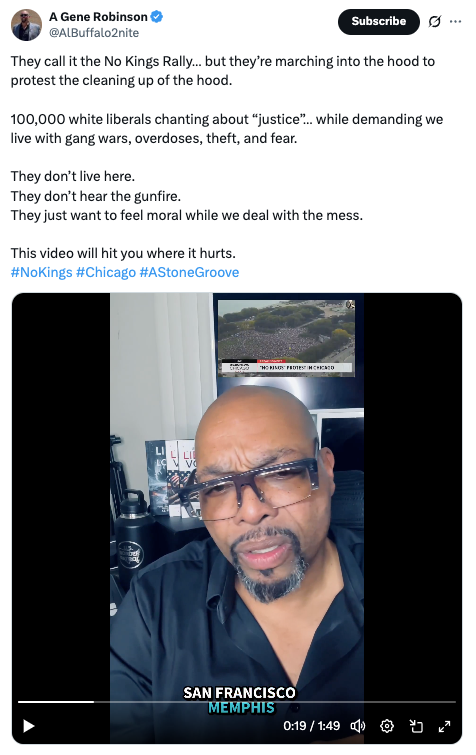
Today, I noticed this post by A Gene Robinson, who doesn't use the term "luxury beliefs," but is angry about non-stop high crime in Chicago contrasted with what he considered the detached cheap signaling of those who participated in the Chicago No Kings Rally:

I asked Grok to compare the economic circumstances of those in Chicago's crime ridden neighborhoods to the circumstances of people who work for corporate media:

Corporate media workers earn 2–5 times more than residents in these Chicago neighborhoods ($60,000+ vs. $25,000–$50,000), enabling comfortable lifestyles with savings, travel, and leisure. They benefit from employer perks like health insurance and flexible time off, contrasting with reliance on public aid in high-crime areas, where poverty rates are 2–3 times higher (40%+ vs. national 12%). Media lifestyles involve professional growth and urban amenities, while these neighborhoods face survival challenges, unemployment-driven desperation, and violence that perpetuates economic stagnation. This disparity highlights broader urban inequalities, where media professionals might even report on these communities from a position of relative privilege.

Then I asked Grok to compare the economic circumstances of those in Chicago's crime-ridden neighborhoods to those who marched in the Chicago no-kings rally:

The economic divide between residents of Chicago's crime-ridden neighborhoods and No Kings rally marchers is stark, highlighting urban inequalities in race, class, and opportunity. Neighborhood residents endure entrenched poverty, with incomes 2–4 times lower than the implied stability of rally participants, who benefit from assets like homes and retirement funds accumulated over decades.

While the former face unemployment, reliance on aid, and violence-linked economic stagnation, marchers—often older, white, and from more affluent backgrounds—enjoy financial security enabling activism without personal economic risk.

This contrast underscores how protests like No Kings may draw from privileged demographics, potentially overlooking the direct economic hardships in the city's most vulnerable areas.

Continue ReadingLuxury Beliefs in Chicago

Eli Steele Identifies the Hidden Root of Leftist Violence

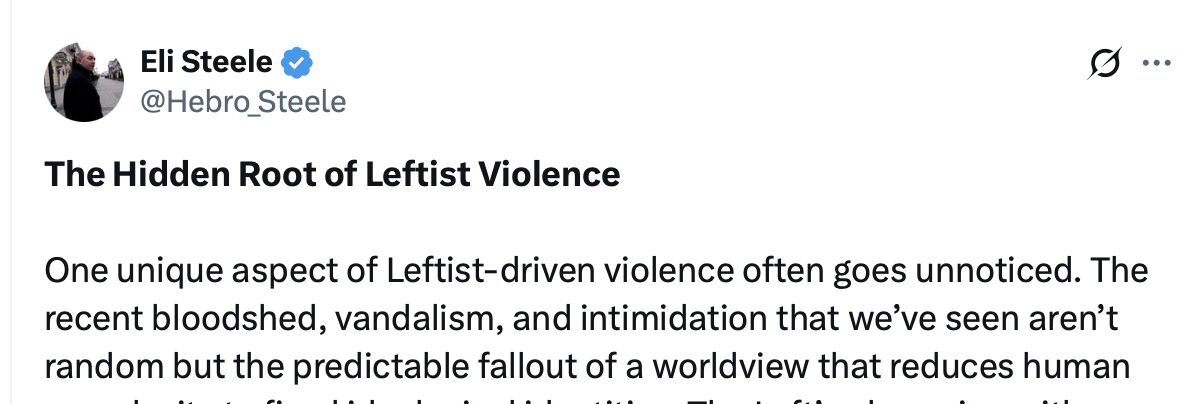
I'm concerned that Eli Steele has correctly pointed out a problem that has no obvious solution. Certainly no quick fix:

One unique aspect of Leftist-driven violence often goes unnoticed. The recent bloodshed, vandalism, and intimidation that we’ve seen aren’t random but the predictable fallout of a worldview that reduces human complexity to fixed ideological identities. The Left’s obsession with immutable traits -- race, gender, sex -- creates a victimhood hierarchy where dissent feels like an existential threat. When challenged, responses spiral into denial, defensiveness, or even violence from those unable to defend their dogma. This isn’t mere political disagreement, but the grim consequence of a belief system that rejects the Enlightenment’s focus on reason and individuality for rigid orthodoxy.

Recent events expose this pattern. The assassination of Charlie Kirk by Tyler Robinson, radicalized through Leftist politics and his transgender partner’s identity struggles, shows how loyalty to identity can turn lethal when faced with opposing views. School shootings like Audrey Hale’s 2023 Nashville attack and Robin Westman’s 2025 Minneapolis shooting reveal how issues with or challenges to gender identity can ignite rage. Elias Rodriguez’s 2025 murder of two Israeli Embassy employees, accompanied by cries of “shame on Zio-Nazi terror,” reflects a worldview -- shared by many pro-Hamas supporters -- that reduces Jews, Israeli or not, to whites and oppressors. The decade-long wave of Black Lives Matter protests, grounded in claims of systemic racial oppression, fueled riots that caused billions in damages, claimed lives, and pressured countless American institutions into adopting reductive racial identity politics as dogma.

Beyond violence, this ideology breeds intimidation, silencing dissent with threats of job loss or social ostracism. Rooted in identity determinism, this intellectual dead-end leaves no room for nuance or growth, increasing the potential for violence among those trapped in its logic -- a logic now taught to young minds through ethnic studies in K-12 schools.

If we cannot force the Left to retreat from its fixation on identity politics through the ballot box and all legal means, this ideology will only sow ever-increasing division and violence. This challenge is daunting because it demands stripping people of their very identities grounded in immutable characteristics and showing them their worth lies elsewhere -- their character. They will fight with everything they have.

To break this cycle, we must reject the notion that immutable traits dictate moral worth and recommit to reason and individuality. Until the Left abandons its dogma, it will continue to fuel conflict—a stark reminder of what happens when ideological orthodoxy drowns out dialogue.

One way to reject the notion that immutable traits dictate moral worth would be to make sure we remove all financial and social status incentives for enshrining immutable traits. But I am pessimistic that that we can make any headway by engaging in conversation. Where to start?

Continue ReadingEli Steele Identifies the Hidden Root of Leftist Violence

The Fear of Shame Leads to Tyranny

Unfortunately, decent people often cower to avoid strategically-imposed shame. This allows loud unruly minorities to inflict censorship and tyranny. Eli Steele presents an illustrative article written by his father, black conservative Shelby Steele:

Eli Steele: "Before Charlie Kirk, my father spoke at countless universities and colleges, often for nominal pay, and the verbal abuse he suffered was beyond the pale. It is a sign of how much our culture declined, from screaming to the bullet."

Excerpt: The Loneliness of the "Black Conservative"

by Shelby Steele

"I realized that I was a black conservative when I found myself standing on stages being shamed in public. I had written a book that said, among many other things, that black American leaders were practicing a politics that drew the group into a victim-focused racial identity that, in turn, stifled black advancement more than racism itself did. For reasons that I will discuss shortly, this was heresy in many quarters. And, as I traveled around from one little Puritan village (read "university") to another, a common scene would unfold.

"Whenever my talk was finished, though sometimes before, a virtual militia of angry black students would rush to the microphones and begin to scream. At first I thought of them as Mau Maus but decided this was unfair to the real Mau Maus, who, though ruthless terrorists, had helped bring independence to Kenya in the 1950s. My confronters were not freedom fighters; they were Carrie Nation-like enforcers, racial bluenoses who lived in terror of certain words. Repression was their game, not liberation, and they said as much. "You can't say that in front of the white man." "Your words will be used against us." "Why did you write this book?" "You should only print that in a black magazine." Their outrage brought to light an ironic and unnoticed transformation in the nature of black American anger from the sixties to the nineties: a shift in focus from protest to suppression, from blowing the lid off to tightening it down. And, short of terrorism, shame is the best instrument of repression.

"Of course, most black students did not behave in this way. But the very decency of the majority, black and white, often made the shaming of the minority more effective. So I learned what it was like to stand before a crowd in which a coterie of one's enemies had the license to shame, while a mixture of decorum and fear silenced the decent people who might have come to one's aid. I was as vulnerable to the decency as to the shaming since together they amounted to shame. And it is never fun to be called "an opportunist," "a house slave," and so on while university presidents sit in the front row and avert their eyes. But this really is the point: The goal of shaming was never to win an argument with me; it was to make a display of shame that would make others afraid for themselves, that would cause eyes to avert. I was more the vehicle than the object, and what I did was almost irrelevant. Shame's victory was in the averted eyes, the covering of decency."

Continue ReadingThe Fear of Shame Leads to Tyranny