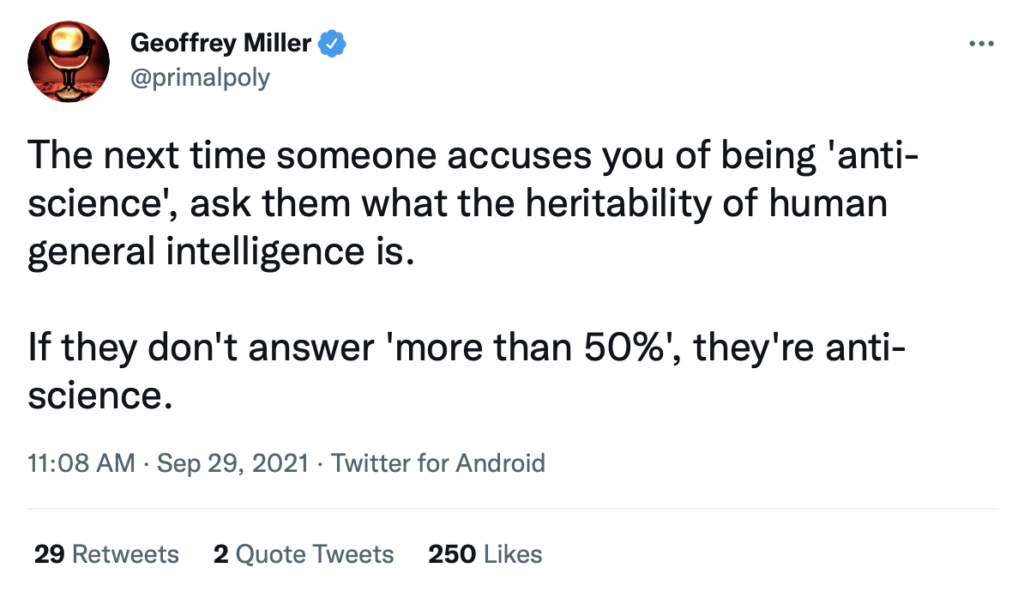
Sometimes science hurts. Are you really willing to follow the science? Here is a bellwether test from Geoffrey Miller:
Here's the evidence for the blank slate crowd: "Genetic variation, brain, and intelligence differences," Molecular Psychiatry, February 2021.
Twin and family studies report that genetic differences are associated with individual differences in intelligence test scores (Box 2). If studies from all ages are taken together, genetic differences account for about 50% (standard error [SE] about 2%) of the variation in intelligence [24]. Higher heritability (see Glossary) estimates are found in samples of adults (where it can be 70% or slightly more) than in children (where estimates as low as 20–30% have been reported) [24,25,26,27]. The finding that intelligence is heritable has been replicated across multiple data sets sourced from different countries and times [28]. Our emphasis herein is on results from the newer, DNA-based studies rather than on traditional twin and family studies.
DNA-based studies have shown that a pattern of hierarchical variance is evident at the genetic as well as the phenotypic level. Using genomic structural equation modelling [29] it was found that a genetic general factor explained, on average, 58.4% (SE = 4.8%, ranging from 9 to 95% for individual tests) of the genetic variance across seven cognitive tests in people with European ancestry. This provides some support for the idea that the phenotypic structure of intelligence is in part due to genetic effects that act on a general factor of intelligence and also at more specific cognitive levels.
What happened to progress in the US? It seemed like we had a plan and a good track record for progress back in the 1990s. A lot of things happened, of course. That is the topic of this discussion involving Jonathan Haidt and John Wood Jr and April Lawson. Here's how Haidt set the table for the longer discussion:
We can go back to some of the ideas in The Righteous Mind, because that's the summary of my own work as a social psychologist who studies morality. What I've always tried to do in my work is look at evolution. What is human nature. How did it evolve. [What is the] interplay of human nature with culture? And of course, everything can change over the course of just a few decades, too. We're very dynamic species.
What I'd like to put on the put on the table here first: let's really lower our expectations for humanity. Okay. Now, this sounds depressing. But let's be serious here. What kind of creatures, are we? We are primates who evolved to live in small groups that dominate territory, in competition with other groups were really, really good at coming together to fight those other groups. Part of our preparation for doing that, I believe, is the psychology of religion, sacredness, tribal rituals. We have all this really complicated stuff we do that binds us to each other. This is a human universal. Every group has rituals. I'm a big fan of the sociologist Emile Durkheim.
And so from that kind of perspective we ought to still be pre-civilization times with very high rates of murder. And somehow we escaped that. Somehow we've had this incredible ascent. This unbelievably rapid ascent, in which we've gotten wealthier, smarter, healthier. We've made extraordinary progress on women's rights, animal rights, gay rights, the concern about the environment. So let's start by appreciating our lowly origins as really violent tribal creatures, and the way that we've rocketed up from
Okay, now, in the last 10 or so, years, 10 to 20 years, we've had a little bit of a come-down. I really want to put this not just in an evolutionary perspective, but in a recent historical perspective, because this, I think, is the key to understanding what is happening to us now. It is that we were fooled in the 1990s into thinking that democracy was easy. The founding fathers were under no such illusion. They knew that democracy is prone to faction. That's what Madison wrote about, especially in Federalist 10. They knew that democracy is generally self-destructed, so they gave us all kinds of safeguards, They tried to create a system that would not be so prone, a system in which these tribal, irrational emotional creatures might actually live together. And it worked. It worked pretty well. And it worked badly at times.
But by the 1990s, we had the the mistaken view, that if we just wait for Iran, and Russia and North Korea to develop market economies, they'll get prosperous, their people will demand rights. And this was true for China too. That people will demand rights. Liberal democracies will break out everywhere. Liberal democracies are the endpoint, the end of history.
And so that's the way those of us who live through--I'm older than you guys--but the late 20th century was an incredibly dangerous and an exciting time in which there was a victor and it was liberal democracy. Okay, but like in a lot of movies where it seems like there's an early denouement and everything's great? Well, we still have a lot of stuff to go and in the 21st century, things have really come down from there. So that's the backstory.
The evolutionary psychologist Robin Dunbar notes that by age 3 an average child can use about 1,000 words (double Kanzi’s bonobo world record); by age 6, around 13,000; and by age 18, some 60,000: ‘that means it has been learning an average of 10 new words a day since its first birthday, the equivalent of a new word every 90 minutes of its waking life.
Trigger warnings do not alleviate emotional distress. They do not significantly reduce negative affect or minimize intrusive thoughts, two hallmarks of PTSD. Notably, these findings hold for individuals with and without a history of trauma. (For a review of the relevant research, see the 2020 Clinical Psychological Science article “Helping or Harming? The Effect of Trigger Warnings on Individuals With Trauma Histories” by Payton J. Jones, Benjamin W. Bellet, and Richard J. McNally.)
We are not aware of a single experimental study that has found significant benefits of using trigger warnings. Looking specifically at trauma survivors, including those with a diagnosis of PTSD, the Jones et al. study found that trigger warnings “were not helpful even when they warned about content that closely matched survivors’ traumas.”
What’s more, they found that trigger warnings actually increased the anxiety of individuals with the most severe PTSD, prompting them to “view trauma as more central to their life narrative.” “Trigger warnings,” they concluded, “may be most harmful to the very individuals they were designed to protect.”
Oppezzo designed an elegant experiment. A group of Stanford students were asked to list as many creative uses for common objects as they could. A Frisbee, for example, can be used as a dog toy, but it can also be used as a hat, a plate, a bird bath, or a small shovel. The more novel uses a student listed, the higher the creativity score. Half the students sat for an hour before they were given their test. The others walked on a treadmill.
The results were staggering. Creativity scores improved by 60 percent after a walk.
A few years earlier, Michelle Voss, a University of Iowa psychology professor, studied the effects of walking on brain connectivity. She recruited 65 couch-potato volunteers aged 55 to 80 and imaged their brains in an MRI machine. For the next year, half of her volunteers took 40-minute walks three times a week. The other participants kept spending their days watching Golden Girls reruns (no judgment here; I love Dorothy and Blanche) and only participated in stretching exercises as a control. After a year, Voss put everyone back in the MRI machine and imaged their brains again. Not much had happened to the control group, but the walkers had significantly improved connectivity in regions of the brain understood to play an important role in our ability to think creatively.
Walking changes our brains, and it impacts not only creativity, but also memory."
Hello, I invite you to subscribe to Dangerous Intersection by entering your email below. You will have the option to receive emails notifying you of new posts once per week or more often.