We Know We are not Infallible, but We Don’t Know What We are Infalliable About.

Jonathan Haidt, Robert George, Steven Pinker, and Leda Cosmides discuss human biases and why we need healthy institutions and viewpoint diversity to counteract them.

One important change could restore vibrancy to our universities: a renewed celebration of viewpoint diversity.

The university is meant to be a sacred space where we can test novel ideas and engage in thoughtful dialogue without fear of repercussions. When these ideals are no longer prioritized, the culture of open inquiry and truth-seeking dissipates.

Listen to Jonathan Haidt, Steven Pinker, Leda Cosmides, and Robert George discuss how to overcome our biases and foster a healthy academic culture.

Continue ReadingWe Know We are not Infallible, but We Don’t Know What We are Infalliable About.

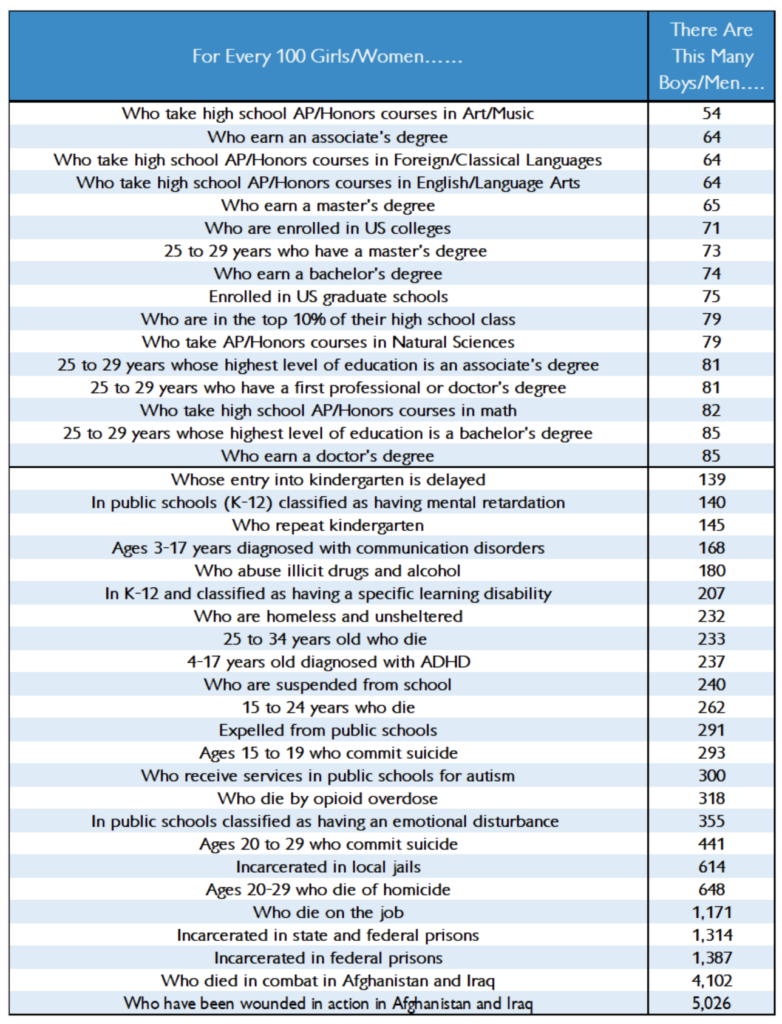
Men versus Women: Some Comparisons

2020 Report Card on some of the achievements and struggles of men compared to those of women.

Before a woman decides that men have it easier, she might want to consider this list. This is not a comprehensive list. Admittedly, women fare worse than men in many situations.

Continue ReadingMen versus Women: Some Comparisons

Giving and Receiving

We don't give to receive, but that's how human nature works, as pointed out by Shane Parrish at Farnum Street.

I think people are afraid. They don’t recognize the power of this rule. And they’re afraid that by going first and giving resources, giving time, giving attention, giving samples, and so on, they might just be losing that. They’re not cognizant of the fact that there’s such a strong rule in every human culture that says you must not take without giving in return.

— Robert Cialdini

Continue ReadingGiving and Receiving

Why People are Going Woke

At this post I will collect passages suggesting the reasons why people, especially young people, are going Woke.

I start with Bari Weiss:

All of this has taken place against the backdrop of major changes in American life—the tearing apart of our social fabric; the loss of religion and the decline of civic organizations; the opioid crisis; the collapse of American industries; the rise of big tech; successive financial crises; a toxic public discourse; crushing student debt. An epidemic of loneliness. A crisis of meaning. A pandemic of distrust. It has taken place against the backdrop of the American dream’s decline into what feels like a punchline, the inequalities of our supposedly fair, liberal meritocracy clearly rigged in favor of some people and against others.

See also,

Camille Paglia:

What has happened is these young people now getting to college have no sense of history – of any kind! No sense of history. No world geography. No sense of the violence and the barbarities of history. So, they think that the whole world has always been like this, a kind of nice, comfortable world where you can go to the store and get orange juice and milk, and you can turn on the water and the hot water comes out. They have no sense whatever of the destruction, of the great civilizations that rose and fell, and so on – and how arrogant people get when they’re in a comfortable civilization. They now have been taught to look around them to see defects in America – which is the freest country in the history of the world – and to feel that somehow America is the source of all evil in the universe, and it’s because they’ve never been exposed to the actual evil of the history of humanity. They know nothing!

I will add other passages below as I encounter them . . .

Continue ReadingWhy People are Going Woke

Tourette Symptoms: Possibly a New Social Contagion

Are Tourette Symptoms a new form of social contagion? A new article from the Wall Street Journal intrigued me.  The title: "Teen Girls Are Developing Tics. Doctors Say TikTok Could Be a Factor." Here are the opening paragraphs:

Teenage girls across the globe have been showing up at doctors’ offices with tics—physical jerking movements and verbal outbursts—since the start of the pandemic.

Movement-disorder doctors were stumped at first. Girls with tics are rare, and these teens had an unusually high number of them, which had developed suddenly. After months of studying the patients and consulting with one another, experts at top pediatric hospitals in the U.S., Canada, Australia and the U.K. discovered that most of the girls had something in common: TikTok.

According to a spate of recent medical journal articles, doctors say the girls had been watching videos of TikTok influencers who said they had Tourette syndrome, a nervous-system disorder that causes people to make repetitive, involuntary movements or sounds.

No one has tracked these cases nationally, but pediatric movement-disorder centers across the U.S. are reporting an influx of teen girls with similar tics. Donald Gilbert, a neurologist at Cincinnati Children’s Hospital Medical Center who specializes in pediatric movement disorders and Tourette syndrome, has seen about 10 new teens with tics a month since March 2020. Before the pandemic, his clinic had seen at most one a month.

I'm intrigued for a couple reasons. Back in college I spent some timing hanging around with guy who was smart and funny. He was also a really good tennis player and he had an easy going confidence.I was a several years younger than he was and I was not feeling confident about who I was at age 17. He also had a tic. Occasionally, his head suddenly jerked while he talked. This happened every couple minutes. After a while, I noticed that I was starting to do that too. The fact that I started doing this seemed odd, because I didn't decide to do it. It just started happening. I consciously clamped down on that behavior and I stopped doing it a few after I noticed myself doing it.

I'm also interested in this article because of the social contagion angle related to the sudden spike in teenaged girls who claim they were born in the wrong bodies. I'm speaking of the transgender social contagion phenomenon discussed extensively by Abigail Shrier (and see here).

Continue ReadingTourette Symptoms: Possibly a New Social Contagion