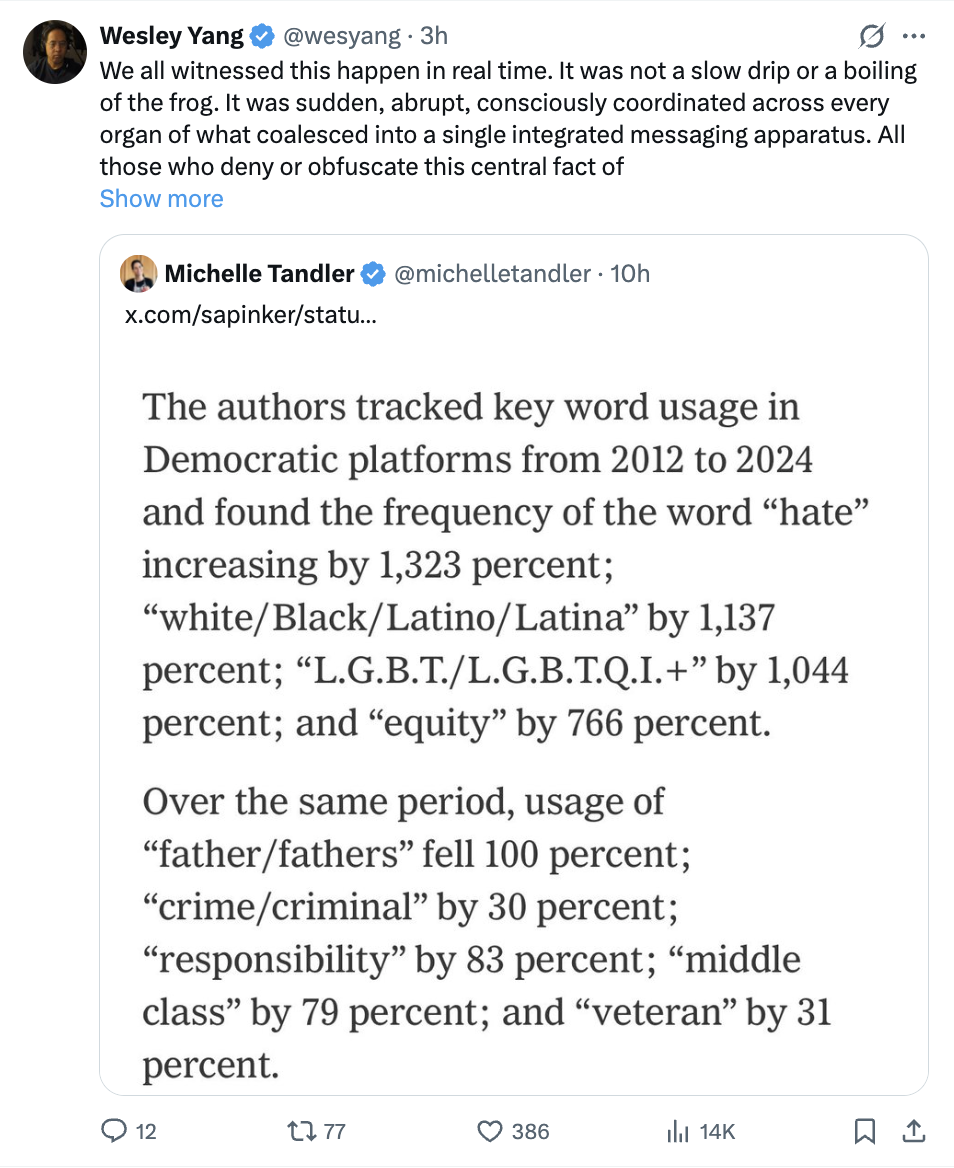
I think Wes Yang is correct. Persons unknown decided that they would perform a 180° turn on this issue and many others, including immigration.
We all witnessed this happen in real time. It was not a slow drip or a boiling of the frog. It was sudden, abrupt, consciously coordinated across every organ of what coalesced into a single integrated messaging apparatus. All those who deny or obfuscate this central fact of American public life are engaged in conscious deceit.
In October, the group behind the centrist Democratic WelcomePAC issued “Deciding to Win,” an analysis of “election results, hundreds of public polls and academic papers, dozens of case studies, and surveys of more than 500,000 voters” that found that “since 2012, highly educated staffers, donors, advocacy groups, pundits and elected officials have reshaped the Democratic Party’s agenda, decreasing our party’s focus on the economic issues that are the top concerns of the American people.”
The authors tracked key word usage in Democratic platforms from 2012 to 2024 and found the frequency of the word “hate” increasing by 1,323 percent; “white/Black/Latino/Latina” by 1,137 percent; “L.G.B.T./L.G.B.T.Q.I.+” by 1,044 percent; and “equity” by 766 percent.
Over the same period, usage of “father/fathers” fell 100 percent; “crime/criminal” by 30 percent; “responsibility” by 83 percent; “middle class” by 79 percent; and “veteran” by 31 percent.
Finally, in November, Politico’s Elena Schneider reported the findings of a 21-state research project funded by Democracy Matters involving polling, dozens of focus groups and message testing.
“Working-class voters see Democrats as ‘woke, weak and out of touch’ and six in 10 have a negative view of the party,” she wrote . . .
a href="https://www.youtube.com/watch?v=T3h7pmhyIwg">
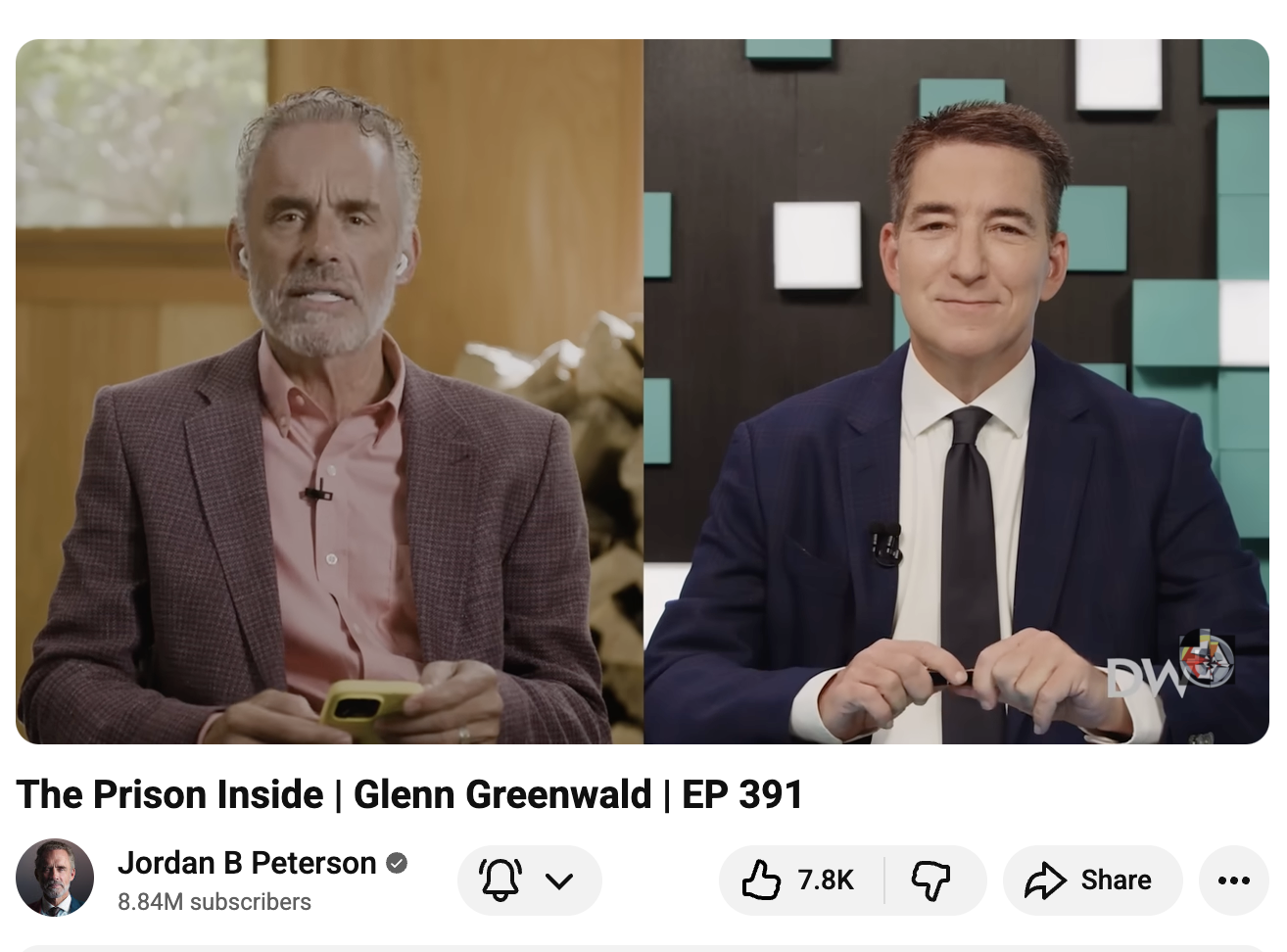
I've listened to this podcast several times. It's long, but it is extremely thoughtful, engaging, disturbing, but also hopeful and celebratory of the human spirit. It involves Jordan Peterson and Glenn Greenwald. These are two of my most cherished thinkers. I am inspired and provoked by many of the topics that they explore here. Topics include censorship, propaganda, the history of these things in the United States. Also, the relationship between religion and politics, and what goes wrong when religion is absorbed into politics. And there's even some meaning of life moments. I took the time to transcribe a large chunk of this discussion, and I am sharing it with the hope that those of you who listen to it or read it will also find it worthwhile.
I asked Grok to crank out a basic table of contents to this interview:
Min 21:30
1. Censorship of RFK Jr. by Google and the tactic of starting with hated figures like Alex Jones
2. Expansion of censorship to mainstream voices, including Devin Nunes and Rand Paul
3. Reasons for increasing censorship: Generational shifts in values among Millennials and Gen Z, and the impact of Trump's election
4. Depiction of Trump as an existential evil justifying extreme measures, including the Hunter Biden laptop scandal and Sam Harris's views
5. Connection to post-9/11 clampdown on civil liberties, transformation of airports into authoritarian spaces
Min 27:35
6. Reflections on 9/11 trauma, the war on terror, and how airport security conditioned obedience to authority
7. Threats to liberty from fear rather than greed; free speech as equivalent to free thought and essential for adaptation
8. George Orwell on tyranny through mind control; the internet's shift from liberation to control, Snowden revelations
9. Biblical phrase "render unto Caesar"; collapse of religious domain into politics leading to unsophisticated good vs. evil wars
10. Personal background on religion; hubris in censorship; human need for spirituality, politics as a substitute for religion
11. Discussions with Douglas Murray on humanism needing a religious framework; Carl Jung on rationality bounded by the dream
12. Grappling with ethics and morality without religion; necessity of spirituality to avoid nihilism
13. Response to materialist atheists; human relationship with the larger whole; introduction to the story of Abraham
These excerpts start at Minute 21:30 of the above video.
Glenn Greenwald
20% of Democratic Party voters say they intend to vote for RFK, Jr. for president. And the most powerful corporations, or one of the richest and most powerful corporations ever to exist, Google sweeps in and says, This is something that you are not permitted to be heard.
Glenn Greenwald
And what happened was, what always is the tactic of sensors is they always pick a test case in the beginning that they believe is someone who is sufficiently hated or disliked so that everybody will acquiesce to the precedent, simply because their emotions for that person are so high. So the first person to really be deplatformed in this collusive effort by Silicon Valley was Alex Jones. And Peter Thiel was on the board of Facebook at the time. Mark Andreessen in Silicon Valley, and a few other people stood up at the time and said, no matter how much you hate Alex Jones, this precedent is going to work its way slowly, or maybe not even so slowly, to expand into the kinds of voices that you probably think shouldn't be censored. And by the point that you cheer the precedent in the first instance, because you allow your emotional dislike for this person to outweigh your rational capacities, it will be too late the precedent is already implemented, and then you're left to just bicker about its application, rather than the principle itself.
Glenn Greenwald
And that's precisely what has happened. They began quickly censoring mainstream conservative voices. Devin Nunes went to rumble in part to escape from Google censorship, and then a huge stream of people did as well. One of the most shocking things that happened along those lines, Rand Paul questioned a couple of epidemiologists, scientists who were testifying before the US Senate about the possible efficacy of ivermectin and other alternative medication for covid. It was a Senate hearing, a hearing in the United States Senate. Rand Paul put it on his YouTube channel as a excerpt of this hearing, and Google decided that was something that ought not to be heard as well.
Stereotype accuracy is one of the largest and most replicable effects in all of social psychology. Richard et al (2003) found that fewer than 5% of all effects in social psychology exceeded r’s of .50. In contrast, nearly all consensual stereotype accuracy correlations and about half of all personal stereotype accuracy correlations exceed .50.
The evidence from both experimental and naturalistic studies indicates that people apply their stereotypes when judging others approximately rationally. When individuating information is absent or ambiguous, stereotypes often influence person perception. When individuating information is clear and relevant, its effects are “massive” (Kunda & Thagard, 1996, yes, that is a direct quote, p. 292), and stereotype effects tend to be weak or nonexistent. This puts the lie to longstanding claims that “stereotypes lead people to ignore individual differences.”
Stunning numbers. The citizens of large countries are rapidly disappearing and it's not because of a war or a plague.. It is an unprecedented loss in population:
South Korea is quietly living through something no society has ever survived: a 96% population collapse in just four generations — with zero war, zero plague, zero famine. 100 people today → 25 children → 6 grandchildren → 4 great-grandchildren. That’s it. Game over for an entire nation by ~2125 if fertility stays where it is (0.68–0.72). . . . Japan, Taiwan, Italy, Spain, Singapore, Hong Kong, Poland, Greece — all following the same curve, just 10–20 years behind.
[T]he core creed of multiculturalism: noble intentions and moral rhetoric paired with total disregard for real-world outcome . . . . Multiculturalism promotes the celebration of difference on the assumption that strengthening one’s group identity naturally produces greater openness toward, and acceptance of, others. Few ideas have been more widely embraced—and more poorly understood—than this. . . Ultimately, tolerance does not grow out of abstract ideals. It grows from loosening the grip of collective identity and seeing others not as representatives of a category but as individuals. Societies must ensure that people of all backgrounds can develop a strong sense of personal identity. This is not merely desirable but essential for any nation that hopes to remain both diverse and cohesive. Prejudice is rooted in group belonging and in the basic psychology of us-and-them. When institutions encourage people to define themselves primarily through group identity, they inevitably reinforce the very us-and-them thinking that fuels prejudice and division.
A functioning multicultural society is not one that obsessively manages groups and their identities, but one that enables individuals to move beyond them and form connections based on shared human and civic values. Only then can we approach the kind of multicultural society we claim to aspire to, and that can be achieved only by loosening, not tightening, the hold of group identity.
Hello, I invite you to subscribe to Dangerous Intersection by entering your email below. You will have the option to receive emails notifying you of new posts once per week or more often.