
Time to simplify eating
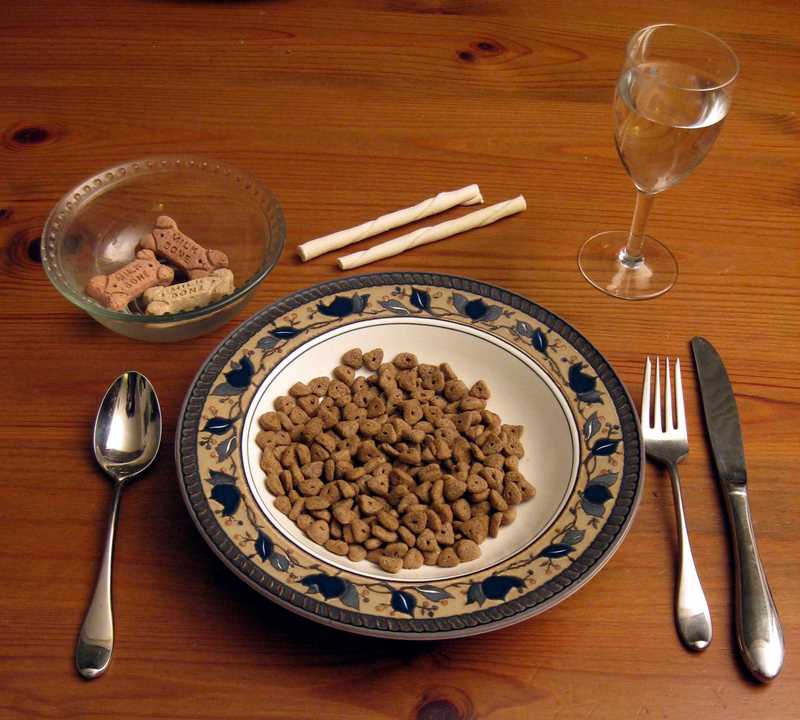
Come on, now. Dog food looks quite delicious, or at least the packaging does. And most dogs I know seem to enjoy reasonably long healthy lives, without requiring anyone to plan their meals or cook them. So how about it? Is anyone ready to switch over to eating dog food, at least occasionally? I suspect that we could get by on a cup of it in the morning and another cup in the evening. Or is eating far to intertwined with being social and being proper? [Disclaimer: I have eaten a piece of dry dog food on several occasions. It tastes like a bland cracker, no matter how "premium" the brand. But it is certainly edible by humans]. I "challenged" readers to switch over to eating dog food in a previous post. It would certainly be convenient, but there was fierce resistance to the idea, even though the morning cereal many of us eat has the same fill-up-the-bowl-and-eat-it procedure. [It shouldn't come as a surprise that humans could survive on dog food. Consider this: "We are not so different when it comes to genes either. The dog genome is basically the human genome divided into about 70 different pieces and rearranged on a greater number of chromosomes, according to a new map of the dog genome."]
I will offer three anecdotes about the social pressures that affect the way we eat: Last night, a woman eating at a table of friends in a diner starting eating her quesadillla with a knife and fork. I embarrassed her more than a bit by asking her whether she'd eat them quesadillas this way at home, in private. She admitted, no. At home, she would simply pick up the pizza-shaped pieces and eat them pizza-style. But at the restaurant she felt compelled to cut them into even smaller pieces with utensils.
Anecdote number Two: A few months ago, I attended a function hosted by a parent at my children's school. Food was offered in a spacious room with a clean dry floor. I was talking with a group of people that included the hostess when the hostess dropped a cracker on the floor. She reached down to pick it up, hesitated, then walked over to a trash can to throw it away. I then asked her whether she would have thrown away that cracker had she been eating alone.
So how about it? Is anyone ready to switch over to eating dog food, at least occasionally? I suspect that we could get by on a cup of it in the morning and another cup in the evening. Or is eating far to intertwined with being social and being proper? [Disclaimer: I have eaten a piece of dry dog food on several occasions. It tastes like a bland cracker, no matter how "premium" the brand. But it is certainly edible by humans]. I "challenged" readers to switch over to eating dog food in a previous post. It would certainly be convenient, but there was fierce resistance to the idea, even though the morning cereal many of us eat has the same fill-up-the-bowl-and-eat-it procedure. [It shouldn't come as a surprise that humans could survive on dog food. Consider this: "We are not so different when it comes to genes either. The dog genome is basically the human genome divided into about 70 different pieces and rearranged on a greater number of chromosomes, according to a new map of the dog genome."]
I will offer three anecdotes about the social pressures that affect the way we eat: Last night, a woman eating at a table of friends in a diner starting eating her quesadillla with a knife and fork. I embarrassed her more than a bit by asking her whether she'd eat them quesadillas this way at home, in private. She admitted, no. At home, she would simply pick up the pizza-shaped pieces and eat them pizza-style. But at the restaurant she felt compelled to cut them into even smaller pieces with utensils.
Anecdote number Two: A few months ago, I attended a function hosted by a parent at my children's school. Food was offered in a spacious room with a clean dry floor. I was talking with a group of people that included the hostess when the hostess dropped a cracker on the floor. She reached down to pick it up, hesitated, then walked over to a trash can to throw it away. I then asked her whether she would have thrown away that cracker had she been eating alone.
 She sheepishly admitted that had she been eating at home and dropped the cracker, she would have picked it up and eaten it. Dropped food often occurs to those of us raising children; parents of young children commonly invoke the "30 second" rule and we eat food that has spilled onto any reasonably clean dry floor. Dropped food triggers zero-tolerance among adults. And God forbid that you would ever try something like this.
Anecdote number Three: I know more than a few attorneys who would rather be found dead than to to be seen eating lunch in low priced restaurant (e.g., a Chinese stir fry restaurant or Taco Bell) in the business district of town on a workday, even though they admit that they often eat this sort of food when with their children and they actually enjoy it.
Thus, our behavior is often not about the food, even when it seems to be. And much of what we do is not really about the thing that it seems to be about. Usually, it's about social relationships and the compulsion to make proper displays to those around us. I suspect that most things that puzzle me about life have similar explanations; it's not about the thing it seems to be about--it's about displaying one's fitness and resources to others. The example that immediately comes to mind is religion. I've previously written about the social compulsions that seem to underlie religious assertions and participation in religious ceremonies.
Well, it's getting late. I think I'll have a bowl of dog food and then turn in.
She sheepishly admitted that had she been eating at home and dropped the cracker, she would have picked it up and eaten it. Dropped food often occurs to those of us raising children; parents of young children commonly invoke the "30 second" rule and we eat food that has spilled onto any reasonably clean dry floor. Dropped food triggers zero-tolerance among adults. And God forbid that you would ever try something like this.
Anecdote number Three: I know more than a few attorneys who would rather be found dead than to to be seen eating lunch in low priced restaurant (e.g., a Chinese stir fry restaurant or Taco Bell) in the business district of town on a workday, even though they admit that they often eat this sort of food when with their children and they actually enjoy it.
Thus, our behavior is often not about the food, even when it seems to be. And much of what we do is not really about the thing that it seems to be about. Usually, it's about social relationships and the compulsion to make proper displays to those around us. I suspect that most things that puzzle me about life have similar explanations; it's not about the thing it seems to be about--it's about displaying one's fitness and resources to others. The example that immediately comes to mind is religion. I've previously written about the social compulsions that seem to underlie religious assertions and participation in religious ceremonies.
Well, it's getting late. I think I'll have a bowl of dog food and then turn in.