The reason Democrats might lose is they aren’t partisan enough

Recent polls show that a majority of voters admire candidates which don’t compromise on issues. When we look at the recent political history of compromise within the Democratic Party, we may discern a major source of voter discontent with Democratic candidates in the upcoming November elections. Recently, US House and Senate Democrats failed to call up for a vote the expiration of Bush era tax breaks for the wealthiest of Americans. According to a recent CNN poll, 69% of Americans support having the Bush era tax breaks for the ultra-rich expiring on January 1, 2011. Republicans adopted an “all or nothing” approach which clearly favored the wealthiest Americans and which Republican approach would have taken away Middle Class Tax Cuts from the Democrats’ Stimulus Plan and given them to the ultra-rich to the tune of $731 billion. The increase in the total national debt of $13.64 trillion from the Republican plan from continuing these tax cuts alone would be 5.4%. The White House also has adopted a “compromise with ‘yourself’” approach in an attempt to garner Republican support for issues even though the GOP has not supported anything put forth by the Democrats during the Obama Presidency. Witness the pre-legislative demise of the “public option” in health care which is still favored by a majority of Americans. Many Democratic candidates are running away from their votes for healthcare reform when according to a recent Pew Center study a majority of voters and large majorities of Democratic and Independent voters support those who voted for healthcare reform. So, while many believe that the “partisanship” of politics is destructive, it is clear that holding the line on your policies is more favorably viewed by voters than any type of compromise. Democrats are likely to learn a very costly lesson in the value of “NO!” come November, 2010. But, the lesson will mostly inform any future minority in the US House or Senate that obstruction and obfuscation are more valuable than compromise, even when a majority of voters support the other side of an issue.

Continue ReadingThe reason Democrats might lose is they aren’t partisan enough

Religion: It’s almost like being in love

You know how it is when someone is in the first throes of infatuation. We call it "love," but it's very different than the kind of relationship that eventually develops. Or doesn't develop. Think of all of those young couples "in love" who are at each other's throats only a couple years later. While they are in the romantic love stage, they are "caught up in the emotion." Their lover can do no wrong. Their lover is perfect. Their lover has no faults; oh, sure he or she has idiosyncrasies, but nothing that could possibly impede this relationship. At least not until the fairy dust settles and they are able to start seeing each other as flawed human beings, sometimes horribly flawed. Amazing as it seems, strong emotions can cause massive distortions in perceptions. They can make A look like Not-A. Strong emotions can also completely shut down our ability to think self-critically. How is it possible that perceptions and understanding can be massively distorted by emotion? How is it that a violent drunkard kleptomaniac can initially seem like a nice fellow? That's evolution at work. As Robert Wright once wrote in The Moral Animal, emotions are "evolution's executioners." We have deep instincts for falling in love, for losing control, for blinding ourselves to the other's faults so that we will make babies. I should restate this. It's not that evolution is trying to do anything at all. Evolution is not conscious and it has no plan. On the other hand, we are survivors at the top of a long branch of the tree of speciation. You and I and all of our ancestors have survived Nature's amoral pruning, millennium after millennium. We are extremely lucky that we evaded the weeding phase of breed and weed. The unrelenting reproductive urge, the one thing that every one of our ancestors had in spades, has been passed on to us or we wouldn't be here to ponder anything. ALL of our ancestors had it and acted on it: the compulsion to reproduce--the urge to merge. This ancient instinct is ubiquitous, even though, once in a while, a cigar is only a cigar. What is the most efficient way to make animals reproduce? How about this? Blind them to each others' faults and make them horny. [More . . . ]

Continue ReadingReligion: It’s almost like being in love

Culture as a collective fabrication facilitating our quest for immortality

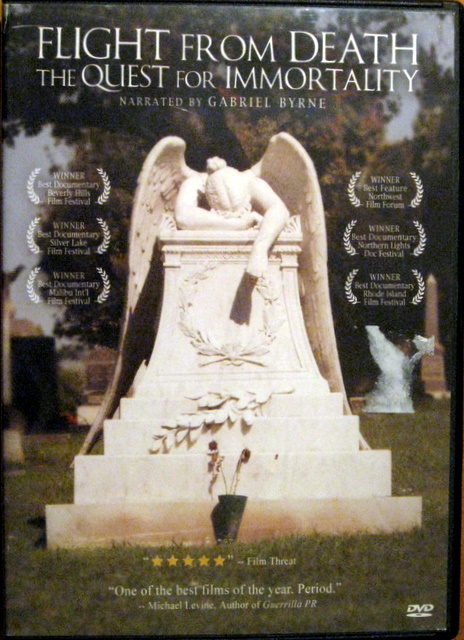
I often wonder how people are capable of simply going about their business, chatting about last night’s sporting event, working on crossword puzzles or thinking about buying a new car, despite the fact that they will be dead someday, maybe even someday soon. And for those with children, their children will also be dead a few decades later. How can we possibly live with those dreaded thoughts hanging over us? In fact, every person now living will likely be dead in 150 years. How can we engage in mundane things like gossiping, consuming, traveling and amusing ourselves when every person on the planet is facing annihilation? How do we put death out of our minds so easily? Ernest Becker would suggest that I have it all backwards. According to Becker, people intensely amuse and distract themselves, and immerse themselves in culture, because they are anxious about death. They are not necessarily consciously aware of their impending deaths, but they feel it deeply, and their minds grind and sputter on this topic, under the surface, unconsciously. We do the best we can to deal with this terrifying thought that we will all be dead, and the best we can think of doing is to distract ourselves with the many bright and shiny bigger-than-us, bigger-than-life things offered by culture. We put these things on a pedestal and then we cling to them as if they were life preservers. We embellish our cultural treasures with accolades recognizing their “eternal” significance. “Strawberry Fields Forever,” Babe Ruth, stamp collections, being a trivia pursuit star, triathlons, Michelangelo’s David. And for some of us, Jesus Christ loves us and He will let us live with him forever in heaven. According to Becker, these cultural mainstays are important for keeping us steady, even while death (and the threat of death) lurks around every corner. I recently had the opportunity to watch the highly acclaimed low-budget 90-minute 2005 documentary titled "Flight from Death: the Quest for Immortality,” produced by Patrick Shen and Greg Bennick. The film is based on the works of Ernest Becker’s “terror management theory,” (TMT) on which I’ve written several times (see here and here). Even though I was well acquainted with the works of Becker prior to viewing this video, I found the film to be transformative, in that it offers a schematic of underlying “hydraulics” that help us to understand many things that otherwise seem so puzzling about culture. I’d highly recommend “Flight from Death” whether or not you sometimes find it stunning that you live on a planet where mobile intestinal tracks scurry about, drive buses and even serve you meals at your local restaurant. Here’s the trailer. Even though I was already familiar with Becker’s theory and many of the experiments substantiating Becker’s theory, I found the film illuminating. “Flight From Death” includes well-chosen imagery and music to accompany the interviews with thoughtful and eccentric people from a wide variety of backgrounds (including psychologist Sheldon Soloman and writer Sam Keen, among others). [More . . . ]

Continue ReadingCulture as a collective fabrication facilitating our quest for immortality

Expelled founder Paul Kurtz explains his departure from the Center for Inquiry

On May 18, 2010 the Center for Inquiry, the Council for Secular Humanism and the Committee for Skeptical Inquiry jointly announced that they had accepted the resignation of Paul Kurtz from each of these boards. Kurtz, who had founded each of these three organizations, had been serving on each of the boards, and as well as serving as Chair Emeritus of CSH and as Editor in Chief of CSH's flagship publication, Free Inquiry. In the joint announcement, the boards recognized Dr. Kurtz for his "decades of service to the Council for Secular Humanism, the Center for Inquiry (CFI), and its other affiliates." This same announcement also contained the following statement:

At Paul Kurtz's behest, CFI and its affiliates began years ago to organize a leadership transition. Moreover, in recent years the board had concerns about Dr. Kurtz's day-to-day management of the organization.

As a long-time subscriber to Free Inquiry and Skeptical Inquirer, I was familiar with many of the writings of Paul Kurtz, but I had never before spoken with him or corresponded with him. As a result of reading his articles at Free Inquiry, I was also aware that there was internal tension at those organizations (e.g., see here , here, and here). After reading about his resignation, I emailed a short note to Mr. Kurtz to wish him well in light of the announcement of his resignation. I also asked him whether he would allow me to interview him with regard to the announcement. He agreed: [Note: CFI's CEO Ron Lindsay responded to the following interview of Paul Kurtz here.] EV: To what extent was your resignation from the Center for Inquiry voluntary? PK: It was done voluntarily, but under great duress. [caption id="attachment_14572" align="alignright" width="150" caption="Paul Kurtz (Permission by Wikimedia Commons)"][/caption] -- EV: What were your titles and job duties prior to your resignation. PK: I founded the modern skeptics movement and sustained it for over three and a half decades. I had been the Chairman of the Center for Inquiry, the Council for Secular Humanism and the Committee for Skeptical Inquiry. In June, 2008, I was made "Emeritus" and stripped of any authority. Since 1980, I was Editor-in-Chief for Free Inquiry, but starting in June 2008, I no longer had any authority. I never received any compensation working for these organizations. I worked as a volunteer, living off savings I accrued while working as a philosophy professor. In fact, my wife and I donated more than $2 million dollars over the years to CFI, CSH and CSI. We were the second largest donors to these organizations. Over the years, I helped to raise over $40 million for the Center for Inquiry. -- EV: I saw the announcement of your resignation in the August/September, 2010 issue of Free Inquiry. Why didn't you publish any explanation regarding your resignation in Free Inquiry? PK: Tom Flynn and the CFI Board refused to run my letter of resignation in Free Inquiry or any of the Websites of CFI. It was censorship, clear and simple. I was censored four times, beginning in June 2008. [More . . . ]

Continue ReadingExpelled founder Paul Kurtz explains his departure from the Center for Inquiry