
American interest in soccer

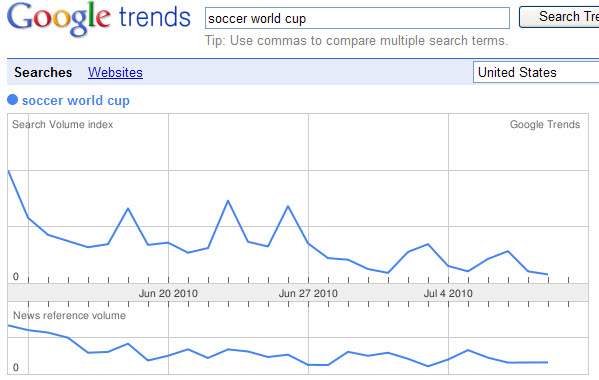
Remember how interested so many people from the United States were in soccer a few weeks ago? "Soccer" was prominent on many American mainstream news sites. Remember how almost everyone was talking about that upcoming game against Ghana, a game that was to be played on June 26? But then Ghana beat the U.S. That loss now allows us to run a little experiment. How many of those American "soccer" fans were in a "soccer" frenzy merely because the United States had a chance to win? How many of these American "soccer" fans were jingoists rather than true soccer fans? soccer-trends Using Google Trends, you can see how the United States audience falls flat after the United States was knocked out of the tournament. It turns out that a huge number of American "soccer" fans only cared about soccer when patriotism fanned the flames of their "soccer" interest.
Continue ReadingAmerican interest in soccer

Mel Gibson and the Problem of Public Privacy

So Mel Gibson has been exposed (once again) as an intolerant, sexist, abusive person. A recording of a phone conversation with his former girlfriend is now Out There on the internet and one can listen to Mel spill molten verbiage into her earpiece while she calmly refutes his charges. All I can wonder is, So what? What business is this of ours? This is private stuff. People lose control. Between each other, with strangers, but more often with those closest, people have moments when the mouth ill-advisedly opens and vileness falls out. The question is, does this define us? Are we, in fact, only to be defined by our worst moments? That would seem to be the case for people like Gibson. The reason, I think, is that for most of us, the Mel Gibsons of the world have no business having shitty days and acting like this. For most of us, there is just cause for having these kinds of days and attitudes, because for most of us the world is not our oyster and we do not have the luxury of squandering time, friends, and money. Mel Gibson is wealthy and famous and, at one time, admired. He ate at the best restaurants, appeared on television, gave interviews, has his picture on the covers of magazines. Is seen with other people, regularly, who fall into that category of Those Who Have It Made.

Continue ReadingMel Gibson and the Problem of Public Privacy

All those cameras

Here's a random thought. I suspect that small tightly-knit communities--small towns--have tended to produce, on average, more people with a traditional sense of morality--more people with strong consciences. Don't steal, don't kill, be kind, look out to help others in need, for instance. I don't know this to be a fact. Rather, it's anecdotal, but it's based on 54 years of experience. I also suspect that part of the reason that this is true (to the extent that it is true) is that people in small towns keep a close eye on each other. In small towns, I suspect that children grow up more closely watched and corrected by others (especially corrected by neighbors and even strangers) when they gets out of line. I think that this sort of upbringing will tend to produce more of a traditional moral "conscience." Now consider that there are a lot of cameras out there these days. Lots and lots of government cameras, of course, but also millions of phone cameras as well as plain old . . . cameras. Anything unusual that happens out in a public space is now likely to draw at least some photos and video. Is it possible that all of these cameras in big cities might have the effect of turning big city "dog-eat-dog" people into something more akin to small town people? Will the presence of so many cameras tend to make big city people feel constantly "watched." Will that, in turn, encourage big city individuals to develop traditional moral habits?

Continue ReadingAll those cameras

Bold, idealistic and anxious

According to Science Daily,

Anxiety and uncertainty can cause us to become more idealistic and more radical in our religious beliefs, according to new findings by York University researchers, published in this month's issue of the Journal of Personality and Social Psychology. . . [T]he results of this research program suggest that bold but vulnerable people gravitate to idealistic and religious extremes for relief from anxiety.

See this related cross-link to Gregory Paul's work showing that religion thrives when a population feels insecure.

Continue ReadingBold, idealistic and anxious

Climategate scientists vindicated

Another inquiry has determined that the "Climategate" scientists' "rigor and honesty as scientists are not in doubt." Not that this will slow down attacks on inconvenient science. Perhaps the biggest lesson illustrated is that when you show know-nothings that they are wrong, it has no effect on their opinions. For an equally good example, read about the "Lenski Affair," where the scientists had conducted 20 years of rigorous experiments that clearly demonstrated evolution of E. coli in the lab. Evidence just isn't good enough for zealots.

Continue ReadingClimategate scientists vindicated