
US Public Health COVID Policies Exploited Three Classic Human Frailties
Kenny Carmody:

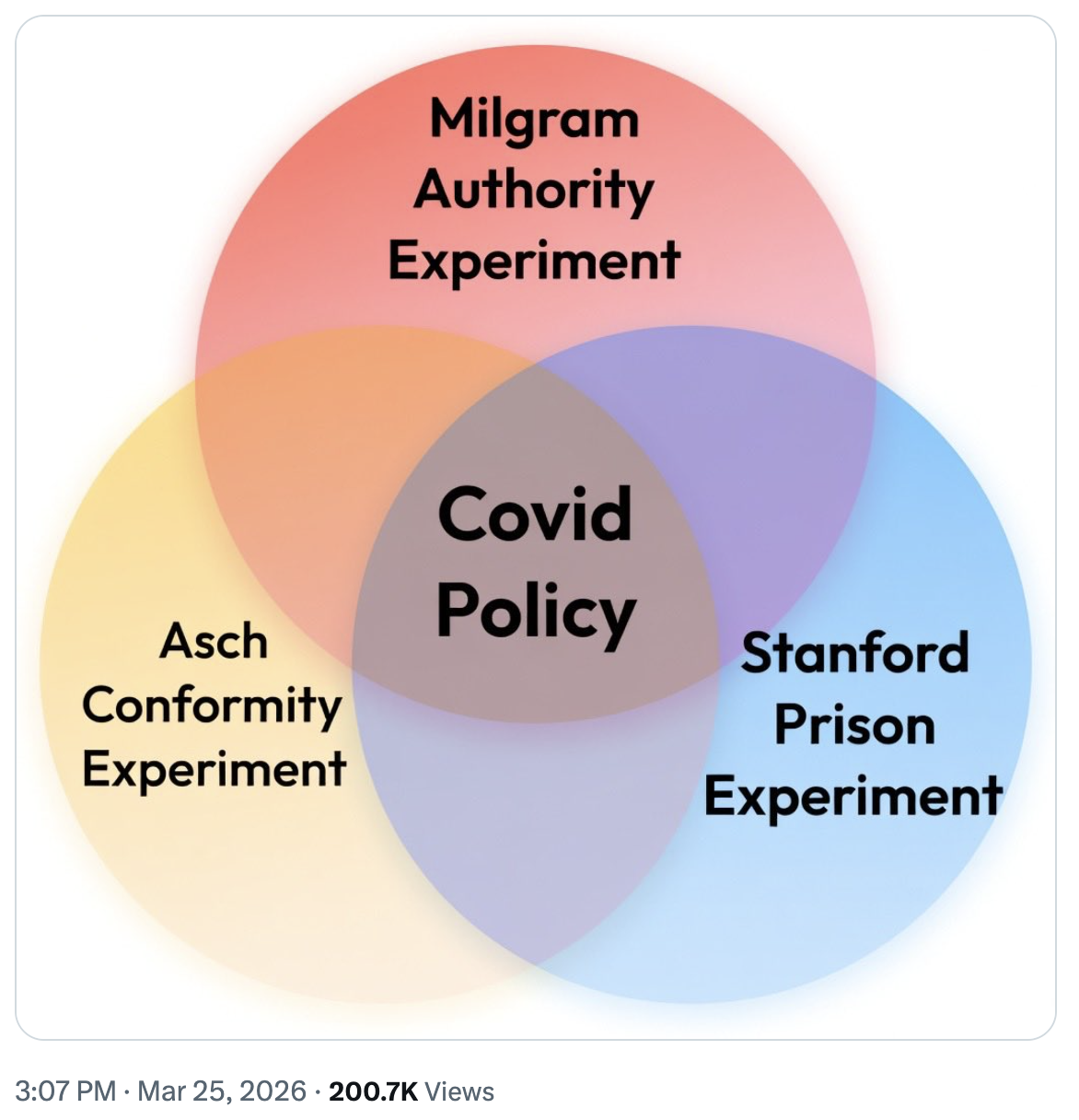
Three of the most disturbing psychological experiments in modern history placed in a Venn diagram with COVID policy sitting precisely at their intersection.
Carmody's analysis on X is spot on:

Most people know the Milgram experiment. Ordinary people administering what they believed were lethal electric shocks to strangers because an authority figure in a white coat told them to continue. We wrote about this. COVID replicated it at planetary scale, the doctors, the neighbours, the employers, the family members who enforced mandates with a zeal that had nothing to do with science and everything to do with institutional obedience.

But the other two are equally important and far less discussed.

The Asch Conformity Experiment demonstrated something even more fundamental. Solomon Asch showed in the 1950s that a significant majority of people will deny the evidence of their own eyes will give an answer they know to be factually wrong, simply because everyone else in the room is giving that answer. Not because they were threatened. Not because they were paid. Because the social pressure of the group was sufficient to override direct sensory experience.

This is what masking a healthy population, cancelling Christmas, and demanding that people treat their neighbours as biological threats actually accomplished. It was not about any of those things specifically. It was about training an entire population to override their own perception and defer to the group consensus, however absurd that consensus became.

And then the Stanford Prison Experiment.

Philip Zimbardo’s 1971 study abandoned early because it spiralled so rapidly out of control, showed that ordinary people assigned roles of authority over other ordinary people will, within days, begin to abuse that authority in ways they would have found unthinkable before the role was assigned. The guards became cruel not because they were cruel people but because the structure gave them permission and the institution backed them up.

We watched this happen in real time.

The COVID marshals. The border agents turning families away. The hospital administrators barring visitors from dying patients. The teachers reporting parents. The neighbours calling police on children playing in parks. The HR departments gleefully processing terminations for the unvaccinated. Ordinary people, handed a role and a uniform of institutional approval, discovering capacities for cruelty that their pre-2020 selves would not have recognised.

Continue ReadingUS Public Health COVID Policies Exploited Three Classic Human Frailties

Rational Limits to Empathy and Inclusivity

Yeah, it's important that we pay some attention to people's feelings, but we aren't there to jump to action whenever someone else (especially strangers) claims that their feelings are hurt and that we owe them our time, energy and money. We need to be on guard so that our natural inclinations to be empathetic don't become toxic. We need to know that it's OK to draw boundaries. It's OK to say "No," and to say it often. Functional people do these things. That is how they develop and maintain strong moral character. Every day it important to put your own oxygen mask on, at least for awhile, before jumping to the rescue of others. We intuitively do this with regard to our money. If we acceded to the demands of all beggars, rent-seekers and scoundrels we encounter in person and on the Internet, everyone one of us would go broke in a week.

Today I spotted a post by Mom Wars:

When we tell kids to always be inclusive, we often fail to teach them discernment.

We don’t live in a world where every person has good intentions. We don’t live in a world where every peer is safe, healthy, or kind. And yet, we tell kids—especially girls—to include everyone, to make room for every voice, to keep the peace even when something feels off. We elevate kindness as the ultimate virtue, but we don’t equip them with the tools to know when and how to draw the line.

What does that teach them? That someone else’s feelings are always more important than their gut instincts. That avoiding awkwardness is more important than avoiding harm. That their discomfort is a small price to pay for another person’s inclusion.

And that’s a dangerous lesson.

When you preach “kindness” without nuance, without boundaries, without discernment, you unintentionally teach your child that being “nice” matters more than being safe, or emotionally well, or even just comfortable in their own skin. You teach them that their own mental health comes second to another person’s momentary hurt feelings. That ignoring their inner voice in favor of social harmony is maturity, rather than self-abandonment.

When you preach “acceptance” as a blanket virtue, you fail to give your child a framework for recognizing anti-social behaviors. For noticing when someone is manipulative, attention-seeking, boundary-breaking, or just draining to be around. Kids—especially empathetic ones—can easily absorb the idea that all behavior must be tolerated, all personalities embraced, all people welcomed no matter how they treat others.

But that’s not kindness. That’s codependency."

This is spot on. Such an important lesson that so many people need to learn and heed.

This topic relates to the work of Paul Bloom. In 2016 he wrote a book titled: Against Empathy: The Case for Rational Compassion. He defines “empathy” as follows: “Empathy is the act of coming to experience the world as you think someone else does.” He further describes empathy as “a spotlight directing attention and aid to where it’s needed.” According to Bloom, empathy is an emotion, not a good tool for moral decision-making. “Compassion,” on the other hand, is feeling concern or compassion for someone. Bloom contrasts empathy with “rational compassion,” which can productively be used to “make decisions based on considerations of cost and benefits.” Empathy, by contrast, has no such protective limitations, meaning that empathy often leads to ill-considered policies.

Continue ReadingRational Limits to Empathy and Inclusivity

The Parallel Stories of Lucy Calkins (the Disparagement of Phonics) and Anthony Fauci (COVID)

I've been listening to outstanding podcast titled "Sold a Story,” an eight-part investigative series hosted by journalist Emily Hanford. Launched in October 2022, “Sold a Story.” This podcast examines the widespread use of an ineffective (and often counter-productive) reading instruction method used in many U.S. schools. This method, heavily promoted by Lucy Calkins, author of the “Units of Study”, was one of the most widely used reading curricula in U.S. elementary schools after its introduction in 1987. This method, which intentionally discourages the use of phonics, has been so firmly embedded in grade school curricula that it continues to be used in many schools despite decades of cognitive science showing that kids learn far better when they are taught significant amounts of phonics. “Sold a Story” exposes how millions of children struggle to read (even now as adults) because schools relied on Calkins' thoroughly debunked theories, often referred to as "balanced literacy" and "whole language."

The focus of the “Sold a Story” is this: Why do so many American schools continue to use reading curricula rooted in such a flawed idea that children can learn to read primarily by guessing words using context clues or pictures, rather than systematically decoding words through phonics? Calkins' approach, influenced by figures like Marie Clay and perpetuated by popular authors and publishers somehow ignored the "science of reading," research showing that explicit phonics instruction is a critical component for most children to become proficient readers. The series also highlights the horrific consequences of excluding phonics—65% of current U.S. fourth graders are not proficient readers.

[Note and Spoiler Alert: Lucy Calkins began incorporating phonics into the Units of Study for Teaching Reading curriculum with the release of her newest method, called the Units of Study in Phonics in 2021. This was in response to growing criticism, including the criticism levied by the "Sold a Story" podcast. Calkins' updated method includes phonics primarily in K-2 classrooms to supplement the core reading curriculum, aiming to address foundational skills like decoding. In her current method, phonics is still deemphasized for grades 3 and beyond.]

Lucy Calkins agreed to be interviewed by Emily Hansford in 2021 after previously rebuffing Hansford. For me, this interview was gripping--I've transcribed it below. What would Calkins say after causing such widespread damage to millions of children? Well, this interview revealed Calkins' lack of integrity and an unwillingness to fall squarely on her sword. She just couldn't bear to admit that she refused to look at the science of reading while creating and promulgating her flawed method. This willful ignorance occurred while Calkins was the nation's de facto rock star of reading education. For years, the science of reading demonstrated that her method was harming children by teaching them to pretend to read. Many kids are wired such that they learned to read despite the fundamental flaws of Calkins' original method but, as indicated above, many other students were left behind, some of them for life. The following is from Episode 6:

Continue ReadingThe Parallel Stories of Lucy Calkins (the Disparagement of Phonics) and Anthony Fauci (COVID)

About Our Societal Death Spiral . . .

Gad Saad writes:

A fundamental question that I ask people when I'm gauging their intellectual honesty is to describe for me what the evidence would need to look like in order for them to alter a given position that they hold. With that in mind, is there any reality that would cause the West to snap out of its parasitic ideological rapture and implement the necessary cataclysmic auto-corrective measures? If yes, we must still have some hope to hold on to. If not, it is going to be a painful death spiral.

Let's start by trying to convince people to use basic induction to convince them that A = A. That would be a good start. It's the basis for the Rule of Law.

Continue ReadingAbout Our Societal Death Spiral . . .