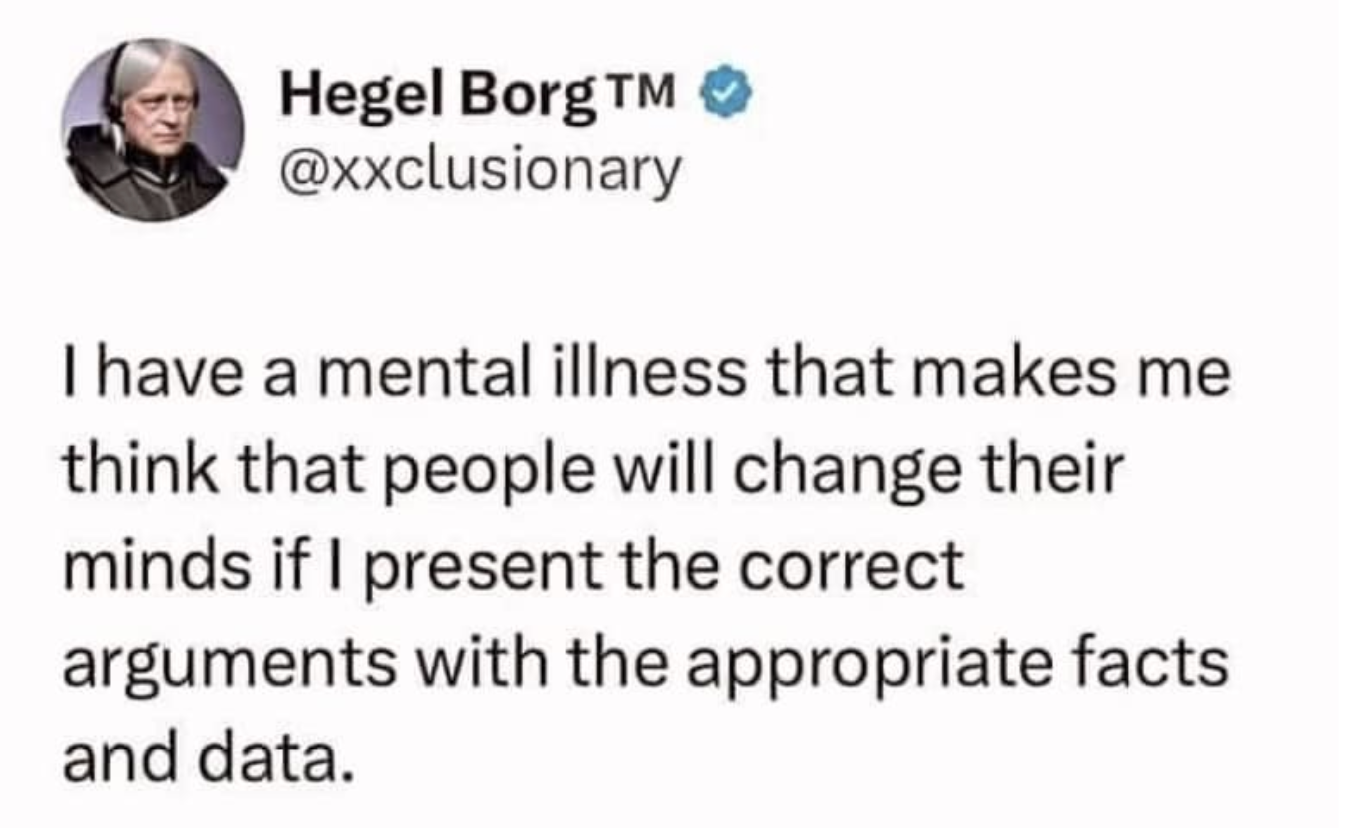
Fascinated by the ubiquitous occurrences of social contagion, where seemingly intelligent people start saying things that don't add up. I've documented hundreds of these things at this website, many of which are illustrated under the category of "Media Narratives."
Recently, a friend of mine gave me an old example that is rather strange and stunning, the case of Florence Foster Jenkins, and exceedingly bad singer who was enthusiastically praised in the 1920s through the 1940s. I'll quote a few passages about her from Wikipedia:
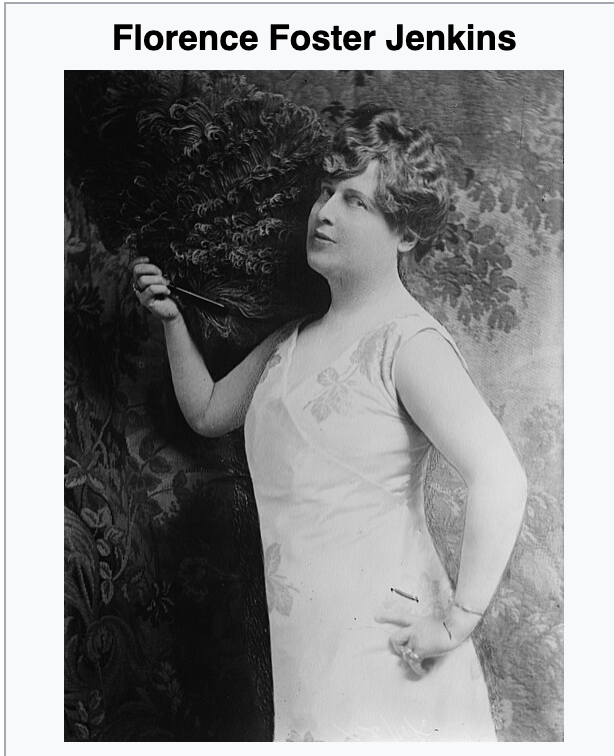
Florence Foster Jenkins (born Narcissa Florence Foster;[a] July 19, 1868 – November 26, 1944) was an American socialite and amateur coloratura soprano who became known, and mocked, for her flamboyant performance costumes and notably poor singing ability. Stephen Pile ranked her "the world's worst opera singer ... No one, before or since, has succeeded in liberating themselves quite so completely from the shackles of musical notation."[1]
Despite – or perhaps because of – her technical incompetence, she became a prominent musical camp cult-figure in New York City during the 1920s, 1930s, and 1940s. Cole Porter, Gian Carlo Menotti, Lily Pons, Sir Thomas Beecham, and other celebrities were counted among her fans.[2][3] Enrico Caruso reportedly "regarded her with affection and respect".[4]
The poet William Meredith wrote that a Jenkins recital "was never exactly an aesthetic experience, or only to the degree that an early Christian among the lions provided aesthetic experience; it was chiefly immolatory, and Madame Jenkins was always eaten, in the end."
Perhaps this is not exactly social contagion. Maybe it's better described as Kayfabe, the classic example being pro wrestling, but it seems to have widespread application in our dysfunctionally performative modern culture. Kayfabe [pronounced Kay-Fabe] is described by Grok as follows:
Kayfabe is a term originating from professional wrestling, referring to the practice of presenting staged events, characters, storylines, and rivalries as genuine or "real" to maintain the illusion for audiences.
It's essentially a form of suspension of disbelief, where wrestlers (and sometimes promoters) stay in character both in and out of the ring to preserve the fiction of the sport.
The word itself is believed to derive from carny slang (carnival worker lingo), possibly a Pig Latin variation of "be fake" or "fake," though its exact etymology is debated and dates back to the early 20th century in wrestling circles.
History and Usage in WrestlingIn the early days of pro wrestling, kayfabe was strictly enforced to protect the industry's secrets. Wrestlers would avoid being seen together in public if their characters were rivals, and they'd even use separate travel arrangements or fake injuries to sell storylines.
Breaking kayfabe—revealing the scripted nature of events, going off-script, or acknowledging the fakery—could result in fines, suspensions, or blacklisting. For example, in the 1980s and '90s, figures like Hulk Hogan or The Undertaker maintained their personas rigorously outside the arena.Over time, with the rise of the internet and "dirt sheets" (insider newsletters), kayfabe has become harder to uphold. The 1999 documentary Beyond the Mat and WWE's own "reality era" in the 2010s blurred lines further, leading to more meta-storylines where wrestlers reference real-life events.
Today, it's more flexible, but elements persist—like wrestlers "working" the crowd or media with in-character interviews.Broader Cultural MeaningBeyond wrestling, kayfabe has entered wider slang to describe any situation where people collectively pretend something scripted or artificial is authentic, such as in politics, reality TV, or corporate culture. For instance, it might apply to politicians maintaining a public facade despite behind-the-scenes deals.
It's about a tacit agreement to ignore the "fourth wall" for the sake of the performance.