The Political Left’s Problem is not Joe Rogan. It’s in the Mirror.

Krystal Ball's commentary is spot. The Left constantly ignores Joe Rogan's many left-leaning positions and it's to their own detriment. One problem is that Joe is too damned independent and doesn't pass the left's political purity tests. Krystal also suggests a time-of-genesis and a motive for this dysfunction: Joe's words in support of Bernie Sanders during the primary.

Continue ReadingThe Political Left’s Problem is not Joe Rogan. It’s in the Mirror.

The New Partisan ACLU

This change of de facto mission has been obvious for years. The ACLU is now unapologetically partisan, which is in sharp conflict with its stated principles. This NYT new coverage of this change is better late than never.

"It was supposed to be the celebration of a grand career, as the American Civil Liberties Union presented a prestigious award to the longtime lawyer David Goldberger. He had argued one of its most famous cases, defending the free speech rights of Nazis in the 1970s to march in Skokie, Ill., home to many Holocaust survivors.

Mr. Goldberger, now 79, adored the A.C.L.U. But at his celebratory luncheon in 2017, he listened to one speaker after another and felt a growing unease.

"I got the sense it was more important for A.C.L.U. staff to identify with clients and progressive causes than to stand on principle,” he said in a recent interview. “Liberals are leaving the First Amendment behind.”

The A.C.L.U., America’s high temple of free speech and civil liberties, has emerged as a muscular and richly funded progressive powerhouse in recent years, taking on the Trump administration in more than 400 lawsuits. But the organization finds itself riven with internal tensions over whether it has stepped away from a founding principle — unwavering devotion to the First Amendment."

The NYT piece offers this compelling evidence in support:

Since Mr. Trump’s election, the A.C.L.U. budget has nearly tripled to more than $300 million as its corps of lawyers doubled. The same number of lawyers — four — specialize in free speech as a decade ago.

As I've pointed out many times, the legacy media take-over by social justice/woke partisanship mirrors the take-over of the ACLU. Good to see the NYT finally look into the mirror and ask itself some simple questions about its own mission. That had to happen in order for this ACLU article to find the light of day.

Continue ReadingThe New Partisan ACLU

Matt Taibbi: The Horseshoe Theory is Now a Real Thing

This is what I am seeing too. It is based on our Americhean (American + Manichean) zeitgeist. Matt Taibbi calls it the "horseshoe theory." He has unlocked his entire article, which I highly recommend, mostly for people who (mostly) will refuse to read it, but who need to read this. The title is "Congratulations, Elitists: Liberals and Conservatives Do Have Common Interests Now." Here is an excerpt:

The American liberalism I knew growing up was inclusive, humble, and democratic. It valued the free exchange of ideas among other things because a central part of the liberal’s identity was skepticism and doubt, most of all about your own correctitude. Truth was not a fixed thing that someone owned, it was at best a fleeting consensus, and in our country everyone, down to the last kook, at least theoretically got a say. We celebrated the fact that in criminal courts, we literally voted to decide the truth of things.

This new elitist politics of the #Resistance era (I won’t ennoble it by calling it liberalism) has an opposite view. Truth, they believe, is properly guarded by “experts” and “authorities” or (as Jon Karl put it) “serious people,” who alone can be trusted to decide such matters as whether or not the Hunter Biden laptop story can be shown to the public. A huge part of the frustration that the general public feels is this sense of being dictated to by an inaccessible priesthood, whether on censorship matters or on the seemingly daily instructions in the ear-smashing new vernacular of the revealed religion, from “Latinx” to “birthing persons.”

In the tone of these discussions is a constant subtext that it’s not necessary to ask the opinions of ordinary people on certain matters. As Plato put it, philosophy is “not for the multitude.” The plebes don’t get a say on speech, their views don’t need to be represented in news coverage, and as for their political choices, they’re still free to vote — provided their favorite politicians are removed from the Internet, their conspiratorial discussions are banned (ours are okay), and they’re preferably all placed under the benevolent mass surveillance of “experts” and “professionals.”

Add the total absence of a sense of humor and the inability of “moral clarity” politics to co-exist with any form of disagreement, and there’s a reason why traditional liberals are suddenly finding it easier to talk with old conservative rivals on Fox than the new authoritarian Snob-Lords at CNN, MSNBC, the Daily Beast or The Intercept. For all their other flaws, Fox types don’t fall to pieces and write group letters about their intolerable suffering and “trauma” if forced to share a room with someone with different political views. They’re also not terrified to speak their minds, which used to be a virtue of the American left (no more).

From the moment Donald Trump was elected, popular media began denouncing a broad cast of characters deemed responsible. Nativists, misogynists and racists were first in line, but from there they started adding new classes of offender: Greens, Bernie Bros, “both-sidesers,” Russia-denialists, Intellectual dark-webbers, class-not-racers, anti-New-Normalers, the “Substackerati,” and countless others, casting every new group out with the moronic admonition that they’re all really servants of the “far right” and “grifters” (all income earned in service of non-#Resistance politics is “grifting”). By now conventional wisdom has denounced everyone but its own little slice of aristocratic purity as the “far right.”

They’re wrong on the ideology, but right about one thing: they’ve created a brand of imperious elite politics so revolting that it has the potential to unite even this Balkanized wreck of a country. If they keep this up, liberals and conservatives may start talking for real, and maybe even fix a thing or two.

Continue ReadingMatt Taibbi: The Horseshoe Theory is Now a Real Thing

Religion to the Left of Me, Religion to the Right . . .

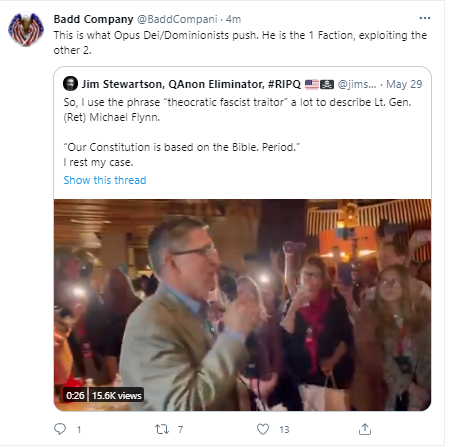
New religions are springing up in America, both on the left and the right. Click these Tweets and weep. You'll learn some surprising things. For instance, "Our Constitution is based on the Bible, Period!"

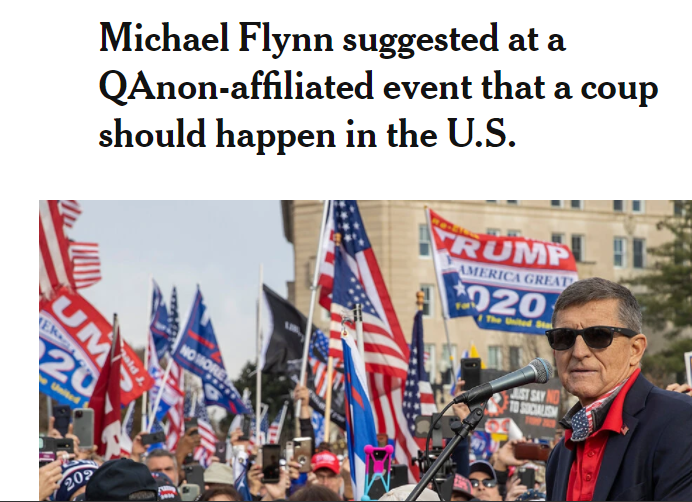
BTW, this is also what Michael Flynn is up to these days:

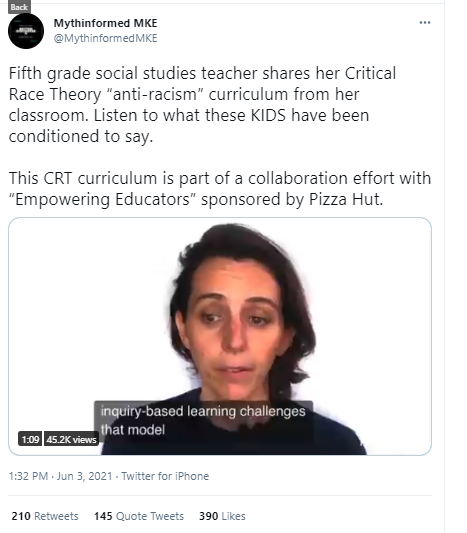
And here is the religion to the left of me:

As you can hear, above, you will learn things like this from properly indoctrinated children (despite the teacher's claim that "the children guide the learning"): "White people make other people think that they are bad." No nuance in any of this, so just write it all down and believe it.

I suspect that a large part of the American rage machine (online and in-person) is the far right and far left antagonizing each other. We need to discover a new version of Australia and ship both fringes there so that the moderates of each party can demonstrate how to communicate with each other and strike meaningful adult-like compromises.

Continue ReadingReligion to the Left of Me, Religion to the Right . . .

Alternatives to “Likes” on Social Media

Most social media platforms invite users to reply "Like" a Tweet, Post or Photo. It might be fun, for instance, when a dozen people "Liked" a photo of my salad. As argued, in "The Social Dilemma," however, piles of like can serve to steer people into tribes. This can happen when people post conclusions rather than thoughtful discussions.  It can happen when people make ad hominem attacks on their least favorite politicians and simplistic cartoons of complex social issues, such as immigration.

What is social media for?  That's a good question and it might evoke ten different answers from ten people.  Is it for cat videos and photos of one's children or is it appropriately used for discussing critically important social issues?  The suggestion that I'm about to make is for those of us who see social media as an opportunity to engage in serious conversations about important issues of the day with others in our network. Those not interested in serious discussions are invited to continue sharing cat photos.

I would suggest that in addition to the "Like" option, we add a few other options, including the following:

  • Your post merely parrots a talking point of one of the two political parties.
  • You are making an ad hominem attack on a person, not providing me with useful information.
  • You are engaged in a [cognitive bias] [logical fallacy].
  • Your post caused me to think about a topic in a new way.
  • Your post made me less certain of an opinion that I had.
  • Your post made me realize that this topic is more complex than I realized.
  • Your post states the facts fairly, but I still disagree with you.
  • You provided me with new intriguing information that I appreciate.
  • Your post made me angry, but I am glad you read it.
  • Your post irritates me, I disagree with you, but I value you as a friend.

I'm sure there are others that should be considered.  The main question is whether we are satisfied hoot panting for each other to display tribal loyalties or whether we want to be challenged to understand out world better . . .

Continue ReadingAlternatives to “Likes” on Social Media