I know more than a few people who swear that Donald Trump colluded with Russia to win the 2016 election. They "know" this because they limit their informational ecosystem to the New York Times, Washington Post and other corporate media outlets. When the Columbia Journalism Review published its August 1 paean to the New York Times, Matt Taibbi took exception to the many well-documented lies and distortions published by the NYT on this topic and also called out the CJR. Here's an excerpt of Taibbi's well-deserved response to the CJR, titled "Open Letter to the Columbia Journalism Review, on the Atrocious New York Times: The ostensible high priests of journalism should be able to detect the difference between passable coverage and epic, historic failure":
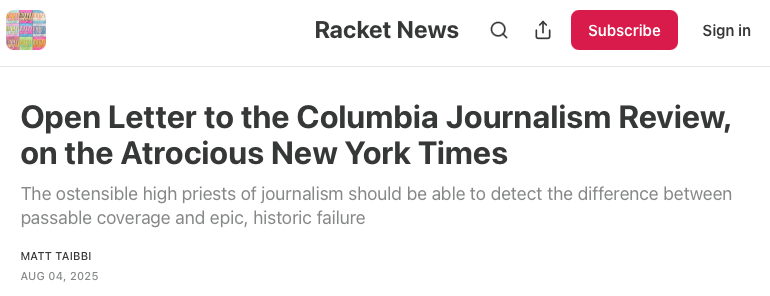
Letter to Bill Grueskin, former Dean of the Columbia Journalism School, on his recent article in the Columbia Journalism Review
Mr. Grueskin,
Regarding your August 1 article, “Knowing: Still Only Half the Battle,” which lauds Charlie Savage of the New York Times for having “dissected and eviscerated” Director of Intelligence Tulsi Gabbard’s claims about corruption of intelligence in the Trump-Russia investigation:
You praised Savage’s article, “New Reports on Russian Interference Don’t Show What Trump Says They Do,” as an example of the work of an “experienced beat reporter” who can distill complex stories into a “coherent, compelling whole.” Your sub-headline stressed the importance of “showing receipts” in journalism, where “most people don’t follow stories very closely,” but “they can learn a lot when an experienced beat reporter helps them sort out what’s important and what’s chaff.”
Chaff.
Except — and you should know this because the Columbia Journalism Review published over 20,000 words on the subject in January 2023 — Savage and his colleagues at the Times have badly miscovered this story for nearly a decade, and continue to do so. The 2018 Pulitzer Prize the paper won on the topic along with the Washington Post will go down as the same kind of “disgrace” as its 1932 Pulitzer for Walter Duranty’s breathless coverage of Stalin’s Russia. In this case, the Times drifted so far from its traditional mission that it became an animating motive for Gabbard and other investigators in Donald Trump’s administration.
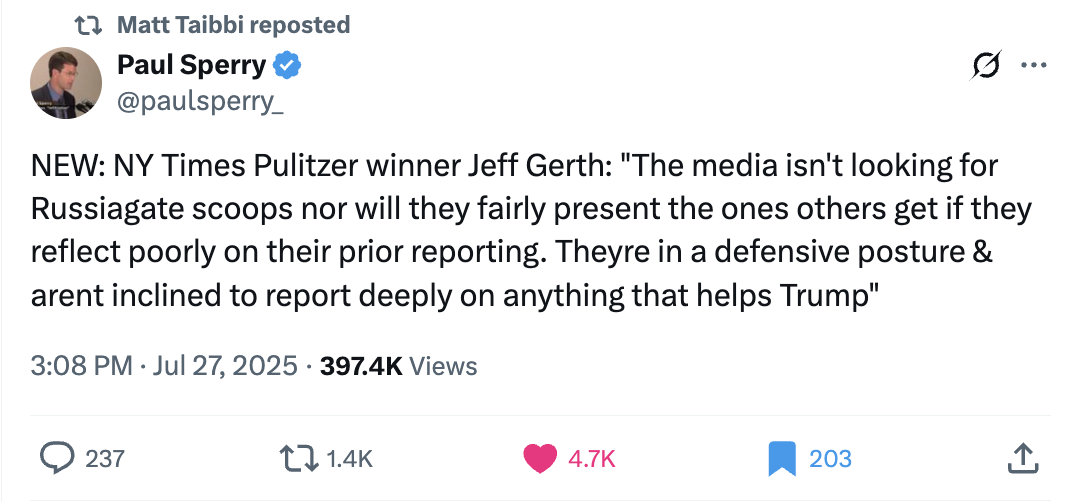
It is critically important to remember here that in 2023, Jeff Gerth excoriated the NYT for its "coverage" of Russiagate.
Jeff Gerth's article critically examined how the media, particularly The New York Times, amplified the "Russia thing" narrative, often relying on anonymous sources and incomplete context, such as the Times' reporting on a February 2017 story about Trump campaign contacts with Russian intelligence, which Comey later criticized as “almost entirely wrong.” Gerth argued that the NYT often lacked rigor, contributing to a polarized public perception and Trump’s distrust of the press, as evidenced by his “enemy of the American people” rhetoric.
The piece also critiques the media’s handling of leaks, such as Comey’s memos, and the subsequent appointment of Special Counsel Robert Mueller, suggesting that sensationalized reporting fueled a narrative that sometimes outpaced evidence. Gerth points to specific examples, like the Times’ failure to fully retract or clarify disputed stories, and contrasts this with other outlets like The Washington Post, which included more context in their reporting. Through interviews and analysis, Gerth underscores a broader pattern of media overreach, arguing that the lack of accountability and reliance on uncorroborated sources damaged credibility.