Glenn Loury raises many "unspeakable truths" in his talk. His conclusion:
As a black American intellectual who loves his country, I can say without equivocation in the year 2021 that the Fourth of July-- like Shakespeare like Balzac, like Einstein--is ours. It belongs to me every bit as much as it does to you.
The question confronting we black Americans today then is not whether we are included within the body politic of the United States of America. What a ridiculous question! We most emphatically and obviously are. Today's question is not how to end our oppression. Rather, it is "What shall we do with our freedom?" What will we make of the enormous inheritance that is our birthright: citizenship in history's greatest republic?
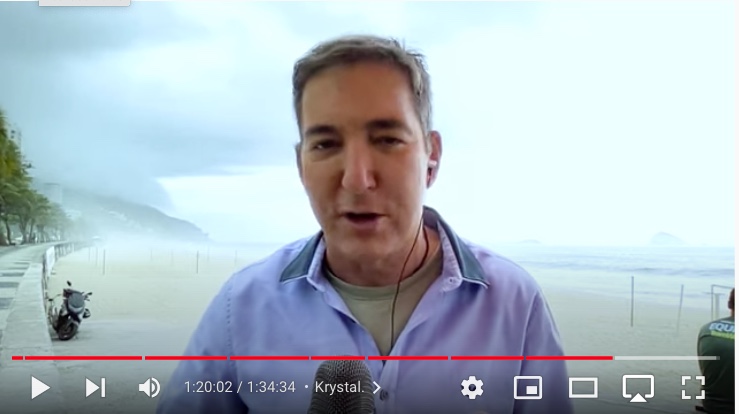
At Breaking Points, hosted by Saagar and Krystal, Glenn Greenwald explains the early warning signs that the Steele Dossier was fraudulent: 1) It was regurgitated cold war/McCarthyism BS, and 2) the narrative was supported only by anonymous sources touted by the spy state. Now we know the Steele Dossier was absolute bullshit concocted by the campaign of Hillary Clinton and that it went far and wide thanks to a credulous "news media," leading to the Mueller investigation.
The same news media outlets that enthusiastically pushed the Steele Dossier and all the subsequent Trump-Russian connection falsehoods have almost entirely been silent given the blockbuster news that they were pushing major falsehood for several years and that these falsehoods likely affected the way many people voted in national elections. As Greenwald notes, the legacy news media does not care that it got things so wrong, which is evidence that they were intentionally misleading their audience. This conversation begins at about the 1:20:00 mark:
But we have found a number of instances of coverage that was not as rigorous as it should have been. In some cases, information that was controversial then, and seems questionable now, was insufficiently qualified or allowed to stand unchallenged. Looking back, we wish we had been more aggressive in re-examining the claims as new evidence emerged -- or failed to emerge.
The problematic articles varied in authorship and subject matter, but many shared a common feature. They depended at least in part on information from a circle of Iraqi informants, defectors and exiles bent on ''regime change'' in Iraq, people whose credibility has come under increasing public debate in recent weeks. (The most prominent of the anti-Saddam campaigners, Ahmad Chalabi, has been named as an occasional source in Times articles since at least 1991, and has introduced reporters to other exiles. He became a favorite of hard-liners within the Bush administration and a paid broker of information from Iraqi exiles, until his payments were cut off last week.) Complicating matters for journalists, the accounts of these exiles were often eagerly confirmed by United States officials convinced of the need to intervene in Iraq. Administration officials now acknowledge that they sometimes fell for misinformation from these exile sources. So did many news organizations -- in particular, this one.
. . . We consider the story of Iraq's weapons, and of the pattern of misinformation, to be unfinished business. And we fully intend to continue aggressive reporting aimed at setting the record straight.
The new version of the NYT has not learned any of the lessons from the WMD disaster. The now well-recognized collapse of the Steele Dossier is damning information regarding the Clinton campaign, the DNC and the news media. The left leaning legacy media at out of the hands of the U.S. spy state, failing to track down real information. They wanted to believe the Trump-Russia connection and that was good enough for printing stories they failed to vet.
I resisted using the term "fake news" when I first heard the phrase, but there is no getting around the fact that the left-leaning legacy media engaged in journalism malpractice--fake news--regarding most, if not all--Trump Russia stories that it produced.
Do I need to add that I despise Donald Trump? Even since he appeared on the political stage I have found him arrogant, narcissistic, corrupt and incompetent. I voted for two severely compromised candidates, Hillary Clinton and Joe Biden because I concluded that they were far less dangerous than Trump.
You know personally I’ve been achingly specific about my critiques of social justice politics, but fine - no woke, it’s a “dogwhistle” for racism. (The term “dogwhistle” is a way for people to simply impute attitudes you don’t hold onto you, to make it easier to dismiss criticism, for the record.) But the same people say there’s no such thing as political correctness, and they also say identity politics is a bigoted term. So I’m kind of at a loss. Also, they propose sweeping changes to K-12 curricula, but you can’t call it CRT, even though the curricular documents specifically reference CRT, and if you do you’re an idiot and also you’re a racist cryptofascist. Also nobody (nobody!) ever advocated for defunding the police, and if they did it didn’t actually mean defunding the police. Seems to be a real resistance to simple, comprehensible terms around here. . . . And for fuck’s sake, give me a simple term to use to address you. Please? Because right now it sure looks like you don’t want to be named because you don’t want to be criticized.
The production of knowledge thrives when universities value open inquiry, but recent trends in conformist thinking pose new threats to research, writing, and teaching. How do we combat conformist culture in our classrooms and research, while encouraging inquiry into unorthodox ideas? How can our epistemic institutions continue to seek and know truth? We were joined by HxA co-founder and Board Chair Jonathan Haidt for an in-depth discussion with Jonathan Rauch, author of The Constitution of Knowledge: A Defense of Truth.
As Rauch states in the teaser, the system doesn't work by magic. It requires all of us to participate in good faith:
What the fuck is happening to Democrats? We have tons of recent evidence telling us that the deep state exists and that it comprises anti-democratic poison coursing through our country's arteries.
Six or seven years ago, “Deep State” was a term you would only see in left-leaning media. Bill Moyers explored the theme on his site from time to time, and when The Nation asked Edward Snowden about it, he said, “There’s definitely a deep state. Trust me, I’ve been there.”
The “deep state” was on the liberal left’s front burner then because a spate of horrendously ugly revelations put it there. We learned via Snowden that the NSA was collecting the communications of people all around the world in secret (Carollo might want to mark down that congress wasn’t informed) in a program the U.S. Court of Appeals just last year declared illegal.
We found out top intelligence officials like CIA chief John Brennanand Director of National Intelligence James Clapper lied to congress, among other things about the warrantless surveillance program, and got away without perjury charges despite a furious outcry from legislators (another useful factoid for Carollo, on the oversight front). We learned about the CIA’s systematic use of torture techniques, ranging from anal feeding to threatening to rape and murder relatives to induced hypothermia, another fun set of pastimes the agency decided not to burden congress with knowledge of. . . . Pre-Trump, all of this spoke to the worst nightmares of American liberalism. Millions of Boomers and Gen-Exers alike had grown up worshipping at the altar of Miranda and Mapp v. Ohio, believing the ideas of due process and transparency inviolable. . . .
Young or not, the average commentator now is both committed to forgetting the sordid history of agencies like the CIA, and perfectly equipped mentally to keep that commitment. . . .
Then Trump arrived. Almost immediately, it was obvious his historical destiny was to be the best thing that ever happened to the secret services. In the same way hydroxychloroquine became snake oil the instant Trump said he was taking it, the “Deep State” became a myth the moment Trump and his minions started talking about it. Deep state warriors like Brennan, Clapper, and former CIA chief Michael Hayden, held in near-universal disdain before as some of the world’s most loathsome people, people so morally ugly it showed on their hideous faces, became immediately respectable by rebranding themselves as Trump critics. The early Trump years, in fact, made heroes of every tumescent peeping-Tom creep and spook in the federal register, now cast in the press as democracy’s infantry, saving the world through intercepts, informants, and leaks.
In a flash, programs that terrified American liberals previously, like FISA, became weapons of Holy War, in the ongoing campaign to Oust Trump via a succession of investigations and impeachment bids. When it came out that a known FBI informant spied on presidential candidate Trump, pundits not only cheered, they refused outright to call it spying.
. . . .
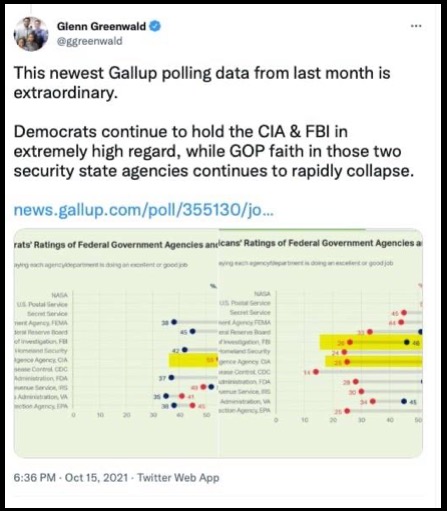
The cultural memories of the coming wave of media professionals extend back a few years at most. Most have read thousands more tweets than book pages. Their opinions come mainly from the dung-pile of popular news and are in sync with most Democrats, whom polls consistently show to have strong majority favorable views of the CIA and the FBI, a dramatic turnaround from the pre-Trump years. In fact, now that the War on Terror has ostensibly been reconfigured to target gun owners, white supremacists, and “insurrectionists,” they can scarcely remember why they ever felt negatively about the NSA or the folks at Langley, which of course makes them perfect for their jobs. In a dystopia, a good memory is just an inconvenience.
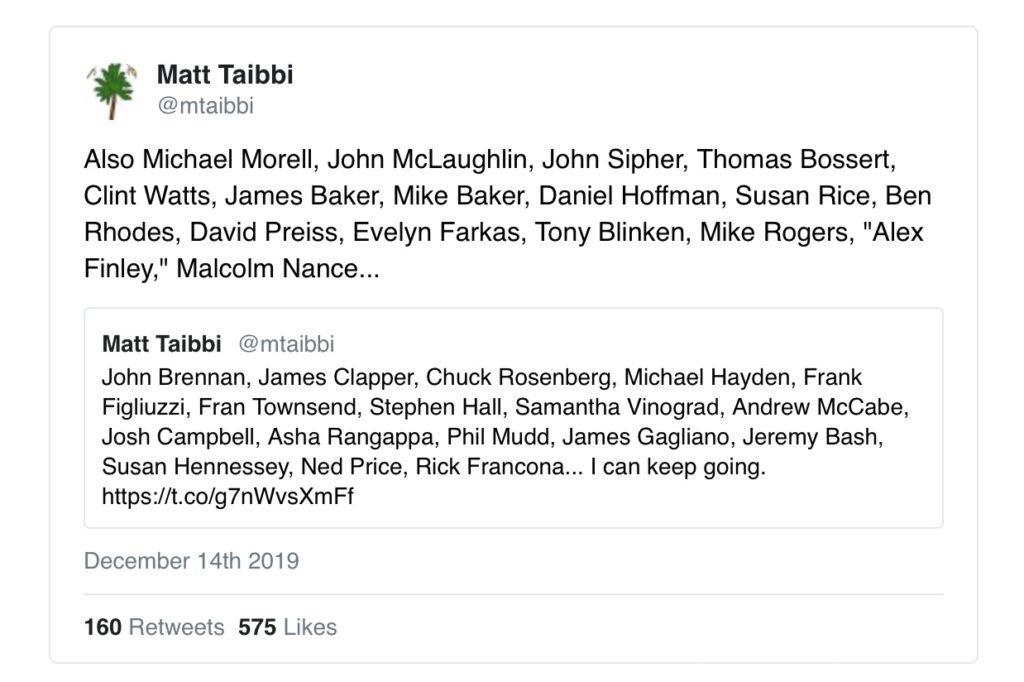
If this is not enough to make you cry a river, Taibbi reminds us that the liberal news media is infested with spooks:
Now, just like any other tinpot third-world country, we get our news directly from secret agents. I made a list once:
Hello, I invite you to subscribe to Dangerous Intersection by entering your email below. You will have the option to receive emails notifying you of new posts once per week or more often.