
United corporations of America

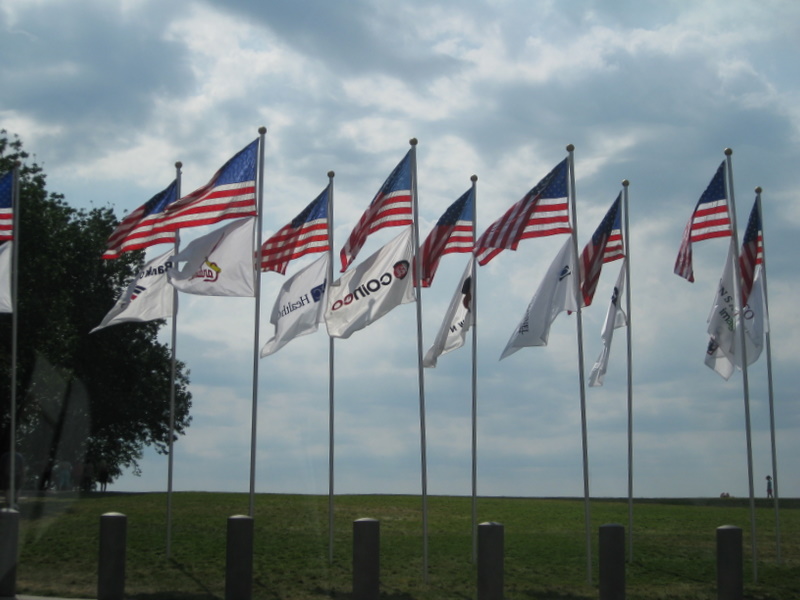
As part of the biggest Fourth of July celebration in St. Louis, Missouri, one could see corporate flags waving on the same staffs as American flags, which is apparently exactly where they belong. To me, this arrangement symbolizes the almost complete corporate take-over of the United States. Photo by Erich Vieth We’re in an ominous environment right now. We have a thoroughly corrupt Congress (Dick Durbin: “The banks frankly own the place”) and a Supreme Court filled with corporation-idolizing free market fundamentalists. If you think it’s already bad, here’s what’s about to happen. This upcoming ruling by the United States Supreme Court will make clean money legislation unworkable. Citizens United was apparently just the beginning of a terrible trend. There are relatively few politicians speaking up with passion. Sheldon Whitehouse is one of the few. We need massive marches across America. We need millions of people to turn off their damned TVs and iPods and get up and march, but I don't see it happening. Most of the people I talk with don't care that money buys elections, even while they go to Fourth of July celebrations and give lip service to "America is the world's greatest country."
Continue ReadingUnited corporations of America

How much has the Wall Street bailout cost American taxpayers?

How much have U.S. taxpayers paid to bail out Wall Street? Here are many of the details, but note that $2.02 trillion remains outstanding. Also keep in mind that the TARP payments were only 10% of the total U.S. aid given to Wall Street. Be wary, then, when you hear Wall Street crowing that it has paid back much of the TARP money. Dylan Ratigan puts the topic in perspective.

Continue ReadingHow much has the Wall Street bailout cost American taxpayers?

Book Review: Nothing to Envy

Summary: A chilling portrait of everyday life in the world's most fanatically totalitarian state. When the Cold War ended, communism came tumbling down worldwide. The Soviet Union disintegrated, the Warsaw Pact nations joined the West, and though China's authoritarian government still stands, its economy has become capitalist in all but name. But one true communist state still exists, defiant in its isolation, sealed off from the outside world by almost impenetrable barriers. That state is North Korea, the topic of Barbara Demick's superb book Nothing to Envy. By interviewing some of the few who've successfully escaped, Demick weaves a frighteningly compelling narrative of what everyday life is like in the world's most brutal and reclusive dictatorship. Isolated from the outside world, North Korea has developed into a cult of personality rivaling anything found in the most fanatical religion. Its first president, Kim Il-sung, and his son and successor Kim Jong-il aren't just the absolute rulers of the country, they're hailed as divine saviors, literally able to perform miracles:

Continue ReadingBook Review: Nothing to Envy

Mel Gibson and the Problem of Public Privacy

So Mel Gibson has been exposed (once again) as an intolerant, sexist, abusive person. A recording of a phone conversation with his former girlfriend is now Out There on the internet and one can listen to Mel spill molten verbiage into her earpiece while she calmly refutes his charges. All I can wonder is, So what? What business is this of ours? This is private stuff. People lose control. Between each other, with strangers, but more often with those closest, people have moments when the mouth ill-advisedly opens and vileness falls out. The question is, does this define us? Are we, in fact, only to be defined by our worst moments? That would seem to be the case for people like Gibson. The reason, I think, is that for most of us, the Mel Gibsons of the world have no business having shitty days and acting like this. For most of us, there is just cause for having these kinds of days and attitudes, because for most of us the world is not our oyster and we do not have the luxury of squandering time, friends, and money. Mel Gibson is wealthy and famous and, at one time, admired. He ate at the best restaurants, appeared on television, gave interviews, has his picture on the covers of magazines. Is seen with other people, regularly, who fall into that category of Those Who Have It Made.

Continue ReadingMel Gibson and the Problem of Public Privacy