Jeffrey Sachs recently appeared at an Occupy Wall Street protest and explained that there are still "normal" countries where companies merely do business and they don't try to run the government. That is what we need here in the United States, and Sachs believes that the People can take back their government. He has much else to say on sustainable living, media, corporate misinformation, campaign finance reform, warmongering, the top 99%, typical folks who are unwittingly doing the bidding of billionaires, candidates who need to swear off big money, and the fact that big money has thoroughly Barack Obama. Sachs has just written a new book: The Price of Civilization: Reawakening American Virtue and Prosperity.
Kleptocracy, alternatively cleptocracy or kleptarchy, (from Ancient Greek: κλέπτης (thief) and κράτος (rule), "rule by thieves") is a form of political and government corruption where the government exists to increase the personal wealth and political power of its officials and the ruling class at the expense of the wider population, often without pretense of honest service. This type of government corruption is often achieved by the embezzlement of state funds.
Regarding most issues, I get suspicious when I hear people say that if you're not part of the solution, you're part of the problem. This adage doesn't apply where the proposed solution doesn't really address the alleged problem. In the case of the Occupy Wall Street Occupations, though, I believe that this adage does apply.
The main focus of the protests is that large amounts of money have corrupted our political process. Consider whether there anything of value to democratic government where the deliberative process excludes citizen input and, instead, is driven by the highest bidder. As long as private money flows freely in our political system, there can't be meaningful discussion and decision-making. Where money drives the process of making political decisions--where the real decision-making occurs outside of public view along with promises of money--the citizens are left with only the cheap baubles of democracy: flag waving, saying pledges and lighting fireworks. It is for these reasons that those who fail to support this main concern of the Occupy protests are not for government for and by the People. If one is not for meaningful citizen input regarding the political process, one is against meaningful democracy. I haven't yet heard even the most right wing right winger assert that he/she is against democracy.
The problem with money in politics is mentioned so often that it sounds like a cliche, but money destroys government's ability to respond to the needs of its non-monied constituents. They are excluded from political deliberations.
But you keep hearing from politicians that money won't corrupt them. It's time for all of us to join with the Occupy protesters and respond to that claim by collectively shouting "Bullshit!" If I'm hungry and I'm considering eating either vegetables or a double cheeseburger and fries, the decision is hard enough without any money entering the process. I know, however, that if someone offered me $100 every time I ate the burger/fries, I'd start eating more burgers and fries. It would warp my judgment such that my decision would not be in tune with what I know to be the best decision. And when accused of letting money sway me, I would claim that the $100 had nothing to do with my decision-making.
That's what's going on in our Congress: money is driving decision-making and we are seeing our politicians making extraordinary numbers of terrible decisions, the crowning jewels of which are two extraordinarily unnecessary wars. Or is it the bailout of banks with no reform of the banking system? There are actually many other candidates. The power of money is so destructive to the deliberative process that even a highly idealistic candidate like Barack Obama has betrayed numerous promises he made during the campaign for no good reason. The list of Obama's failures is staggering: Ramping up Afghanistan, abandoning net neutrality, Wall Street non-reform, a health care plan that amounted to a bailout for the private insurers, continuation of the domestic spying programs of the Bush Administration, ramping up the "War on Drugs," and reckless compromise with Republicans regarding the Bush era tax cuts, domestic spending cuts. Thoughtful people don't simply give up well-considered positions on such important issues; rather, they sell out. That is how I interpret Obama's failures; he has become intoxicated by money.
It is my hope that the Occupy Protestskeep their focus on getting money out of the political process. This should be a bi-partisan issue, as indicated by Dylan Ratigan:
The Occupy Wall Street movement as well as the Tea Party Movement should agree: our Federal government is bought and sold and rarely represents the people. In our quest to get money out of politics, we are not beginning at square one. There has been an anti-corruption movement against the modern financing system since the 1970s, and we have many allies in this struggle. It is Citizens United and the bailouts, twin representatives that make corruption so explicit, that have shown us we must act. And it is the foreclosure crisis that suggests that if we do not act, we will be acted upon. Such is how Constitutional moments happen. Now it is up to us, the people, to make this our moment, as our forebears have in their moments of crisis.
But, again, we need to keep the focus on the free flow of money in the political process. It is the reason that honest deliberation of major issues are now impossible in Congress. John Nichols of The Nation explains in an article titled "The 99 Percent Rise Up":
The target is right. This has been a year of agitation, from Wisconsin to Ohio to Washington. It has seen some of the largest demonstrations in recent American history in defense of labor rights, public education, public services. But all those uprisings attacked symptoms of the disease. Occupy Wall Street named it. By aiming activism not at the government but at the warren of bankers, CEOs and hedge-fund managers to whom the government is beholden, Occupy Wall Street went to the heart of the matter. And that captured the imagination of Americans who knew Michael Moore was right when he finished his 2009 documentary Capitalism: A Love Story with an attempted citizen’s arrest of the bankers who not only avoided accountability after crashing the economy but profited from a taxpayer-funded bailout. Like the populists, the socialists and the best of the progressive reformers of a century ago, Occupy Wall Street has not gotten distracted by electoral politics; it has gone after the manipulator of both major parties—what the radicals of old referred to as “the money power.”
I occasionally listen to Rush Limbaugh's radio show because I consider it important to understand how it is that my views differ from those of people who oppose my views. Two days ago, I listened to Limbaugh bloviating about the people who are participating in the Occupy Protests springing up all over the United States. By some reports, there are more than 1,000 such protests ongoing, and they are actually occurring all over the world. Limbaugh announced, without hesitation, that these protesters are mostly unemployed, lazy, dirty, amoral, socially irresponsible and ignorant young people. Those who rely on Rush Limbaugh for their facts might thus be highly likely to object to these protests (including Occupy Wall Street) based on Limbaugh's description of the protesters. But is the description he gave to his many (though dwindling number of) listeners accurate? I had an opportunity to check this yesterday at the Occupy St. Louis protest in my hometown of St. Louis, Missouri.
Over the past few days, I've been quite occupied at my day job, and it was only while walking back to my law office from the federal courthouse at 4 pm yesterday that I spotted an organized march coming down Market Street in downtown St. Louis. I would estimate that there were almost 1,000 people marching. I didn't have my video camera with me, but I did have my Canon S95 pocket camera, so I got to work taking hand-held video and still shots of the protesters. Here's the finished product, which will allow you to actually meet the types of people who are participating in the Saint Louis Occupy protest. You can now be your own judge of what these protesters are like:
As you can see from the parade route pans and the interviews, none of these people fit the description given by Rush Limbaugh. Off camera, I asked most of the protesters about their "day jobs," and all of them indicated that they were gainfully employed, and in a wide variety of challenging fields. These "young" protesters of Occupy St. Louis ranged in age from 20's to their 80's. The on-camera statements of the people I interviewed show that they are well-informed, thoughtful, highly articulate and good-hearted. Many of the people I spoke with indicated that they are not going away. They have been waiting for a good time and place to express their deep concerns about the way our government works, and they have finally found what they've been looking for.
In case anyone is concerned that I intentionally skewed my sampling regarding who I interviewed, this was my method: I simply walked up to someone nearby and asked whether he or she would be willing to give a short statement about why they were attending the protest. I approached 12 people. One woman sympathetic to the protest apologized and said she couldn't talk on camera because she was a member of the news media. One man said that he supported the protest, but he'd rather not go on camera. Another man said he had never been part of a protest before, but he read about this protest recently and then said to himself, "Yeah, these people are right on these issues." The other nine people I approached agreed to give statements on camera. I'd like to thank each of these folks for taking the time to talk (I've listed their names in the order in which they appear in my video):
Al Vitale
Fred Raines (a retired economics professor, who said that he compiled the statistics displayed on one of the signs appearing on the video)
Apollonia Childs
Chrissy Kirchhoefer
Curtis Roberts
Michel Kiepe
Jeff Schaefer
Matt Ankney, and
Frances Madeson
Based on the above video, there is no lack of intellectual moorings for this protest. The focus is that our government, including politicians of both major parties, has been substantially bought by big business, and many destructive things are flowing from the consequent misuse of government power.
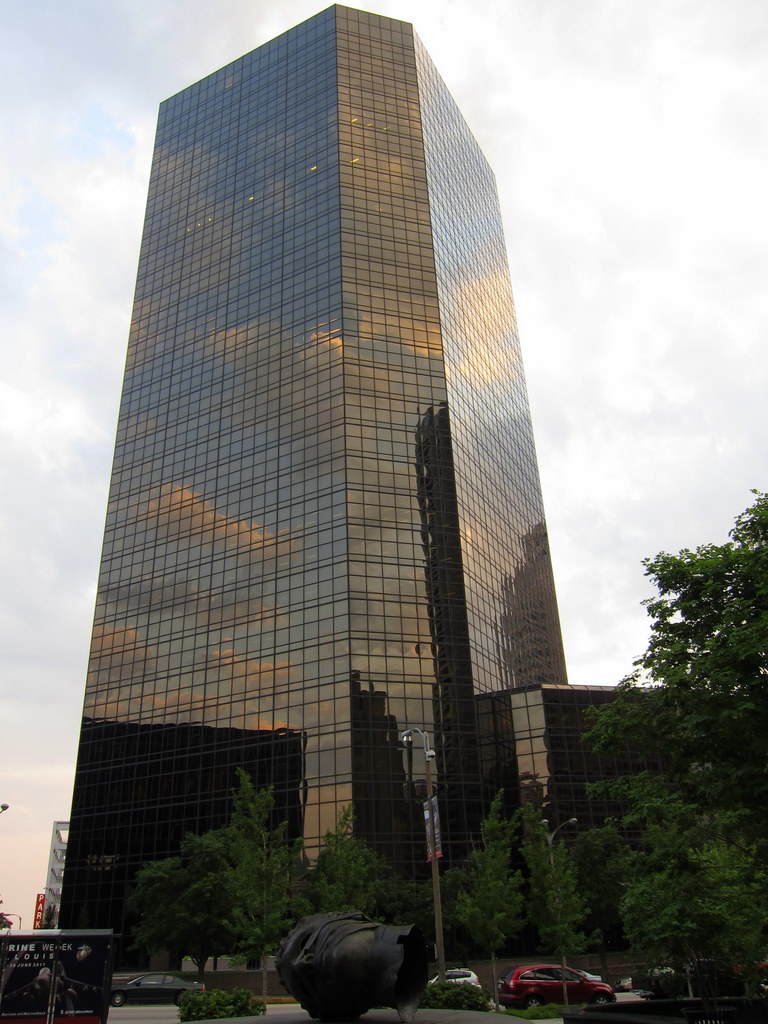
About a dozen protesters have have formed a camp in Kiener Plaza, a public gathering spot across the street from the towering downtown headquarters of Bank of America. I was told by several protesters that some of the camping protesters had been evicted from the camp over the past week, but that the intent is nonetheless maintain a presence in Kiener Plaza indefinitely. The Bank of America building has been the geographical focus of other recent protests, including this one in August, 2011. (A payday loan protest by a group called GRO occurred at this same bank last year--here's video). I should note that most of the people who work in the huge Bank of America building work for companies other than the Bank of America, yet the building remains a symbol of what has gone so very wrong with the political process.
I'd also like to mention that the St. Louis Police, who were out in the hundreds, were courteous and professional. The protesters were there merely to protest-to get their message out. There were no untoward incidents that would distract from the central message of the protests.
For more on yesterday's protest, see this description by St. Louis blogger Gloria Bilchik at Occasional Planet. See also, this post by another St. Louis blogger, Adam Shriver at St. Louis Activist Hub.
What do all of those people in the Wall Street towers actually do? You won't find them doing much of what most people think about when they hear the term "banking." The following description of the business of Wall Street is from Christopher Ketcham's "The Reign of One Percenters" at Orion Magazine:
At one time, the financial sector could be relied upon to allocate capital for the building of things that society needed—projects that also invariably created jobs. But productivity is no longer its purview. . . . Structured investment vehicles, credit default swaps, futures exchanges, hedge funds, complex securitization and derivative pools, the tranching of mortgages—these were shown to have “little or no long-term value,” according to [John Cassidy, a staff writer for The New Yorker]. The purpose was to “merely shift money around” without designing, building, or selling “a single tangible thing.” The One Percenter seeks only exchange value, as opposed to real value. Thus foreign exchange currency gambling has skyrocketed to seventy-three times the actual goods and services of the planet, up from eleven times in 1980. Thus the “value” of oil futures has risen from 20 percent of actual physical production in 1980 to 1,000 percent today. Thus interest rate derivatives have gone from nil in 1980 to $390 trillion in 2009. The trading schemes float disembodied above the real economy, related to it only because without the real economy there would be nothing to exploit.
Behold, then, the One Percenter in his Wall Street tower. He creates “value” by tapping on keyboards and punching in algorithms. He makes money playing with money, manipulating abstractions. He manufactures and chases after financial bubbles and then pricks them. . . . A study from the New Economics Foundation in England found that for every pound made in financial services in the city of London, roughly seven pounds of social wealth is lost—meaning the wealth of those in society who do productive work.
Hello, I invite you to subscribe to Dangerous Intersection by entering your email below. You will have the option to receive emails notifying you of new posts once per week or more often.