How to land a plane on a runway without landing gear
This is exactly how it should be done, according to these commentators. And speaking of airplanes, here's how you send a paper airplane on a longgg flight.

Noteworthy entries.
This is exactly how it should be done, according to these commentators. And speaking of airplanes, here's how you send a paper airplane on a longgg flight.
I took a few moments to Stumble around tonight (at Stumbleupon.com). I found a most unusual bedroom. And then this delightful worksheet on Fibonacci numbers. I learned a lot about stress over at Psychology Today. It's "worse than you think."
The experience of stress in the past magnifies your reactivity to stress in the future. So take a nice deep breath and find a stress-stopping routine this instant. . . . We may respond to stress as we do an allergy. That is, we can become sensitized, or acutely sensitive, to stress. Once that happens, even the merest intimation of stress can trigger a cascade of chemical reactions in brain and body that assault us from within. Stress is the psychological equivalent of ragweed. Once the body becomes sensitized to pollen or ragweed, it takes only the slightest bloom in spring or fall to set off the biochemical alarm that results in runny noses, watery eyes, and the general misery of hay fever. But while only some of us are genetically programed to be plagued with hay fever, all of us have the capacity to become sensitized to stress.How does one best relief stress? Here are several tried and true ways. But then off I was, learning how to close a bag without a bag clip. And I learned in disarming detail how the TSA is keeping us "safe." And then I stumbled onto an article told me how to disappear. And here is a really cool photo of Albert Einstein Marilyn Monroe. Speaking of illusions, it is claimed that this cube illusion will work on you only once, and I believe that. But the last thing I stumbled onto tonight was the most spectacular. These are 24 scanning microscope photos from a book called Microcosmos by Brandon Brill. These photos are stunning. Thank you, Brandon Brill. Thank you, Stumbleupon, for a delightful 30-minute journey.
I spent an hour this evening fixing an appliance that I bought at a yard sale many years ago for a coin. Not only that, but I solely and regularly use this appliance for my daily work. You may wonder, how do I use a potpourri crock pot for work? As the heater part of a small double boiler for an etchant that can eat through glass or titanium, of course.
And what can go wrong with a crock pot? Well, this one has been dropped a couple of times. But the crack was dealt with well enough some years ago by a liberal application of Acrylic monomer (Super Glue).
 So what was wrong now? The crack had weakened the heating element (the hair-thin Ni-chrome filament) and it finally burned through.
So I took the thing apart and spliced in a bit of brass wire that I had lying around. That delicate job turned out to be the easy part, given strong magnifying goggles, tiny tools, and decades of fix-it experience.
But these diabolical inexpensive units are designed to not-be reassembled. They had actually added an extra part to the design to make reassembly impossible. It took me over a half hour to outwit the designers and get the base re-attached in a manner that would let me take it apart again in the future.
For a dozen tax-deductible dollars I can have a new one delivered to my house via eBay. Why do I regularly chose to repair disposable appliances?
My parents both went through economic times much worse than the U.S. Depression, each losing nearly everything but their lives. They raised me with essential parsimony. Not actual deprivation, mind you. Just a frugal mindset that pervades my being.
But now I have predictable (if meager) income, and no debt. I have money in the bank, and could afford nice things. But it just feels wasteful to throw away something that I can fix. I mentioned this in "How Does a Microwave Work?"
Things I no longer need may end up on eBay. I usually net less than minimum wage for my time on most of these sales. But the widget/parts/book gets a new life with someone who really wants it, and the post office makes some money.
Yet I regularly ask myself, "Is it worth it?"
So what was wrong now? The crack had weakened the heating element (the hair-thin Ni-chrome filament) and it finally burned through.
So I took the thing apart and spliced in a bit of brass wire that I had lying around. That delicate job turned out to be the easy part, given strong magnifying goggles, tiny tools, and decades of fix-it experience.
But these diabolical inexpensive units are designed to not-be reassembled. They had actually added an extra part to the design to make reassembly impossible. It took me over a half hour to outwit the designers and get the base re-attached in a manner that would let me take it apart again in the future.
For a dozen tax-deductible dollars I can have a new one delivered to my house via eBay. Why do I regularly chose to repair disposable appliances?
My parents both went through economic times much worse than the U.S. Depression, each losing nearly everything but their lives. They raised me with essential parsimony. Not actual deprivation, mind you. Just a frugal mindset that pervades my being.
But now I have predictable (if meager) income, and no debt. I have money in the bank, and could afford nice things. But it just feels wasteful to throw away something that I can fix. I mentioned this in "How Does a Microwave Work?"
Things I no longer need may end up on eBay. I usually net less than minimum wage for my time on most of these sales. But the widget/parts/book gets a new life with someone who really wants it, and the post office makes some money.
Yet I regularly ask myself, "Is it worth it?"
My law office recently moved to a new building in downtown St. Louis, Missouri. We're now on the 17th floor, and we have unobstructed views in many directions. That led to conversations about how far we could actually see. That led to the purchase of a good set of 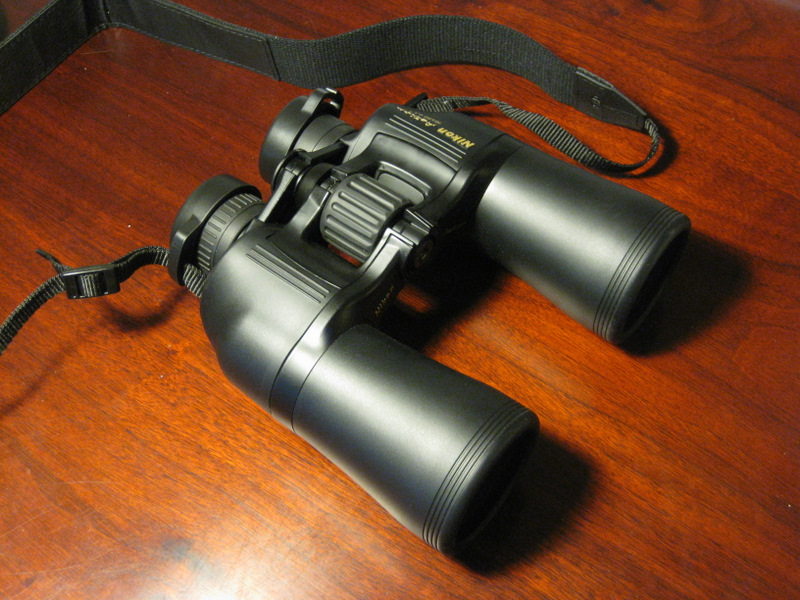 binoculars (we bought a pair of Nikon 7223 16 x 50 mm binoculars at Amazon for about $100). We also invested in a tripod for the binoculars (another $24). This equipment has led to some rather surprising discoveries.
For instance, we can clearly see the McKinley Bridge, which is almost three miles away. Aiming upwards, we can clearly see the Chain of Rocks Bridge, which is almost ten miles away. We can clearly see the Mississippi water flowing under both of these bridges.
Looking even further in the distance, we can see several manmade structures in Alton, Illinois. That is 35 miles away by car, at least 25 miles away by air. Alton is also on the Mississippi River. We can't see the river itself in Alton; the structures we can see are on elevated land past the river on the Illinois side. These sites are all to the north--we have yet to explore the other vistas.
binoculars (we bought a pair of Nikon 7223 16 x 50 mm binoculars at Amazon for about $100). We also invested in a tripod for the binoculars (another $24). This equipment has led to some rather surprising discoveries.
For instance, we can clearly see the McKinley Bridge, which is almost three miles away. Aiming upwards, we can clearly see the Chain of Rocks Bridge, which is almost ten miles away. We can clearly see the Mississippi water flowing under both of these bridges.
Looking even further in the distance, we can see several manmade structures in Alton, Illinois. That is 35 miles away by car, at least 25 miles away by air. Alton is also on the Mississippi River. We can't see the river itself in Alton; the structures we can see are on elevated land past the river on the Illinois side. These sites are all to the north--we have yet to explore the other vistas.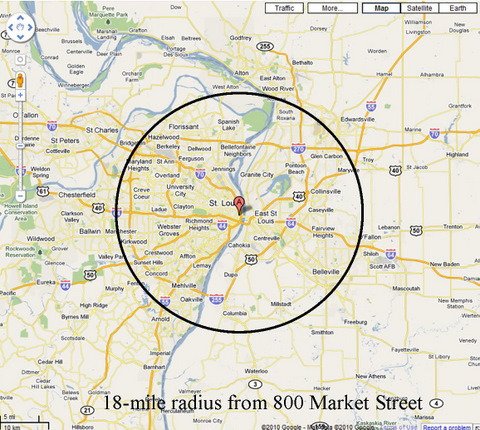 I didn't know that you could see so far with a good set of binoculars. Rumor has it that one can even see the moon, which is a quarter million miles away. More seriously, and much more impressive, I'm waiting for a clear night to train the binoculars onto Jupiter; it is apparently easy to see the four largest moons of Jupiter from Earth using only binoculars.
Back down to earth the question arises: how far can one see, before the Earth's curvature drops the scene too far down? There are formulas to calculate this distance. Assuming the land is relatively flat, the answer depends on how high one's eye are above the ground. Up on the 17th floor, we can supposedly see more than 16 miles over flat ground. Assuming most of that view is not blocked by other buildings, this gives us the ability to "see" (based upon the formula A= pi times r(squared). With a radius of 16, we can see an area of more than 800 square miles, an impressive area of land (I designated a reference-area based upon an 18 mile radius on the attached map).
I'll end this post here. I'm now a king ruling over a large kingdom, and my subjects need me to keep a careful lookout.
I didn't know that you could see so far with a good set of binoculars. Rumor has it that one can even see the moon, which is a quarter million miles away. More seriously, and much more impressive, I'm waiting for a clear night to train the binoculars onto Jupiter; it is apparently easy to see the four largest moons of Jupiter from Earth using only binoculars.
Back down to earth the question arises: how far can one see, before the Earth's curvature drops the scene too far down? There are formulas to calculate this distance. Assuming the land is relatively flat, the answer depends on how high one's eye are above the ground. Up on the 17th floor, we can supposedly see more than 16 miles over flat ground. Assuming most of that view is not blocked by other buildings, this gives us the ability to "see" (based upon the formula A= pi times r(squared). With a radius of 16, we can see an area of more than 800 square miles, an impressive area of land (I designated a reference-area based upon an 18 mile radius on the attached map).
I'll end this post here. I'm now a king ruling over a large kingdom, and my subjects need me to keep a careful lookout.
A chuckling acquaintance recently talked up a television show called "Bully Beatup. The idea of the show is that victims of bullies report the bullies to the producers of "Bully Beatdown." The show's host, Jason "Mayhem" Miller, offers the over-confident bully $10,000 to get into a cage with a highly-skilled mixed martial artist. In sum, then, the idea is to see a highly-skilled fighter beat the shit out of a neighborhood bully. There are some rules:
Each fight features two three-minute rounds: the first consists of grappling (no striking allowed), and the second round involves kickboxing. The bullies begin each round with $5,000 in potential earnings; each time the bully taps out in the first round, $1,000 of his potential earnings go to the victim, and if the fight is stopped in the second round by KO, TKO, or referee, the bully loses the entire sum. In the unlikely scenario that the bully can KO the MMA fighter, he wins money in addition to his first round earnings and the $5,000 from the second round.If you're in a mood for schadenfreude check it out. This episode lays out the method of the payback, and presents the case of "Vince" the nightmare roommate. A highly confident 6 foot 7 Vince ends of facing an imposing fighter named Michael Westbrook, formerly an NFL wide receiver with tae kwon do and other martial arts training. I suppose that we need shows like this to serve as a counter-weight to less visceral approaches to conflict, such as love thy neighbor. This show is painful to watch, even when the bully gets what he has coming, but immensely memorable.