
Noteworthy entries.

Eagle days on the Mississippi River

Although St. Louis was founded as a fur trading post, it is no longer well known as a place to view wildlife. But you can still spot wildlife. Yesterday my family traveled about 10 miles north of downtown St. Louis to the "Old Chain of Rocks Bridge," which spans the Mississippi River.
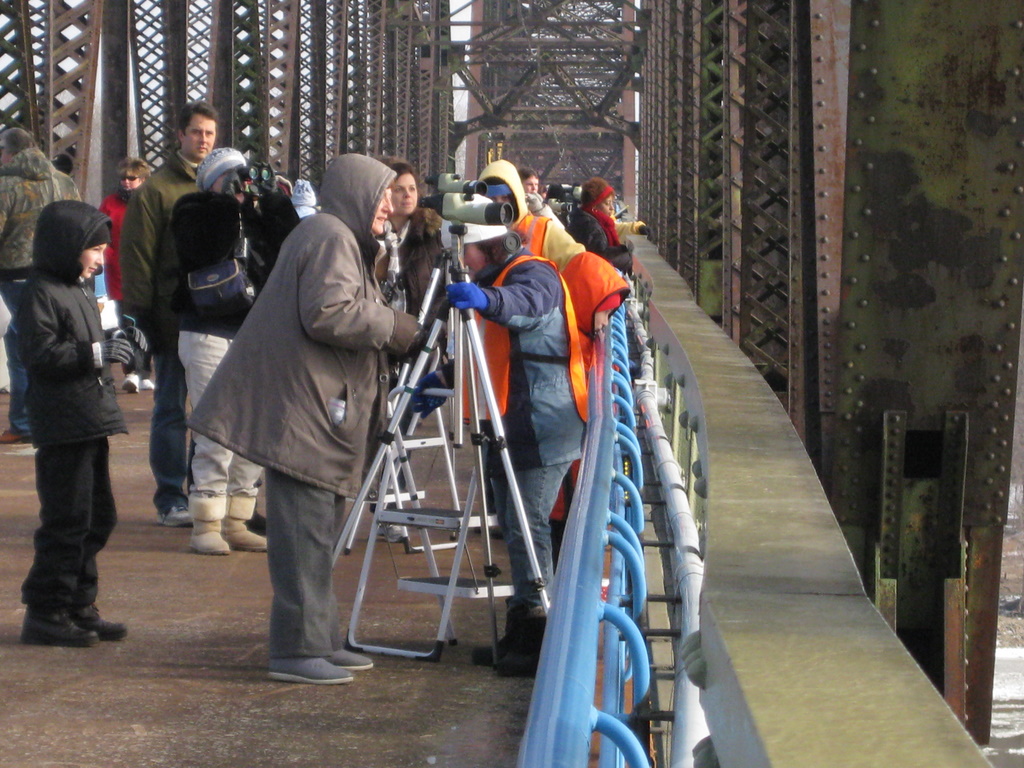
The bridge was for a time the route used by U.S. Route 66 to cross over the Mississippi. Its most notable feature is a 22-degree bend occurring at the middle of the crossing, necessary to allow river traffic to have uninterrupted navigation on the river. Originally a motor route, the bridge now carries walking and biking trails over the river. The bridge was added to the National Register of Historic Places in 2006.

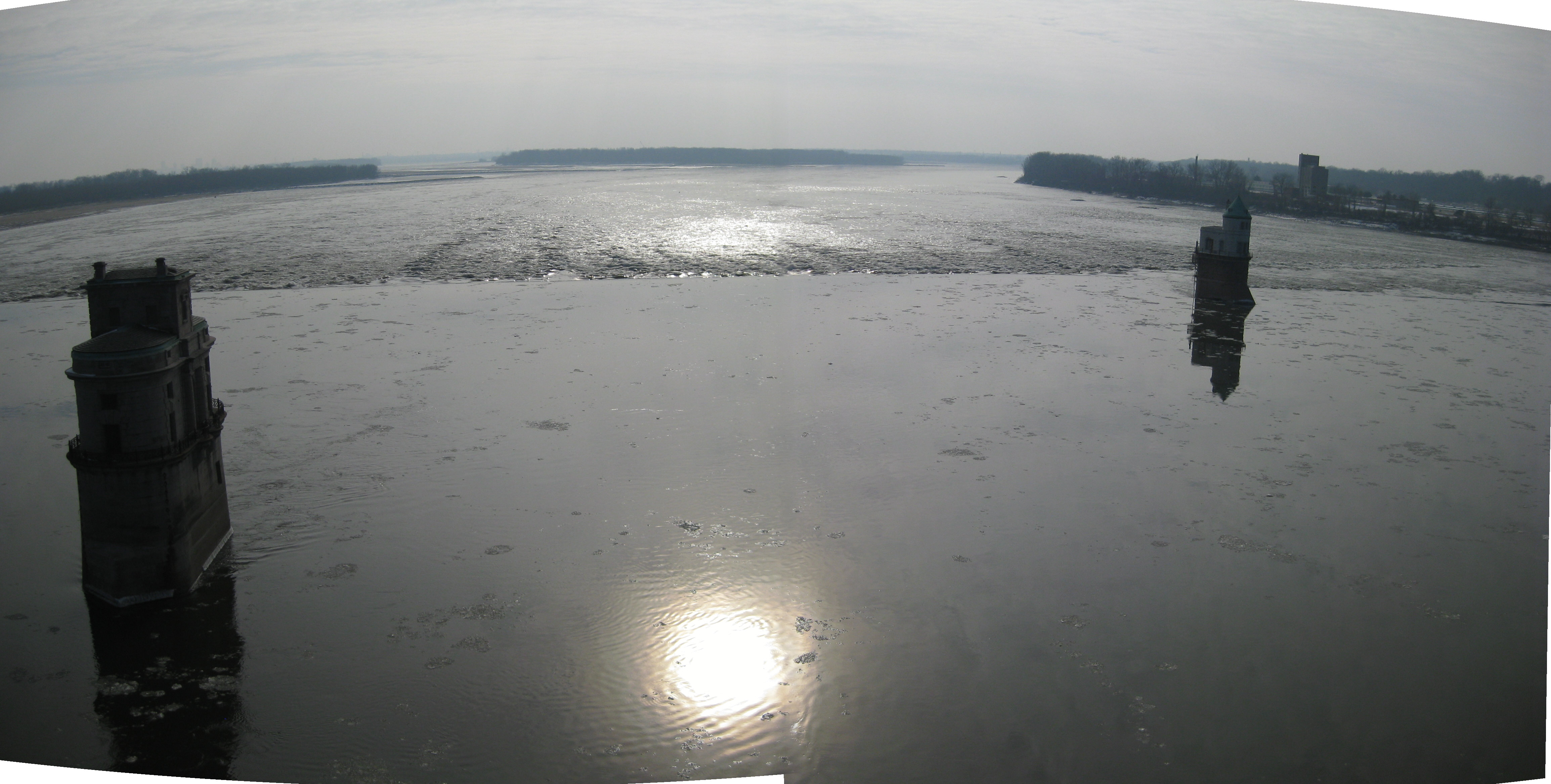
I do need to add that this was a brilliant use of an old narrow bridge. Click on the thumbnail for a panorama showing the view south from the bridge (Downtown St. Louis is on the horizon to the left). The bridge is located in a big wide relatively quiet area (except for one other bridge that runs parallel), where one can enjoy the Mississippi River and the surrounding undeveloped areas, just north of the Chain of Rocks rapids and a bit south of the confluence between the Missouri and Mississippi Rivers. For one weekend each year, this wonderful bridge is featured as the venue for Eagle Days, a prime spot for viewing American bald Eagles. This is rather cool, to be able to spot wild bald eagles right in the heart of the Midwest. Here's a bit more description of their migration relevant to the Mississippi. [More . . . ]
Continue ReadingEagle days on the Mississippi River

The cigarette industry is even more evil than we thought

According to Scientific American, there are more dangers to smoking cigarettes than tar and nicotine. There's also polonium:

[P]eople worldwide smoke almost six trillion cigarettes a year, and each one delivers a small amount of polonium 210 to the lungs. Puff by puff, the poison builds up to the equivalent radiation dosage of 300 chest x-rays a year for a person who smokes one and a half packs a day.  Although polonium may not be the primary carcinogen in cigarette smoke, it may nonetheless cause thousands of deaths a year in the U.S. alone. And what sets polonium apart is that these deaths could be avoided with simple measures.
The print edition of this article reveals that most of the polonium could be removed from cigarettes by removing it from the fertilizer and by washing the tobacco leaves with a dilute solution of hydrogen peroxide. What follows is an old sad story: the tobacco industry has long refused to incorporate these changes to reduce the polonium. The good news is that the Family Smoking Prevention and Tobacco Control Act, passed in June 2009, requires the tobacco industry to address this problem, which it has ignored for more than four decades. Now let's be conservative with the numbers. Let's assume that only 2,500 people needlessly died each year from polonium poisoning for the past 40 years. That's 100,000 people who have been sent to early deaths by tobacco executives. That's the moral equivalent of dropping an atomic bomb on Green Bay, Wisconsin. Yet no tobacco executives have ever been prosecuted, much less thrown in prison for this hideous conduct.

Continue ReadingThe cigarette industry is even more evil than we thought

Substitute NYT for Wikileaks and substitute Iran for the United States

Wikileaks continues to be punished for being one of the few organizations brash enough to inform us what our governments are really doing and why. This is intolerable, of course, because the U.S. government is being run by big corporations and wealthy people who, for the most part, are driven by greed--so sorry to break this to the kids who are studying civics in grade school, where they don't tell you about armies of lobbyists, and they don't tell you that the banks own Congress. The true powers that be are running the federal government in secret and they are, regrettably, running it into the ground. That's what one should expect when there is no sunshine to keep powerful people accountable. What we have is a needlessly warmongering, debt-ridden secret and personally invasive brave new government.   I truly wish I didn't believe these things. Consider that our government first attacked Wikileaks by starving it financially, despite the lack of any charges filed against it. They did this by harassing Amazon and various financial organizations to make sure that Wikileaks had no funds to fight in Round II, which is underway. We now know that there are secret subpoenas being issued by the US, and thank goodness that Twitter had the decency to inform its users that their privacy is being invaded, unlike the big U.S. telecoms, who have a long documented track record for turning over our private information without informing us (encouraged very much by President Obama's agreement to grant them retroactive immunity for past invasions of our privacy.  Julian Assange sums up the current grand jury proceedings like this, and we know of this only because the U.K. Guardian has continually refused to be the lapdog of the U.S.:

The emergence of the Twitter subpoena – which was unsealed after a legal challenge by the company – was revealed after WikiLeaks announced it believed other US Internet companies had also been ordered to hand over information about its members' activities. WikiLeaks condemned the court order, saying it amounted to harassment. "If the Iranian government was to attempt to coercively obtain this information from journalists and activists of foreign nations, human rights groups around the world would speak out," Assange said in a statement.
Glenn Greenwald comments further:
It's worth recalling -- and I hope journalists writing about this story remind themselves -- that all of this extraordinary probing and "criminal" investigating is stemming from WikiLeaks' doing nothing more than publishing classified information showing what the U.S. Government is doing: something investigative journalists, by definition, do all the time. And the key question now is this: did other Internet and social network companies (Google, Facebook, etc.) receive similar Orders and then quietly comply? It's difficult to imagine why the DOJ would want information only from Twitter; if anything, given the limited information it has about users, Twitter would seem one of the least fruitful avenues to pursue. But if other companies did receive and quietly comply with these orders, it will be a long time before we know, if we ever do, given the prohibition in these orders on disclosing even its existence to anyone. UPDATE III: Iceland's Interior Minister, Ögmundur Jónasson, described the DOJ's efforts to obtain the Twitter information of a member of that country's Parliament as "grave and odd." While suggesting some criticisms of WikiLeaks, he added: "if we manage to make government transparent and give all of us some insight into what is happening in countries involved in warfare it can only be for the good."

Continue ReadingSubstitute NYT for Wikileaks and substitute Iran for the United States