The History of Modern Stupidity and the Scourge of the Polarized Hidden Sub-Tribes

Jonathan Haidt offers a retrospective and a vision in his recent article: "WHY THE PAST 10 YEARS OF AMERICAN LIFE HAVE BEEN UNIQUELY STUPID. It’s not just a phase."

But first of all, who is making most of the noise in America?

The “Hidden Tribes” study, by the pro-democracy group More in Common, surveyed 8,000 Americans in 2017 and 2018 and identified seven groups that shared beliefs and behaviors. The one furthest to the right, known as the “devoted conservatives,” comprised 6 percent of the U.S. population. The group furthest to the left, the “progressive activists,” comprised 8 percent of the population. The progressive activists were by far the most prolific group on social media: 70 percent had shared political content over the previous year. The devoted conservatives followed, at 56 percent.

These two extreme groups are similar in surprising ways. They are the whitest and richest of the seven groups, which suggests that America is being torn apart by a battle between two subsets of the elite who are not representative of the broader society. What’s more, they are the two groups that show the greatest homogeneity in their moral and political attitudes. This uniformity of opinion, the study’s authors speculate, is likely a result of thought-policing on social media: “Those who express sympathy for the views of opposing groups may experience backlash from their own cohort.” In other words, political extremists don’t just shoot darts at their enemies; they spend a lot of their ammunition targeting dissenters or nuanced thinkers on their own team. In this way, social media makes a political system based on compromise grind to a halt.

Here is a glimmer of hope because we have now identified the problem (and see here):

The story i have told is bleak, and there is little evidence to suggest that America will return to some semblance of normalcy and stability in the next five or 10 years. Which side is going to become conciliatory? What is the likelihood that Congress will enact major reforms that strengthen democratic institutions or detoxify social media?

Yet when we look away from our dysfunctional federal government, disconnect from social media, and talk with our neighbors directly, things seem more hopeful. Most Americans in the More in Common report are members of the “exhausted majority,” which is tired of the fighting and is willing to listen to the other side and compromise. Most Americans now see that social media is having a negative impact on the country, and are becoming more aware of its damaging effects on children.

Will we do anything about it?
Continue ReadingThe History of Modern Stupidity and the Scourge of the Polarized Hidden Sub-Tribes

Jesse Singal: Transgender Puberty Blocker and Hormone Research Fails to Justify Their Use

Jesse Singal analyzes new research regarding puberty blockers and hormones used by researchers to promote their use. He concerned that the researchers have been dishonest. Here is an excerpt from his article: "Researchers Found Puberty Blockers And Hormones Didn’t Improve Trans Kids’ Mental Health At Their Clinic. Then They Published A Study Claiming The Opposite.". Here is an excerpt:

All the publicity materials the university released tell a very straightforward, exciting story: The kids in this study who accessed puberty blockers or hormones (henceforth GAM, for “gender-affirming medicine”) had better mental health outcomes at the end of the study than they did at its beginning.

The headline of the emailed version of the press release, for example, reads, “Gender-affirming care dramatically reduces depression for transgender teens, study finds.” The first sentence reads, “UW Medicine researchers recently found that gender-affirming care for transgender and nonbinary adolescents caused rates of depression to plummet.” All of this is straightforwardly causal language, with “dramatically reduces” and “caused rates… to plummet” clearly communicating improvement over time.

. . .

What’s surprising, in light of all these quotes, is that the kids who took puberty blockers or hormones experienced no statistically significant mental health improvement during the study. The claim that they did improve, which was presented to the public in the study itself, in publicity materials, and on social media (repeatedly) by one of the authors, is false.

It’s hard even to figure this out from reading the study, which omits some very basic statistics one would expect to find, but the non-result is pretty clear from eTable 3 in the supplementary materials, which shows what percentage of study participants met the researchers’ thresholds for depression, anxiety, and self-harm or suicidal thoughts during each of the four waves of the study:

Among the kids who went on hormones, there isn’t genuine statistical improvement here from baseline to the final wave of data collection. At baseline, 59% of the treatment-naive kids experienced moderate to severe depression. Twelve months later, 56% of the kids on GAM experienced moderate to severe depression. At baseline, 45% of the treatment-naive kids experienced self-harm or suicidal thoughts. Twelve months later, 37% of the kids on GAM did. These are not meaningful differences: The kids in the study arrived with what appear to be alarmingly high rates of mental health problems, many of them went on blockers or hormones, and they exited the study with what appear to be alarmingly high rates of mental health problems.

. . .

Despite the fact that two of the authors worked at Seattle Children’s Hospital, where the gender clinic is based, the paper doesn’t include a single word of even informed speculation attempting to explain why some kids accessed GAM and others did not. Nor do the authors seem to notice that by the end of the study, the no-GAM group has dwindled to a grand total of six kids who reported mental health data, as compared to 57 in the group receiving treatment.

Adding intrigue to this situation, the researchers are refusing to release their raw data. Singal does a deep-dive the substantiate his conclusion that the conclusions of the researchers are not substantiated by this research. The problems with this "research" are overwhelming and Jesse Singal offers line and verse on the many questions, lack of questions and holes. Too bad many legacy media outlets lap up unsubstantiated results on this topic produced by so many biased "researchers."

Continue ReadingJesse Singal: Transgender Puberty Blocker and Hormone Research Fails to Justify Their Use

Douglas Murray: Black Lives Matter Started with a Good Cause, Then Turned it Into a Racket

Douglas Murray, writing in the New York Post:, is concerned about the factually defective positions taken by Black Lives Matter as well as its highly questionable financials:

Like the most fraudulent pastors, the heads of BLM take advantage of good people. They present an undeniably good cause. They prey on people’s hopes and fears. After all, who in America does not believe that black lives matter? Who wouldn’t have sympathy with, or support, a group that claims to want to help people fight injustice? But BLM operates like all rackets do.

Firstly, they lie about reality. In the case of BLM, they pretend that black people in the United States in 2022 can be killed at any time by the police. They pretend that racism is a pandemic in this country and that everything and anything must be done to tackle it.

The effects of this work is there for all to see. The American public has been misled about the real state of race in this country. A poll in 2020 asked Americans how many unarmed black men they think are killed by the police in America the previous year. More than a fifth of people who described themselves as “very liberal” said they thought it was over 10,000 unarmed black people in America killed by police every year. Among self-described “liberals,” around 40% said they thought that the figure was somewhere between 1,000 and 10,000. The actual figure was around 10. Meaning that liberals in America were off by several orders of magnitude. They had a completely wrongheaded idea of what America is actually like.

But no wonder. For they had spent years hearing BLM pretend that black people are killed with impunity in this country.

Murray then turns to BLM's financial misdeeds, including recent revelations that BLM purchased a "purchase of a swanky new $5.8 million mansion in Southern California."

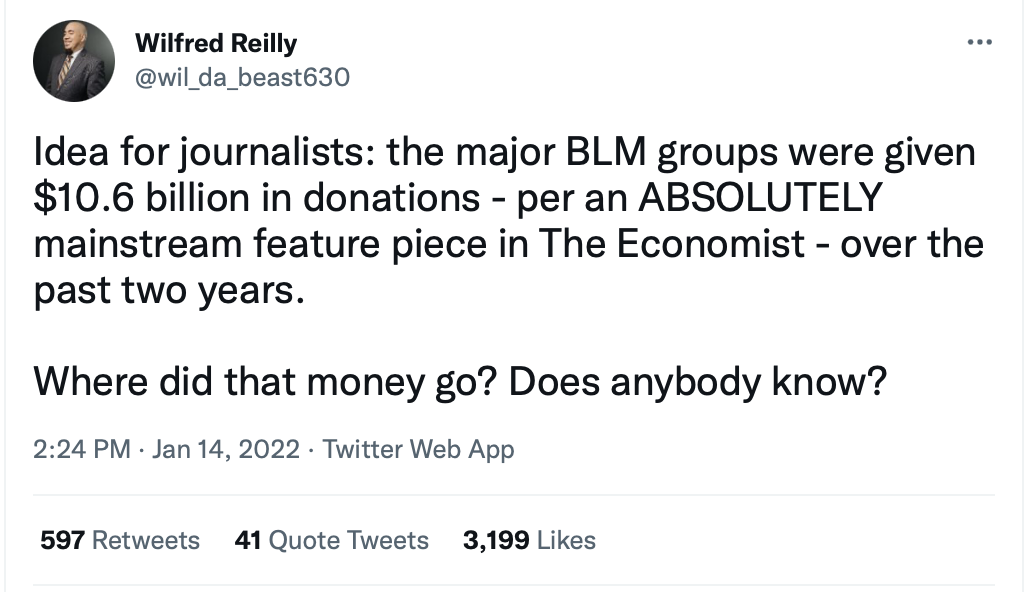
Other commentators have been highly critical of BLM, including Wilfried Riley:

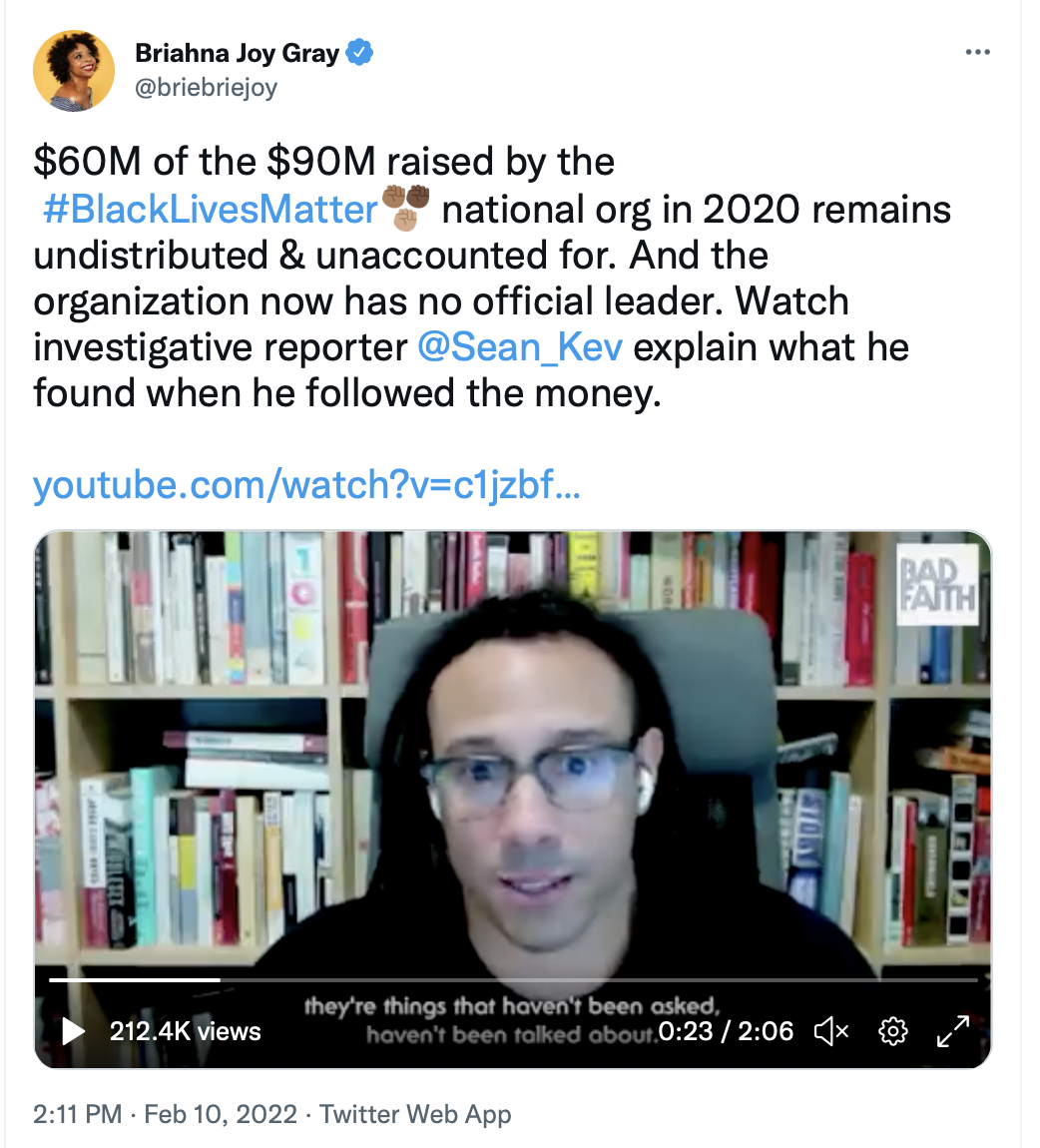
Briahna Joy Gray's podcast featured Sean Campbell, who has taken flack for looking into BLM improprieties.

Here is a longer version of this same video:

Freddie DeBoer has written on the topic. His article is "White Journalists Are Terrified of Appearing to Criticize BlackLivesMatter, Obviously"

That pouring billions of dollars into an amorphous social movement could result in mismanagement and corruption is as obvious a thing as I can imagine, and so the need for a watchdog press that helps ensure that money isn’t misspent is also quite obvious. I would analogize the current moment and BLM to the Red Cross after 9/11, when a great deal of scrutiny was justly applied to that organization and its practices. But the media has spent the past year and a half saying almost nothing about BLM and where the money has gone, ceding the ground to conservative publications. It was the right-leaning New York Post that reported that one of the cofounders of the BLM Global Network Foundation had purchased four houses in a short time span, for example. The trouble is that many left-leaning people feel that they can safely disregard anything published in conservative media, and thus a badly-needed conversation hasn't happened. Anyone who has ever been part of a large protest movement understands how desperately such movements need external review for accountability, but if only Breitbart et al. are engaged in critical inquiry, the liberal donor class is not going to be moved.

Susan Woods sounded alarms about BLM's operation back in 2020:

Continue ReadingDouglas Murray: Black Lives Matter Started with a Good Cause, Then Turned it Into a Racket

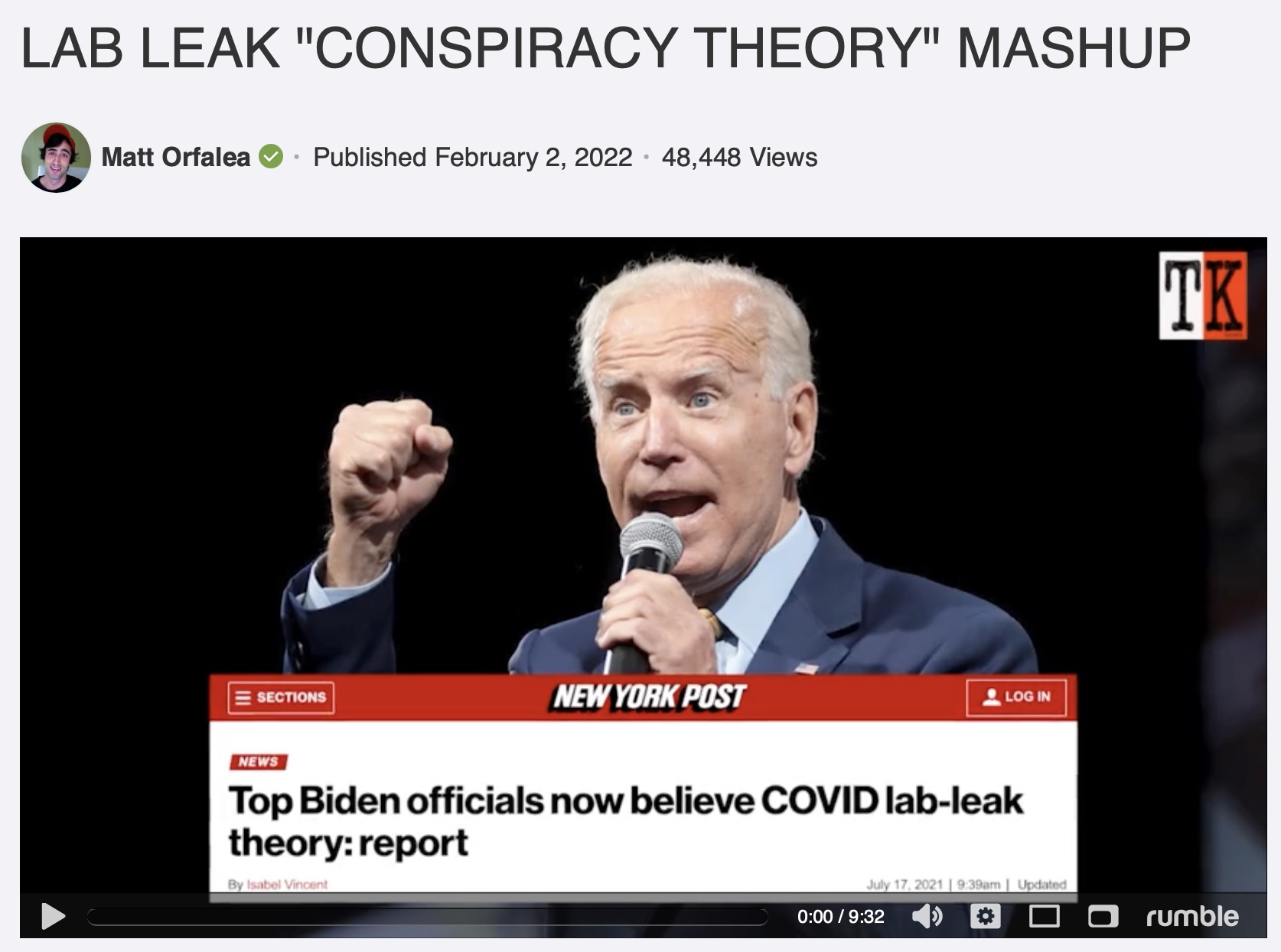
Matt Orfalea’s New Mashup on the “Lab Leak Conspiracy Theory”

My faith that legacy media outlets will take journalism seriously has plummeted in recent years. Matt Orfalea's "conspiracy theory" mashup explores one issue (of many recent issues) where media coverage has been abysmal.

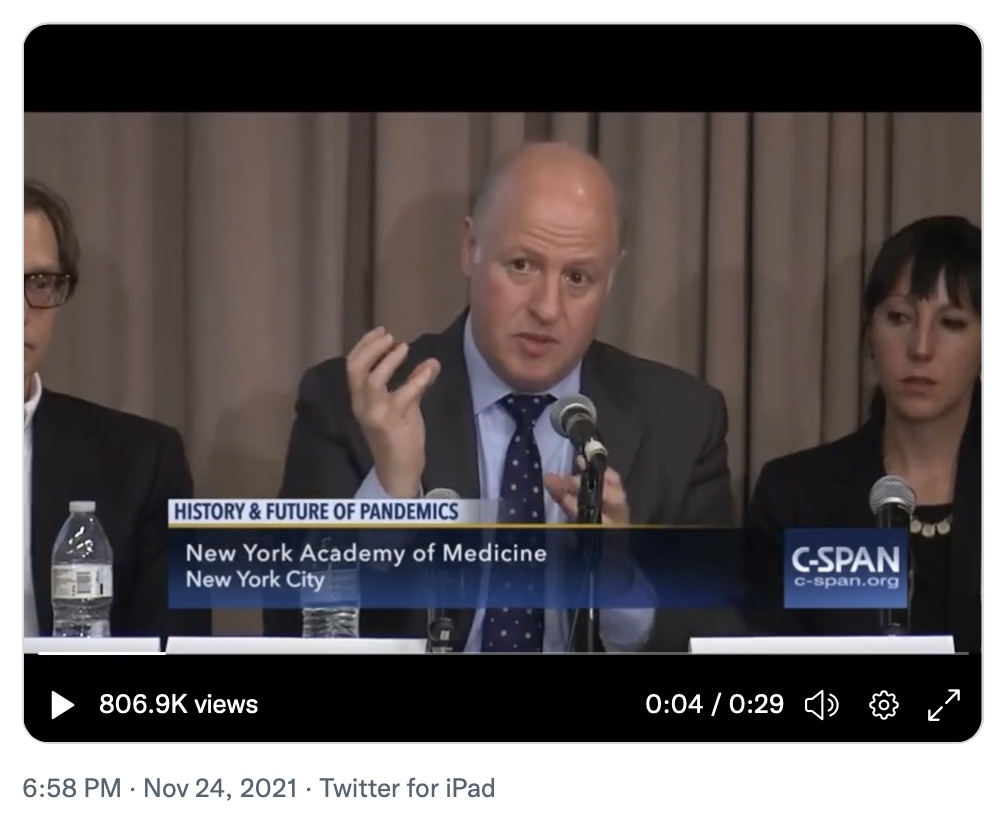
The news outlets kept claiming that the virus could never ever have emerged in a lab, yet they avoided this Peter Daszak video like kryptonite. Whenever they pompously trumpeted that the lab leak was a conspiracy theory, they NEVER mentioned this 2016 video featuring Peter Daszak, president of Eco-Health.

Continue ReadingMatt Orfalea’s New Mashup on the “Lab Leak Conspiracy Theory”

David Sachs’ Response to “Big Tech are Private Companies” and “Go Invent Your Own Internet”

Bari Weiss recently interviewed David Sachs on Common Sense, Bari's Substack. It is an excellent discussion of issues you will not see in legacy media outlets, who would like to see alternative media competition crushed. Here's an excerpt:

BW: The criticism that I hear a ton in response to what you're saying is: David, these are private companies. If I invent YouTube and I pay for the servers of YouTube and I've set up the whole architecture of the company, why can't I do what I want? Same with Facebook. Why don't I get to decide that I don't want some kind of clickbait or fake news or whatever on my thing? I'm going to police it. Who are you to tell me I can't?

DS: I think it's a very disingenuous argument. The same people who say that these social media companies, these big tech companies, should be free to do whatever they want because they're private companies are the same people pushing six bills through Congress right now to restrict and regulate those companies because they see them as monopolies. So they don't even believe their own argument. They all start making these libertarian arguments when these big tech companies are restricting speech in a way that they like. When they agree with the outcome, they want to give these companies the freedom to produce that outcome.

We need to fundamentally understand that free speech in our society has been privatized. The town square has been privatized. When the Constitution was written, the internet didn't exist. Back then, the town square was a physical place that you could go to, and there was a multiplicity of town squares all over the country. There were thousands of them and anybody could put their soapbox down and speak, and anyone could gather around and listen. That’s why, if you look at the First Amendment, it doesn't just protect freedom of speech and of the press. It also protects the right to peaceably assemble.

Well, where do people assemble today? They assemble in these giant social networks that have these gigantic network effects. That is where speech, especially political speech, occurs. And if you are shut out of that digital town square, to what extent do you still even have a First Amendment? To what extent do you have a right to speech? Well, I don't think you do. If you were to grab your soapbox today and go on the courthouse steps, they'll think you're a lunatic. You have no free speech right in this country if you are kicked off of these social networks.

So, I don't think it's good enough to say, well, these are private actors and, therefore, they can do whatever they want. Those private actors have too much power. They have the power to decide whether you, as an American, have an effective free speech right in this country. I think that's unacceptable. I think the Founders, the Framers of the Constitution, would never have permitted that.

...

BW: What do you say to the people who argue: If you don't like the way YouTube conducts itself, if you don't like the way Facebook conducts itself, no problem. Go make another one. Why is that not an acceptable solution to this problem?

DS: This is what you heard when Twitter and Facebook banned Trump. Their argument was: Go to a different app. And then Apple and Google banned Parler, which was the different app. And then the argument was, Well, that's not censorship. Just go create a website. And then Amazon Web Services started banning websites. So, at some point, when are you going to say this is an undue imposition on free speech? What am I supposed to do? Go create my own internet? All I wanted to do was post a tweet. Let’s not be obtuse to the power of these monopolies. I think people are being selectively oblivious to the network effects.

BW: We hear that phrase a lot: network effects. What does it mean?

DS: A network-effect business is one where the value of the service increases with the number of users. So if you think about Twitter or Facebook or the phone company, the more people who are on the service, the more value it has to everybody else. The value actually increases exponentially because the number of connections that can be made increases exponentially every time someone joins the service. If you or I want to create our own Twitter clone, it'll be very, very hard to do that because nobody else will be on it. So you have this huge chicken and egg problem. This is why these social networks are so powerful. They’ve got these huge network effects based on the fact that everybody is already on them, and it gets very, very hard to try and create a competing one.

Continue ReadingDavid Sachs’ Response to “Big Tech are Private Companies” and “Go Invent Your Own Internet”