While reading the Wall Street Journal this morning (courtesy of my hotel) I was appalled, but unsurprised, to read two extremely partisan opinion pieces on Obama's healthcare proposals and the 'reaction' to them.
In a piece entitled "The Health Care Grail", William McGurk clearly criticizes the White House, who "yesterday unveiled a new White House Web site accusing critics of scaring Americans 'with half truths and outright lies'". Unsurprisingly, Mr McGurk makes no mention that this is indeed a valid, and independently substantiated, criticism of the astroturf campaign against healthcare reform. Instead he attempts to make the case that this administration's healthcare reform proposals are a "Doctrine" and that "the president and his allies see disagreement over health care as less a political dispute than the trampling of sacred doctrine"
Who are the people and organization who are actively buying our elected representatives on the issue of health care reform? A visibly angrier than usual Keith Olberman calls them out, specifying the names and the obscene payments of cash:
At a park to weeks ago, a musician started singing “Somewhere Over the Rainbow.” I was talking with an acquaintance, who immediately pulled out his smart phone, clicked on a few buttons and brought up the movie “The Wizard of Oz” to play on his 1 ½” screen. He explained that he loved the movie and that he could watch it wherever he wanted. Impressive technology? Of course, but watching “The Wizard of Oz” (or any movie) is never such an important thing that I'd need to carry it in my pocket. Was my acquaintance really trying to tell me about his love of "The Wizard of Oz," or was he subconsciously trying to communicate something else to me?
For many years we’ve been trying to convince ourselves that electronics manufacturers were right that we HAD to have their gadgets, including 50" screen HD TVs. For decades, we’ve been convincing ourselves that electronic audio manufacturers were correct that we “needed” to plunk down $2,000 for high-end audio components with thick copper cables lest the sound degradation would piss us off too much to enjoy our music.
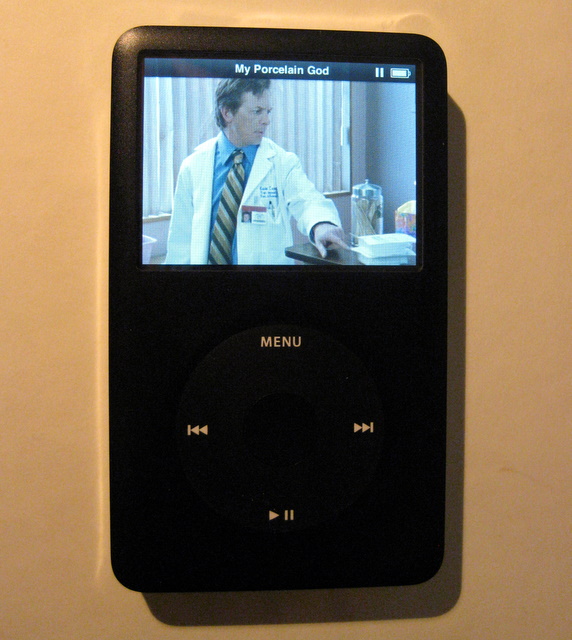
But here we are in an age where small is cool, and we’re somehow able to enjoy full length movies on tiny lo-res phone and iPod screens. And people are somehow surviving with small low-res youtube videos. And consider that the music almost everyone is enjoying on their mp3 players is sampled at a noticeably lower rate than CD-quality. And consider that CD quality sample rates are severely degraded compared to live music. But somehow we’re now OK with far less than perfect because small and convenient and high tech are cool.
I’m in the process of reading Geoffrey Miller’s riveting new book, Spent: Sex, Evolution and Consumer Behavior. We’ve all heard of conspicuous consumption (originally coined by Veblen). Miller refines and extends Veblen's concept, setting out the differences between conspicuous waste, conspicuous precision and conspicuous reputation as signaling principles. Cars exemplifying these three principles would be the Hummer (waste), Lexus (precision) and BMW (reputation). Conspicuous precision “can be achieved only through time, attention, and diligence, while conspicuous reputation (brand names) reflects a “vulnerability to social sanctions.” Most products exhibit each of these three forms of “signal reliability.” Other signaling principles including conspicuous rarity (exotic pets or pink diamonds) and conspicuous antiquity (ancient coins).
I find it interesting how much we fool ourselves about how much we “need” products based on these qualities. We “needed” large high-quality electronic audio and visual players until it became a much more impressive display to have extremely small portable electronics. It turns out that our “need” for things isn’t ultimately about need for the product’s qualities. It’s about trying to impress others with our ability to differentiate and afford various types of products.
A few years ago, I was looking at stunning images of a coral reef on the big new HD TV sets at Costco. I asked my wife whether we should think about “moving up” to a HD TV set. She asked me: “How often have you been watching a movie on our 25-year old TV set when it occurred to you that you weren’t enjoying the show because the screen was not huge or high definition? I answered truthfully: never. We still have our quarter-century old TV set and I’ve never again been tempted to “move up.” But I also admit that if I were trying to impress people today, I wouldn't be able to do it by showing off my TV. I wouldn’t be signaling that I can notice and afford fine engineering tolerances. I might show off my TV nonetheless, to signal my frugality, but my old TV wouldn’t be impressive to modern-day Americans, given that it is not (today) an expensive signal in any sense—I could buy a TV like mine very cheaply indeed at a garage sale.
Miller's book is a powerful reminder that our "need" to buy SO many things is often not about the things themselves, but about the need to tell the world something about ourselves in order to increase our social status or to attract mates.
Miller has a lot to say about the differences among the types of conspicuosity. For instance, Aristocrats eschew conspicuous waste. They tend to hone in on conspicuous precision and reputation.
For more on Miller’s theory, see this book review at the NYT.
Whether you consume rap and hip-hop or not, you know the genres have dingy reputations. I believe the hate for hip-hop and rap blossomed in the 90's. Rappers were actually cold-blooded gangsters at the time, people who occasionally shot one another. The music reflected the turmoil that its creators had experienced- growing up in crack-infused ghettos, resorting to crime to scrape by, and dying in a swarm of bullets even if they did finally make it out and become famous.
"I'm twenty-three now but will I live to see twenty-four/ the way things is going I don't know," Coolio said in "Gangster's Paradise", and he was by no means a Tu-pac; he was gangster-rap-lite. The depression of 90's rappers manifested itself in loud, brash talk of guns and glory; no wonder white outsiders were scared. The violent content of 90's rap inspired Tipper Gore and their ilk to censor and criticize with fervor, cementing rap's image as a crude, violent genre for future gang-bangers.
Hip-hop and rap also have the reputation of being degrading to women. This present stereotype was also inspired by past trends. After 90's gangster rap subsided, it was replaced with a money-cash-hoes mentality. In the early aughts, Jay-Z, 50 Cent and others spat mainly about their wealth, their rise from the streets, and the women that their amassed wealth could attract (Jay-Z wrote a song called "Money, Cash, Hoes").
Women were called hoes and bitches in earlier rap and hip-hop songs, it's true, but in the early 00's the music seemed more intently focused on the subject. Rap and hip-hop from this period was all about the ascent into fame, and the amassing of expensive objects. One of these objects happened to be attractive women. "I'm into having sex, I'm not into making love," 50 Cent reminds listeners in one of his most popular singles. Thus rap and hip-hop received another nasty label: it was degrading and shallow.
I have been following the political news regarding Iran at various websites, including Windows on Iran, a site maintained by Dr. Fatemeh Keshavarz, a professor of Persian and Comparative Literature at Washington University in St. Louis, Missouri. According to Windows on Iran, the protesters are still optimistic:
A young friend returning from Iran recently reported that an amazingly high percentage of people continue to wear green wristbands on a daily basis. Strangers passing by on the street, make “V” signs for victory, smile, and carry on with their daily activities. According to her, the nightly chants continue, and despite the pressures and the presence of police, there is a sense of hope.
The political persecution continues. As reported by ALI AKBAR DAREINI:
Iran began its first trial of the post-election crisis on Saturday, a mass court case against more than 100 activists and protesters accused of plotting a "velvet revolution" to topple clerical rule.
Some of the most prominent politicians of the pro-reform movement, including a former vice president, were among the defendants brought before the court in gray prison uniforms.
One of the recent posts by Keshavarz details the loud protests that are continuing, though the protests have evolved logistically to avoid harassment and arrest by the Basij Officers.
Demonstrators are careful to for small, loud, and fast groups who can protest and run before the riot police moves in. Here is one such demonstration happening near the Iranian state-run TV and Radio.
In the meantime, what is the American corporate media reporting about Iran? Fox News reports on the ongoing trials of the protesters (CBS too). Most American news site home pages reported that three American tourists were arrested after accidentally crossing over into Iran from Iraq. PBS reports nothing about Iran on its home page. Iran was a country that many prominent conservatives insisted on "bombing" in order to effect political reform. If the bombs were dropping, we'd have non-stop stories and photos of American military leveling portions of Iran. Coverage is scant, however, because the reform, which has endangered to lives and careers of many thousands of Iranians, is progressing without the backdrop of exploding American armaments.
Hello, I invite you to subscribe to Dangerous Intersection by entering your email below. You will have the option to receive emails notifying you of new posts once per week or more often.