
Matt Taibbi discusses how the media makes and breaks politicians

Yes, the media makes and breaks politicians. They tell us who the "serious" politicians are before the race has even begun, and it always seems to be about who can raise money. At his blog, Matt Taibbi writes thoughtfully about this issue of the way the media caricatures politicians:

The political media has always taken it upon itself to make decisions about who is and who is not qualified to be taken seriously as candidates for higher office. Without even talking about whether they do this more or less to Republicans or Democrats, I can testify that I witnessed this phenomenon over and over again in the primary battles within the Democratic Party. It has always been true that the press corps has drawn upon internalized professional biases, high-school-style groupthink and the urging of insider wonks to separate candidates into “serious” and “unserious” groups before the shots even start to be fired.
Taibbi's post then morphs into some observations about Sarah Palin, who has constantly complained that she is not being treated fairly by "the liberal press."
Continue ReadingMatt Taibbi discusses how the media makes and breaks politicians

Use nudity when potentially child-killing chemicals don’t garner enough attention

Back in September, Senator Al Franken and Rep. Steve Israel has introduced the "Household Product Labeling Act," which will enable consumers to determine whether potentially harmful chemicals are present in the household cleaning products they use. Here's the full text of the Senate version of the Act. Here's the problem:

In many households across the country, the entire family pitches in on household cleaning chores. The effort is obviously intended to keep everyone healthy by cutting down on germs, bacteria, and mold. But unfortunately, many of the ingredients in commonly used cleaning products may be dangerous themselves. Current law requires that product labels list immediately hazardous ingredients, but there is no labeling requirement for ingredients that may cause harm over time. Many chemicals contained in household products have been shown to produce harmful health effects. Consumers have a right to know which of these potentially harmful chemicals might be present in their kitchen and bathroom cupboards. This information is particularly important to families with small children, who as we all know have more direct contact with floors and household surfaces. This legislation simply makes that information readily available to consumers, giving them the opportunity to make an informed choice about the chemicals they bring into their homes.
This is an incredibly important bill, because consumers should have a right to know the chemicals to which they are exposing their families (see here for related post). How do you promote a bill when the "mere" sickness and death fail to attract enough attention? A private company called Method decided to shoot this clever (and somewhat provocative) video:

Continue ReadingUse nudity when potentially child-killing chemicals don’t garner enough attention

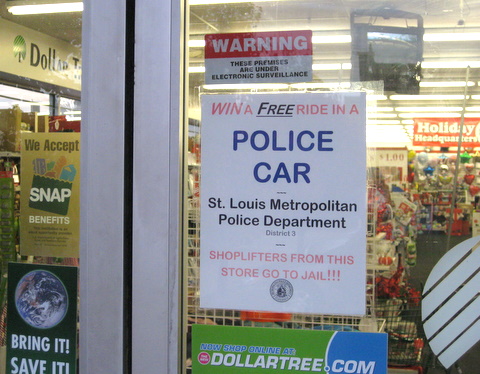
Welcome to our store! . . . sort of . . .

Customers of this Dollar Tree store in St. Louis are greeted with the following signs located on the main entry door: img_0210 Here's how I interpret the above: Welcome, honored guests, but it you rip us off, we'll throw your ass in the slammer before you can even utter "Merry Christmas."

Continue ReadingWelcome to our store! . . . sort of . . .

Ashleigh Banfield’s story of wartime censorship

Ashleigh Banfield has finally gotten hired back to work at a major network, after losing her job at MSNBC in 2003 for speaking out against the U.S. invasion of Iraq. Here's what she had to say back in 2003, which caused her to lose her job. She is speaking of what you are not shown by the news media when the nation is at war:

What didn't you see? You didn't see where those bullets landed. You didn't see what happened when the mortar landed. A puff of smoke is not what a mortar looks like when it explodes, believe me. There are horrors that were completely left out of this war. So was this journalism or was this coverage-? There is a grand difference between journalism and coverage, and getting access does not mean you're getting the story, it just means you're getting one more arm or leg of the story. And that's what we got, and it was a glorious, wonderful picture that had a lot of people watching and a lot of advertisers excited about cable news. But it wasn't journalism, because I'm not so sure that we in America are hesitant to do this again, to fight another war, because it looked like a glorious and courageous and so successful terrific endeavor, and we got rid oaf horrible leader: We got rid of a dictator, we got rid of a monster, but we didn't see what it took to do that.
Banfield also has some critically important things to say about the "Fox News effect" (the patriotizing and glorification of war). Reading this Huffpo post about Banfield reminds me of this post featuring similar comments by Amy Goodman. It also reminds me how Phil Donahue also lost his job at MSNBC for being critical of the Iraq invasion (more about Donahue's views here). These sorts of firings are actually predictable. The documentary "War Made Easy" reminds us that hawks close ranks around Presidents who start wars and they also put tremendous pressure on networks to do the same. Banfield's story reminds us that we need to strive to keep dissenting voices prominent during times of war because something about war makes us insanely fearful and even less able to reason than in times of peace. It is during times of war that we become collectively willing to let ourselves run amok wrapped in the flag.

Continue ReadingAshleigh Banfield’s story of wartime censorship

Church To State: “Do What We Want Or Else.”

The divide between church and state seems on the one hand to be growing but on the other narrowing, especially when you consider how intrusive established religions have been. Representatives of the Catholic Church sat in Nanci Pelosi's office of late while negotiations for the health care bill were ongoing, overseeing what she would do about abortion. Now this. Any way one reads this, it comes out as a threat. The quid pro quo is explicit. "If you don't bend to our will on this, we will stop services your city relies on." I have in the past believed that the tax exempt status of religions was a necessary work-around to preserve the fiction of separation. In the past, there have been instances of state intrusion directly into religions in, for one example, state funding for programs in parochial schools. There was always a quid pro quo in such offers and practices. But never has a representative of the state sat in the office of a minister while he drafted a sermon to be sure certain details got left out or included. Never, despite massive abuses by religious institutions in real estate and related financial areas, has the state moved to revoke 501(c)(3) status. It may be that any state official who tried it would be booted out of office summarily, but nevertheless that has been the unspoken law of the land. Seems the courtesy doesn't go both ways. If that's the case, I think it is time to revisit the whole issue. If the Catholic Church sees itself as providing services as an arm of the civil service sector and allows itself the conceit that it may use that service as a lever to influence political decisions, then they have implicitly given up due consideration as an inviolate institution, free from state requirements of taxation and regulation. Seems fairly clear cut to me. Obviously, there will be those who disagree. But it's time, I think, to seriously reconsider the state relationship to so-called "nonprofit" "apolitical" tax exempt institutions.

Continue ReadingChurch To State: “Do What We Want Or Else.”