
Oh, no O(bama) . . . Tell me it ain’t so!

I remember taking a course at Saint Louis University in International Law with Professor Jean-Robert Leguey-Feilleux Ph.D. in my college days in the late 1970’s and early 1980’s. The course included a discussion of terrorism. Dr. Leguey-Feilleux told us one of the issues before the United Nations and the international community was a definition of “terrorism.” The best definition of “terrorism” I remember, and the one my instructor endorsed, was “the taking of innocents for political purposes.” Terrorism is not necessarily killing, but may cause death and certainly fear. Terrorism is political. In another college class, political science professor and author David Easton defined “politics” as “the authoritative allocation of values.” So “terrorism” is the taking of innocents in an attempt to influence how people or peoples allocate their “values.” The primary motivator in any terrorist effort is fear. The absence of fear negates the intent of the terrorist. But fear may motivate others to seek gain from the tactical terrorist efforts for strategic purposes. I believe such was the goal of the Bush administration and still remains that of the Republican Party in the United States. I now fear we may have to add President Obama to the fold of those which have sacrificed basic American values and democratic freedoms to short term political expediency. During the 40 or so years of the Cold War, the Republican right could be counted upon to rant about Democrats being “soft on Communism” and take electoral victories in the White House which was only interrupted by Kennedy’s “missile gap,” Johnson’s “Great Society” (following JFK’s assassination) and the blip of Jimmy Carter after Watergate. After the rise in expectations after the growth and success of the Solidarity movement in Poland, due in large part to Pope John Paul II, and similarly after Democrats like Sen. Scoop Jackson (D-WA) forced increased emigration from the old USSR (which wanted “most favored nation” trade status) and Jimmy Carter’s “human rights” focus upon US foreign policy, the Cold War ended. Now there was a conundrum for the right. No more “soft on Communism” to run national elections strategies upon anymore. There ensued two terms of President Bill Clinton. President Bill Clinton infuriated the right into heretofore unseen levels of spastic fits of yobbo yapping and a renewed commitment by the right and its corporatist supporters to an electoral victory in 2000. After nearly a billion dollars of campaign spending to support a candidate which the corporations invented and called “George Bush,” Bush v. Gore ensued. “W” was then anointed president thanks to the one vote of Sandra Day O’Connor, along with the rest of the Republicans on the US Supreme Court. But “W” was an unproven commodity and he foundered in his early days in the Presidency, until 9/11. George Bush liked to repeat the mantra “9/11 changed everything” and he’s right. 9/11 gave the political Right an opportunity to claim Democrats are “soft” on terrorism just as they had in the past claimed Democrats were “soft” on Communism. George B. Shaw said; “Everyone is entitled to his opinion, but no one has a right to be wrong on the facts.” Let’s look at the former Soviet Union and its satellites as a threat and compare them to our latter day foes in the “Global War on Terror (GWOT)”. At a minimum, the Soviet Union had hundreds of thousands, maybe a million or so, of soldiers, sailors and airmen in arms. The Soviet Union had hundreds of thousands of tanks, planes, ships and submarines. The Soviets had some 15,000 nuclear warheads, most targeted on the US. Their nukes actually worked. We may not now know where they all are, but there were some 15,000. The Soviets had numerous substantiated chemical, nerve and biological weapons. In short, real weapons of mass destruction (WMD) existed. [More . . . ]
Continue ReadingOh, no O(bama) . . . Tell me it ain’t so!

Martin Luther King: Three methods of dealing with oppression

Martin Luther King eloquently asserts that non-violent resistance is the best approach to oppression. He asserts, though, that he is not advocating "anarchy," and there is such a thing as an "intelligent" use of police force. The backdrop to this discussion was the ongoing struggle to desegregate Little Rock Central High School. In the following conversation with Dr. Kenneth Clark, King disagrees with the criticisms of Malcolm X, emphasizing that non-violent resistance is "powerful" and it is not at all the same thing as "non-resistance," which is to be avoided, because it "leaves you in a state of stagnant passivity and dead-end complacency." Here is a transcript of this conversation. The above video is mislabeled. It is not a discussion involving Malcolm X, but it is about the differences between Martin Luther King and Malcolm X. It includes excerpts from a speech by Malcolm X, as well as numerous historical and entertainment clips.

Continue ReadingMartin Luther King: Three methods of dealing with oppression

Barack Obama again fails to take a stand for individual protections

Jonathan Turley sums up the problem:

Obama has now again betrayed the civil liberties community and lifted the threat of the veto. Americans will now be subject to indefinite detention without trial in federal courts in a measure supported by both Democrats and Republicans. . . This leave Ron Paul as the only candidate in the presidential campaign fighting the bill and generally advocating civil liberties as a rallying point for his campaign. Paul offered another strong argument against the Patriot Act and other expansions of police powers in his last debate. He also noted that the Patriot Act provisions were long advocated before 9-11, which was used as an opportunity to expand police powers. As discussed in a prior column, Obama has destroyed the civil liberties movement in the United States and has convinced many liberals to fight for an Administration that blocked torture prosecutions, expanded warrantless surveillance, continued military tribunals, killed Americans on the sole authority of the President, and other core violations of civil liberties.

Continue ReadingBarack Obama again fails to take a stand for individual protections

Your Gmail account could be hacked

At The Atlantic, James Fallows has written an excellent and harrowing account of how your email program in the cloud be hacked and what you can do about it. The story is centers on a real-life experience of Fallows' wife, who noticed one day that she couldn't get into her Gmail account; by the time she got control of her account again, she noticed that all of her email was missing. After much additional effort she regained access to most of her email, but it wasn't easy and this result is not guaranteed. She made the mistake of simply assuming that her data was safe with Google and that no one would hack her account. Many people are out there trying to take over your email account, and they are successful too often. They have broken into email accounts in all of the cloud email companies (gmail, yahoo, hotmail . . . you name it). The problem is usually password hygiene. Fallows offers some suggestions at the end of his detailed article (I highly recommend that you read the entire article, because his suggestions go well beyond the excerpts below):

[I]f you use Gmail, please use Google’s new “two-step verification” system. In practice this means that to log into your account from any place other than your own computer, you have to enter an additional code, from Google, shown on your mobile phone. On your own computer, you enter a code only once every 30 days. This is not an airtight solution, but it can thwart nearly all of the remote attacks that affect Gmail thousands of times a day. Even though the hacker in Lagos has your password, if he doesn’t have your cell phone, he can’t get in. In case you’ve missed the point: if you use Gmail, use this system. Also, make sure the recovery information for your account—a backup e-mail address or cell phone where you can receive password-reset information—is current. Google uses these to verify that you are the real owner. Next we have password selection, that seemingly impossible task. The science, psychology, and sociology of creating strong passwords is a surprisingly well-chronicled and fascinating field. OnThe Atlantic’s Web site, we will describe some of the main strategies and the reasoning behind them. Even security professionals recognize the contradiction: the stronger the password, the less likely you are to remember it. Thus the Post-it notes with passwords, on monitor screens or in desk drawers. But there is a middle ground, of passwords strong enough to create problems for hackers and still simple enough to be manageable.

Continue ReadingYour Gmail account could be hacked

Meet the protesters of Occupy St. Louis – October 14, 2011

I occasionally listen to Rush Limbaugh's radio show because I consider it important to understand how it is that my views differ from those of people who oppose my views. Two days ago, I listened to Limbaugh bloviating about the people who are participating in the Occupy Protests springing up all over the United States.  By  some reports, there are more than 1,000 such protests ongoing, and they are actually occurring all over the world.   Limbaugh announced, without hesitation, that these protesters are mostly unemployed, lazy, dirty, amoral, socially irresponsible and ignorant young people. Those who rely on Rush Limbaugh for their facts might thus be highly likely to object to these protests (including Occupy Wall Street) based on Limbaugh's description of the protesters.  But is the description he gave to his many (though dwindling number of) listeners accurate?  I had an opportunity to check this yesterday at the Occupy St. Louis protest in my hometown of St. Louis, Missouri. Over the past few days, I've been quite occupied at my day job, and it was only while walking back to my law office from the federal courthouse at 4 pm yesterday that I spotted an organized march coming down Market Street in downtown St. Louis.  I would estimate that there were almost 1,000 people marching.  I didn't have my video camera with me, but I did have my Canon S95 pocket camera, so I got to work taking hand-held video and still shots of the protesters.  Here's the finished product, which will allow you to actually meet the types of people who are participating in the Saint Louis Occupy protest.  You can now be your own judge of what these protesters are like: As you can see from the parade route pans and the interviews, none of these people fit the description given by Rush Limbaugh.  Off camera, I asked most of the protesters about their "day jobs," and all of them indicated that they were gainfully employed, and in a wide variety of challenging fields.   These "young" protesters of Occupy St. Louis ranged in age from 20's to their 80's.   The on-camera statements of the people I interviewed show that they are well-informed, thoughtful, highly articulate and good-hearted.  Many of the people I spoke with indicated that they are not going away.  They have been waiting for a good time and place to express their deep concerns about the way our government works, and they have finally found what they've been looking for. In case anyone is concerned that I intentionally skewed my sampling regarding who I interviewed, this was my method:  I simply walked up to someone nearby and asked whether he or she would be willing to give a short statement about why they were attending the protest.   I approached 12 people.  One woman sympathetic to the protest apologized and said she couldn't talk on camera because she was a member of the news media. One man said that he supported the protest, but he'd rather not go on camera.  Another man said he had never been part of a protest before, but he read about this protest recently and then said to himself, "Yeah, these people are right on these issues."   The other nine people I approached agreed to give statements on camera.  I'd like to thank each of these folks for taking the time to talk (I've listed their names in the order in which they appear in my video):

  • Al Vitale
  • Fred Raines (a retired economics professor, who said that he compiled the statistics displayed on one of the signs appearing on the video)
  • Apollonia Childs
  • Chrissy Kirchhoefer
  • Curtis Roberts
  • Michel Kiepe
  • Jeff Schaefer
  • Matt Ankney, and
  • Frances Madeson
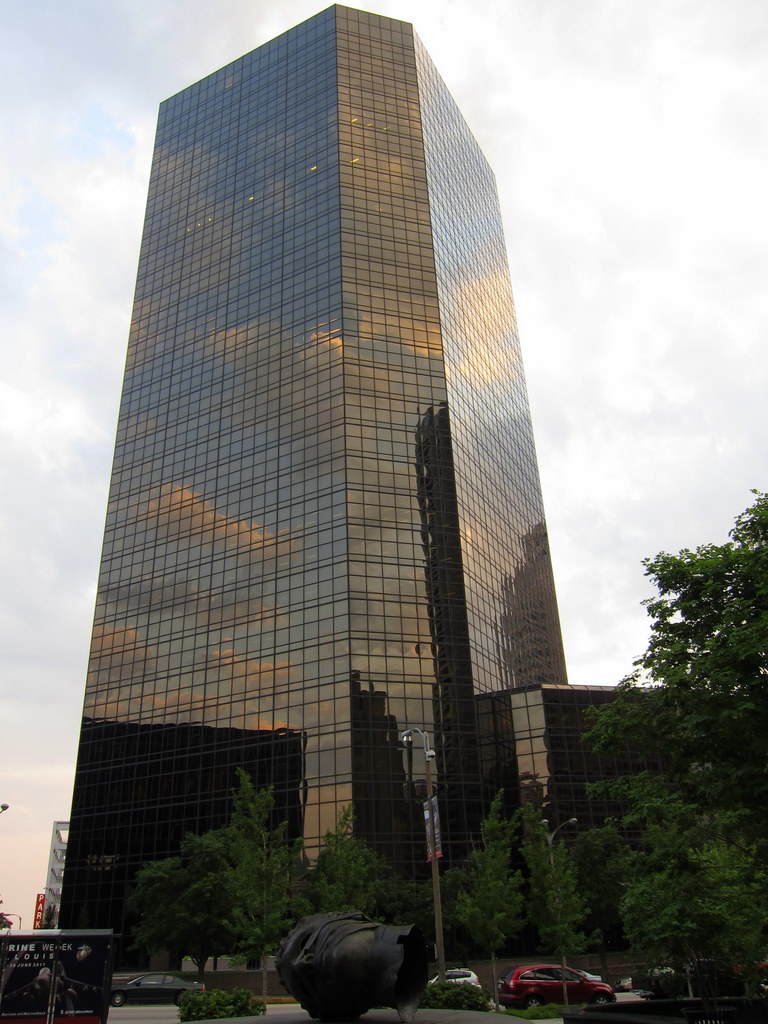
Based on the above video, there is no lack of intellectual moorings for this protest. The focus is that our government, including politicians of both major parties, has been substantially bought by big business, and many destructive things are flowing from the consequent misuse of government power. About a dozen protesters have have formed a camp in Kiener Plaza, a public gathering spot across the street from the towering downtown headquarters of Bank of America. I was told by several protesters that some of the camping protesters had been evicted from the camp over the past week, but that the intent is nonetheless maintain a presence in Kiener Plaza indefinitely. The Bank of America building has been the geographical focus of other recent protests, including this one in August, 2011. (A payday loan protest by a group called GRO occurred at this same bank last year--here's video).  I should note that most of the people who work in the huge Bank of America building work for companies other than the Bank of America, yet the building remains a symbol of what has gone so very wrong with the political process. I'd also like to mention that the St. Louis Police, who were out in the hundreds, were courteous and professional.   The protesters were there merely to protest-to get their message out.  There were no untoward incidents that would distract from the central message of the protests. For more on yesterday's protest, see this description by St. Louis blogger Gloria Bilchik at Occasional Planet. See also, this post by another St. Louis blogger, Adam Shriver at St. Louis Activist Hub.

Continue ReadingMeet the protesters of Occupy St. Louis – October 14, 2011