
Heinlein and the Problem of the Present

Having read the new biography of Robert A. Heinlein, I indulged myself in dipping back into some of the novels. Heinlein worked out a Future History in which he set many of his stories. Obviously, any writer who attempts predictions is usually in for a bit of embarrassment---it's difficult at best to know what might happen next week let alone next century. But Heinlein had more than the usual "horse sense" when it came to sociology and the way in which history unfolds and he often nailed the essence of a coming period if not the specifics. (He tagged the Sixties the Crazy Years all the way back in the Forties.) One of his chillier stories is a short novel called If This Goes On--- in which he depicts the Second American Revolution. This time it occurs in response to a homegrown despotism---a theocracy, established by the First Prophet, a combination of Huey Long and Billy Sunday named Nehemiah Scudder. (You can find it published with two other stories in the book Revolt In 2100.) I reads this in seventh grade, while attending a Lutheran school, and it had a lasting impact on me. In the early Fifties certain publishers started packaging the better SF novels in hard cover for the first time and this was one of Heinlein's. He wrote an afterword to it and I just reread that. In view of our current social circumstances and in light of so much that gets discussed here at Dangerous Intersection I would like to quote two paragraphs in particular. Mind you, Heinlein wrote this in 1952.

Nevertheless this business of legislating religious beliefs into law has never been more than sporadically successful in this country---Sunday closing laws here and there, birth control legislation in spots, the Prohibition experiment, temporary enclaves of theocracy such as Voliva's Zion, Smith's Nauvoo, a few others. The country is split up into such a variety of faiths and sects that a degree of uneasy tolerance now exists from expedient compromise; the minorities constitute a majority of opposition against each other. Could it be otherwise? Could any one sect obtain a working majority at the polls and take over the country? Perhaps not---but a combination of a dynamic evangelist, television, enough money, and modern techniques of advertising and propaganda might make Billy Sunday's efforts look like a corner store compared to Sears Roebuck. Throw in a depression for good measure, promise a material heaven here on earth, add a dash of anti-Semitism, anti-Catholicism, anti-Negroism, and a good large dose of anti-"furriners" in general and anti-intellectuals here at home and the result might be something quite frightening---particularly when one recalls that our voting system is such that a minority distributed as pluralities in enough states can constitute a working majority in Washington.
I was very much struck by that. Looking around, it made me even sadder, since obviously there have always been people with foresight enough to see what might happen and how and yet they are often ignored. In Heinlein's case, because he was just one of those "Buck Rogers guys" with all the cookie ideas about space and aliens and such like. But obviously even then the shortcomings of our "voting system" raised a possible red flag for some. Anyway, I thought I'd share that little near-forgotten gem.

Continue ReadingHeinlein and the Problem of the Present

A question for President Obama

I wonder, which is a better recruitment tool for potential terrorists: the burning of a Koran or the following news items from the past month or so:

  • Civilian death toll in Afghanistan "soared" by more than 30% since 2009
  • Taliban asks for independent commission to investigate civilian deaths, insisting that they are not to blame. U.S. says they don't want to grant Taliban legitimacy by negotiating with them, stonewalls the issue.
  • 12 American soldiers on a secret "kill team" have been (allegedly) caught murdering Afghan civilians for sport. They then (allegedly) took pictures posing with the bodies, mutilated them, and kept fingers of the dead as souvenirs. They were turned in by a fellow GI, who was then beaten and told to keep his mouth shut and stop "snitching". Originally five soldiers were arrested, now seven more have been arrested as part of the cover-up and assault on the whistleblower.
Continue ReadingA question for President Obama

Robert A. Heinlein In Perspective

I finished reading William H. Patterson's large new biography of Robert A. Heinlein yesterday. I knew I wanted to write something about it, but I gave it a day to simmer. Frankly, I'm still not sure what to say other than I was positively impressed. Basically, Patterson achieved the remarkable goal of demythologizing the man without gutting him. I've read any number of biographies of famous (and infamous) personalities which tended either to be hagiographic (and therefore virtually useless as any kind of honest reference) or a brutal airing of personal failings in some sort of attempt to drag the subject down to "our level" and resulting in a catalogue of reasons to think ill of the person under study. (This is one reason I tend to urge people that if they like an artist's work, read it all if possible, see it all, listen to it all before finding out about them as human beings. Too often the person, depending on the book, spoils the work for many.) Patterson has done something useful for aspiring science fiction writers. (Hell, for any kind of writer as far as that goes.) Heinlein's reputation casts a long, dark shadow across the field. He is one of the pantheon of timeless Greats and in many ways the most intimidating of the lot. It is, I think, useful to know that he had just as much trouble getting started---and staying started---as any other decent writer. (Harlan Ellison has observed that the hard part is not becoming a writer but staying a writer, that anyone basically can get lucky at the beginning, but over time the work simply has to stand up for itself.) The legend has been repeated ad nauseum, how Heinlein saw an ad for a short story contest, wrote a story, then decided to send it to Astounding instead of the contest because Campbell paid better, and it sold. That story was Life Line. From there, up was the only direction Heinlein went. The reality is much more as one might expect. True, he sold that first story to Campbell and sold more, but not without rejections getting in there and Campbell making him rewrite some of the pieces and not without a lot of wrestling with reputation and deadlines. Writing is hard damn work and this book shows what Heinlein had to go through. Yes, he was better than most, but he wasn't teflon. And he had to learn, just like any of us. Reading about time spent living in a four-by-seven foot trailer on $4.00 a day while he sweated a new story makes him suddenly very human. But also very admirable. The other problem with Heinlein is that he did codifying work. There were time travel stories, generation ship stories, alien invasion stories, and so on and so forth before him, but he wrote a number of stores---all lengths---that more or less set the standard for how those stories should be done. He wrote "defining" stories, and for a long time people gauged their work and the work of others by that gold standard. One gets tired of having such a bar hanging over one's head all the time and naturally a reaction emerged over time that was as nasty as it was inevitable, casting Heinlein as the writer to work in opposition to. By the time I discovered Heinlein, during my own golden age at 11, 12, and 13, he was already being touted as "the Dean of Space Age fiction." [More . . . ]

Continue ReadingRobert A. Heinlein In Perspective

The real cost of the U.S. invasion and occupation of Iraq.

What is the cost of the U.S. invasion of Iraq? The cost, which will continue to mount for decades, is staggering, even insane. It wasn't $50 B, as W stated; it's already in the trillions. Here are the numbers from the Washington Post. The reason for the U.S. invasion and occupation? Unknown. The deleterious effect on the soldiers, their families and the U.S. economy? Long term and devastating. For the hawks, it was fun going in with all those fancy weapons blazing, but they are not offering any ideas as far as cleaning up this catastrophic mess. And those hawks have absolutely nothing to offer to the massive number of Iraqi refugees, who have spilled all over the Middle East, placing an enormous burden on Syria and Jordan. And combat is not "over," per the recent lies of the Obama Administration. And the corrupt corporate media is, for the most part, not calling out the Obama Administration for this recent fabrication any more than they confronted the U.S. for the fictitious "reasons" for invading in the first place. The media excels at serving as official stenographer for U.S. politicians whenever the topic is war (and see this piece on a documentary by Phil Donahue, and this article regarding Amy Goodman's views about the additional failures of the media). The corporate media bears thus much of the blame for the bleak economic future of the U.S.

Continue ReadingThe real cost of the U.S. invasion and occupation of Iraq.
Read more about the article CEOs Earn More When They Fire People
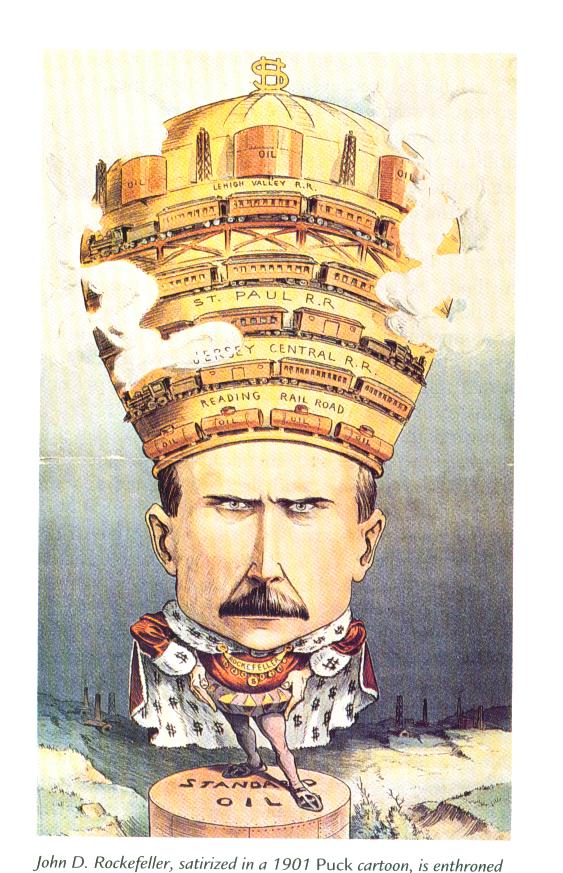
John D Rockefeller - Archetype of today's CEO

CEOs Earn More When They Fire People

John D Rockefeller - Puck Magazine 1901 The Institute for Policy Studies has just released their 17th annual review of CEO salary. It makes for scary reading. While the rest of us suffer through the double-dip-recession-that-never-actually-lifted-off-the-bottom, CEOs, who are not only some of the wealthiest people in the country but are also the most handsomely paid to boot, have seen their income rise in real terms, while their employees have seen a reduction in real income and a significant contraction of job opportunities. According to the Institute

Corporate executives, in reality, are not suffering at all. Their pay, to be sure, dipped on average in 2009 from 2008 levels, just as their pay in 2008, the first Great Recession year, dipped somewhat from 2007. But executive pay overall remains far above inflationadjusted levels of years past. In fact, after adjusting for inflation, CEO pay in 2009 more than doubled the CEO pay average for the decade of the 1990s, more than quadrupled the CEO pay average for the 1980s, and ran approximately eight times the CEO average for all the decades of the mid-20th century.
Their employees, meanwhile
are taking home less in real weekly wages than they took home in the 1970s. Back in those years, precious few top executives made over 30 times what their workers made. In 2009, we calculate in the 17th annual Executive Excess, CEOs of major U.S. corporations averaged 263 times the average compensation of American workers. CEOs are clearly not hurting.
But reality is even worse:
In 2009, the CEOs who slashed their payrolls the deepest took home 42 percent more compensation than the year’s chief executive pay average for S&P 500 companies
The market, and the embedded compensation committees, are rewarding CEOs for destroying livliehoods, for shipping jobs overseas, and for eviscerating the american workplace. These are the same people who lobby our politicians to create business friendly legislation (aka legislation that will protect their bonuses and options) and to fight against social programs (that would level the playing field a little) What was so wrong with the vibrant, growing, energetic America of the 70s and 80s? Why do CEOs hate America, so?

Continue ReadingCEOs Earn More When They Fire People