
Old photos
I co-founded a band in 1973. We called it Ego, and the 8 of us (sometimes nine) played the music of Chicago, Blood, Sweat and Tears, Doobie Brothers and many other types of music. Many of our arrangements were our own. The trumpet player for Ego (Ron Weaver) recently sent me some photos from our band days 35 years ago, and I'm astounded at the emotions that the photos have triggered. At this point (see below--I'm the 3rd from the left), we ranged in age from 16 to 20 years of age. We were all going to school and most of us were working other jobs too. Yet playing with Ego was our passion. The proof is that we were willing to split our $200 fees eight or nine ways.
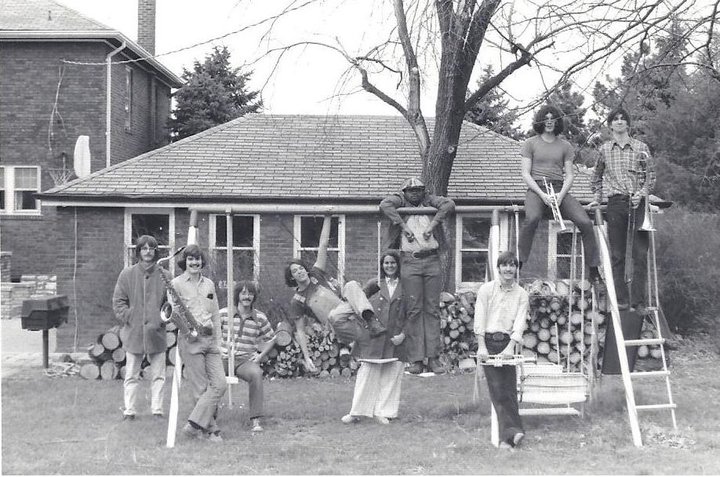 I'm now three times the age that I was back then, but I felt like an adult even back then. I was studying in a pre-med program, totally unaware that I would switch paths and end up practicing law. Totally unaware that I would be raising 10 and 12-year old daughters 35 years later. I could have never imagined giving up music, and I haven't, though I have never played with a large group since Ego. Several of the other players still have careers playing music, two of them (Charles Glenn and Kelly Durbin [not in the above photo]) on a high level.
It was a lot of work to organize a band in 1974, given that this era was pre-email and pre-cellphone. We wrote out much of our own music with pencil and paper, including detailed brass parts. None of this could have happened without everyone pitching in, and the band was filled with talented and hard-working people, all of whom had good senses of humor. Somehow it all worked for more than two years before we went our separate ways, pulled by a variety of things, none of which I can clearly articulate at this point.
There's nothing like an old photo to bring these memories flooding back. In fact, I'd never before seen this photo, so seeing it was like stepping into a time machine. This photo makes me want to jump back in time to play Chicago's "Make Me Smile" with the group or to struggle once more through an original tune we wrote in 7/4 time. It is such an amazing gift to see this photo so many years later (and to be alive to see it 35 years later). It is such an amazing thing that the mind, though it forgets so many episodes of the past, clings for decades to emotionally-embedded memories. This photo also makes me wonder whether it was the hard work of co-running and marketing a band that might have prepared me for resolving many of the conflicts I encountered later in life. There was a lot of improvising that was required back then and only some of it involved music. Much of that improvisation involved logistics, like how to afford necessary equipment, how to build our own mixer and lights and how many of us needed to convince parents yet again that we needed to borrow the family station wagons to make it to the gig.
This photo also reminds me of that wonderful tired feeling, at about 3 am, when we had finished working and finished unloading the equipment back home, when we knew that we brought some joy to the audience, and that we would have a chance to do it again a day or a week later. In case it's not obvious, I'm really proud of what we accomplished as teenagers. If a parent asked me to suggest a way for their own teenager to grow into a responsible adult, I might blurt out: "Tell them to run a band." It's not the only way to come of age, but for me it was a terrific path.
This photos is packed with emotion for me, and looking back at it, the emotion was the logic of what we did. Whoever says that humans are primarily rational rather than emotional creatures has it so very wrong, indeed.
I'm now three times the age that I was back then, but I felt like an adult even back then. I was studying in a pre-med program, totally unaware that I would switch paths and end up practicing law. Totally unaware that I would be raising 10 and 12-year old daughters 35 years later. I could have never imagined giving up music, and I haven't, though I have never played with a large group since Ego. Several of the other players still have careers playing music, two of them (Charles Glenn and Kelly Durbin [not in the above photo]) on a high level.
It was a lot of work to organize a band in 1974, given that this era was pre-email and pre-cellphone. We wrote out much of our own music with pencil and paper, including detailed brass parts. None of this could have happened without everyone pitching in, and the band was filled with talented and hard-working people, all of whom had good senses of humor. Somehow it all worked for more than two years before we went our separate ways, pulled by a variety of things, none of which I can clearly articulate at this point.
There's nothing like an old photo to bring these memories flooding back. In fact, I'd never before seen this photo, so seeing it was like stepping into a time machine. This photo makes me want to jump back in time to play Chicago's "Make Me Smile" with the group or to struggle once more through an original tune we wrote in 7/4 time. It is such an amazing gift to see this photo so many years later (and to be alive to see it 35 years later). It is such an amazing thing that the mind, though it forgets so many episodes of the past, clings for decades to emotionally-embedded memories. This photo also makes me wonder whether it was the hard work of co-running and marketing a band that might have prepared me for resolving many of the conflicts I encountered later in life. There was a lot of improvising that was required back then and only some of it involved music. Much of that improvisation involved logistics, like how to afford necessary equipment, how to build our own mixer and lights and how many of us needed to convince parents yet again that we needed to borrow the family station wagons to make it to the gig.
This photo also reminds me of that wonderful tired feeling, at about 3 am, when we had finished working and finished unloading the equipment back home, when we knew that we brought some joy to the audience, and that we would have a chance to do it again a day or a week later. In case it's not obvious, I'm really proud of what we accomplished as teenagers. If a parent asked me to suggest a way for their own teenager to grow into a responsible adult, I might blurt out: "Tell them to run a band." It's not the only way to come of age, but for me it was a terrific path.
This photos is packed with emotion for me, and looking back at it, the emotion was the logic of what we did. Whoever says that humans are primarily rational rather than emotional creatures has it so very wrong, indeed.