Facilitated Communication: Another Version of Make Shit Up “Medicine”

Many people I know who got the COVID shots absolutely refuse to come to groups with the fact that US public health authorities and "experts" got almost everything wrong about Covid. Almost everything.

How could it be that someone who is highly educated to get something so completely wrong?

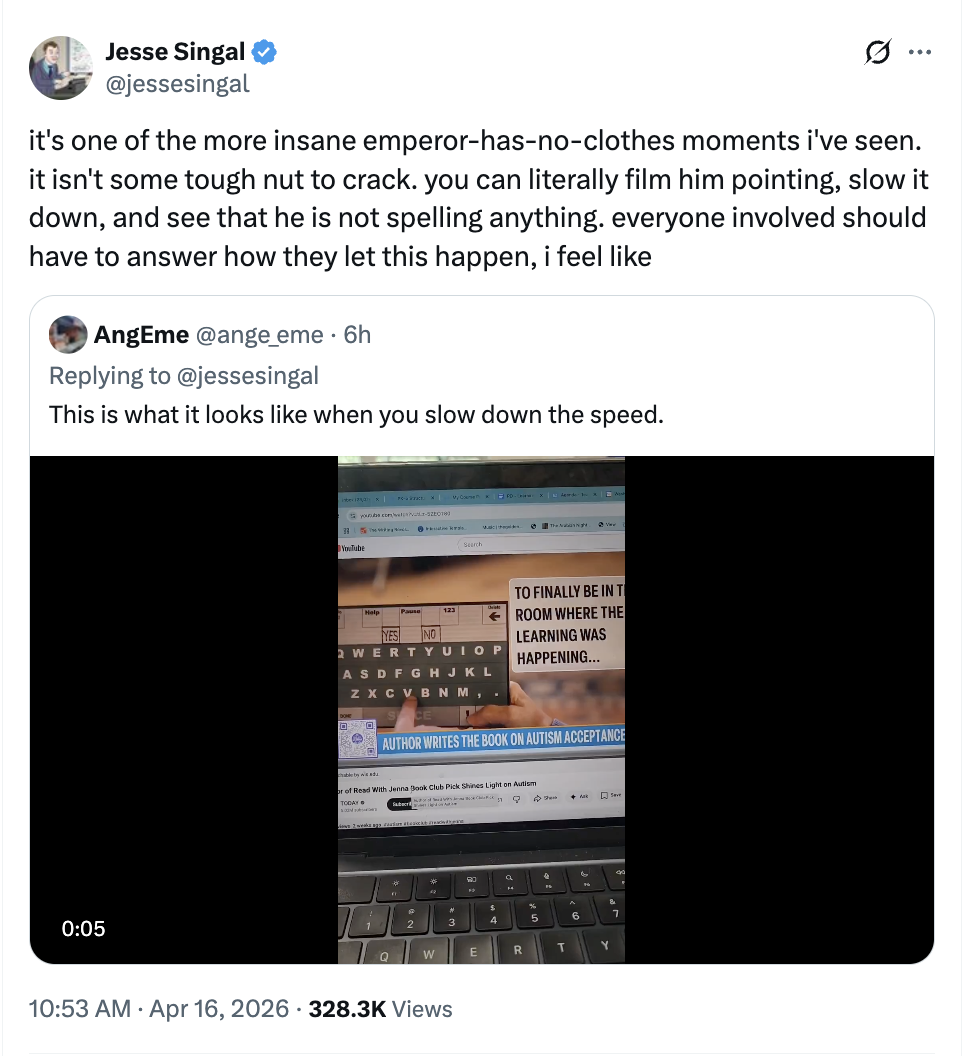
Here's another example from the early 1990s: "Facilitated Communication" for people who are autistic. I saw a documentary on this technique about 20 years ago and I couldn't believe what I was saying. Stuart Vyse describes it in detail in this article:

"When Silence Speaks: The Harmful Pseudoscience of Facilitated Communication: The Stubblefield case in ‘Tell Them You Love Me’ highlights the wide array of potential victims who can be harmed by promoting pseudoscientific methods of communication." Here's an excerpt:

The early results [of facilitated communication] were astonishing. People who had never spoken a complete sentence were suddenly writing poetry and novels with the assistance of their facilitators, and FC began to spread like wildfire. However, the involvement of another person in the process—the facilitator—raised obvious questions about who was really typing. Peer-reviewed studies using simple blinding techniques began to emerge, and the results were devastating.

In a typical experiment, researchers placed the non-speaking individual and the facilitator at a table with a barrier between them so that each could be shown pictures of familiar objects, but they could not see each other’s pictures. When both saw the same picture, such as a shoe, all was fine, and “s-h-o-e” was typed. However, when shown different images, the typed word invariably matched what the facilitator, not the nonspeaking person, had seen. Across hundreds of trials, there were virtually no correct responses independently made by the nonspeaking individuals. People who had supposedly been writing sophisticated essays through FC could not identify everyday objects in controlled tests, revealing that the facilitators were the actual authors of the typed messages.

Were the therapists lying when they claim that the patient was actually in charge? Not quite:

Ideomotor effects have been implicated in hypnosis, dowsing, automatic writing, and several other phenomena. Finally, these unconscious actions are reinforced by the philosophy advocated by the FC/RPM/S2C community. Decades ago, Douglas Biklen coined the slogan “presume competence.” In an effort to show respect for people with disabilities, Biklen suggested that all people should be approached with the assumption that they are intelligent and literate. While this may sound like an admirable philosophy, this assumption introduces an explicit bias.
Continue ReadingFacilitated Communication: Another Version of Make Shit Up “Medicine”

COVID Panic in 2025

Wow. And I know other people like this too.

Billy Binion:

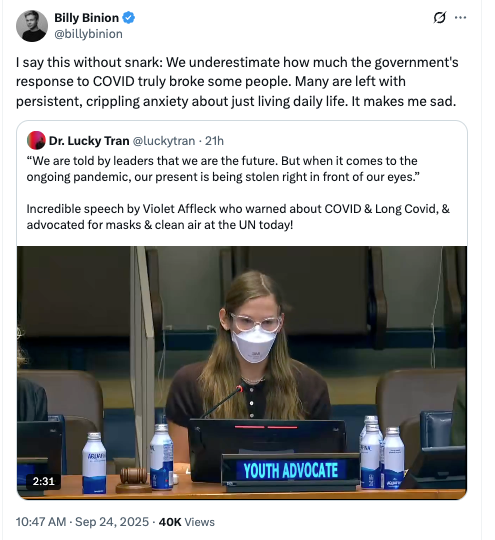
I say this without snark: We underestimate how much the government's response to COVID truly broke some people. Many are left with persistent, crippling anxiety about just living daily life. It makes me sad. Some people also seem to really thrive—over 5 years later—off of the purpose & identity they get from being a COVID purist. It's very human to want to fight for something. But the world is not going to stop for you anymore. It is time to find a new cause.

Continue ReadingCOVID Panic in 2025

Therapy that Cannot Stand the Pain

In talking with some acquaintances and viewing videos of people who are clearly struggling to cope, I'm often distracted by their use of language that abstracts away from human-to-human conflict. Their focus has been repackaged into sterilized abstruse terminology. It's as though the emotions and suffering have been packed away into the basement and they are trapped upstairs in a nonstop web of psychological chatter that is facilitated by their therapists.

Freya India points out the increasingly common problem of therapy buzzwords in a communication to Ayishat Akanbi, a writer:

I’m very skeptical of therapy-speak, unconvinced it even helps us open up. More often I think it actually closes down our ability to have honest conversations.

But you got to the heart of what bothers me about it, the insincerity. If someone tells me about their “fearful-avoidant” attachment style or how they are learning to “hold space” for others, I find it hard to feel anything. But if they tell me about their hurt and heartbreak, or how they are trying to be less selfish, I’m listening. We are talking human to human now.

As you write, “We’re encouraged to describe even ordinary interpersonal conflict in the language of pathology and melodramatic categories. So we start treating every slight like persecution because exaggeration is the only way to make pain legible.”

But I’ve been wondering lately if two things are happening at once. On one hand, we have this therapeutic group-speak, this exaggeration of suffering. But on the other hand, I think we are also losing the ability to talk about actual pain.

The writer Samuel Kronen, in a piece about chronic illness, put it like this: “There still appears to be a lot of unrewarded suffering in the world and our culture can seem pretty cruel and callous toward the vulnerable…If anything, I think our screen-addled, instantly-gratifying, digitally-intoxicated culture actually makes people less sensitive and conscious of suffering in certain ways, contributing to a more casual cruelty.”

I think he’s right. We might pathologise ordinary feelings and exaggerate small slights, but we also seem unwilling to accept genuine suffering. We can’t seem to cope with it. It’s hard, for example, to have a sincere conversation about something like family breakdown. I hear so many young women talking about their attachment styles, about “reparenting” themselves and healing their inner child, but not so much about the pain of divorce. I think this is why, as a culture, we have ended up with so much therapeutic advice and so little wisdom. Because we aren’t speaking about our problems in any recognisably human way. Maybe we are trying to make things easier on ourselves. If you phrase your problem as “anxious attachment”, you need a therapist. If you phrase it as your parents’ divorce, you need a difficult conversation with your dad.

As I read India's email to Akanbi, I was reminded of a book I read in college: The Myth of Mental Illness (1961), by Thomas Szasz. I think Szasz overstated his case in his book, but he did draw necessary attention to whether metaphoric terms like "mental illness" been literalized to unduly justify psychiatry's authority, turning common problems of living into impenetrable diagnoses, often harming individuals by stripping them of agency and responsibility for their actions.

Continue ReadingTherapy that Cannot Stand the Pain

About Anxiety

Today I watched this video by comedian Bill Hader. The topic, struggling with anxiety, is a serious--sometimes debilitating--topic, but, as one would expect, Hader deals with it in a serious way. I know more than a few people who are imprisoned by their anxious thoughts. They are often letting life pass them by, which is tragic.

I don't think I struggle more than most people with anxiety, but I know I can sometimes have anxious thoughts and these sometimes interfere with my ability to do my job (trial attorney) and deal with the other challenges of living life, which are, of course, ubiquitous. Lucky for me, I have never felt the need to take any medications. But I am always on the lookout for ways to tamp down those pesky and distracting anxious feelings.

I think Bill's approach is a good one. He reframes his anxiety as a thing separate from him. His anxiety is a thing that he does not need to accept as a part of himself.

In this clip, Abigail Shrier points out potential environmental causes for anxiety in children. Interesting finding that I find unsurprising for the reasons she suggests. Lack of limits and rules (i.e., too much freedom) can be disorienting. I think we need foundational axiom in order to make sense of the world. They might not be perfect, but we need base assumptions of some sort or we become unanchored. We can't reason at all without at least some anchors:  It's the same thing with geometry, as Bertrand Russell discussed:

Before I began the study of geometry somebody had told me that it proved things and this caused me to feel delight when my brother said he would teach it to me. Geometry in those days was still 'Euclid'. My brother began at the beginning with the definitions. These I accepted readily enough. But he came next to the axioms. 'These', he said, 'can't be proved, but they have to be assumed before the rest can be proved.' At these words my hopes crumbled. I had thought it would be wonderful to find something that one could PROVE, and then it turned out that this could only be done by means of assumptions of which there was no proof. I looked at my brother with a sort of indignation and said: 'But why should I admit these things if they can't be proved?' He replied: 'Well, if you won't, we can't go on.' I thought it might be worth while to learn the rest of the story, so I agreed to admit the axioms for the time being. But I remained full of doubt and perplexity as regards a region in which I had hoped to find indisputable clarity. In spite of these doubts, which at most times I forgot, and which I usually supposed capable of some answer not yet known to me, I found great delight in mathematics-much more delight, in fact, than in any other study.

From Basic Writings of Bertrand Russell, "Why I took to Philosophy," p. 57.

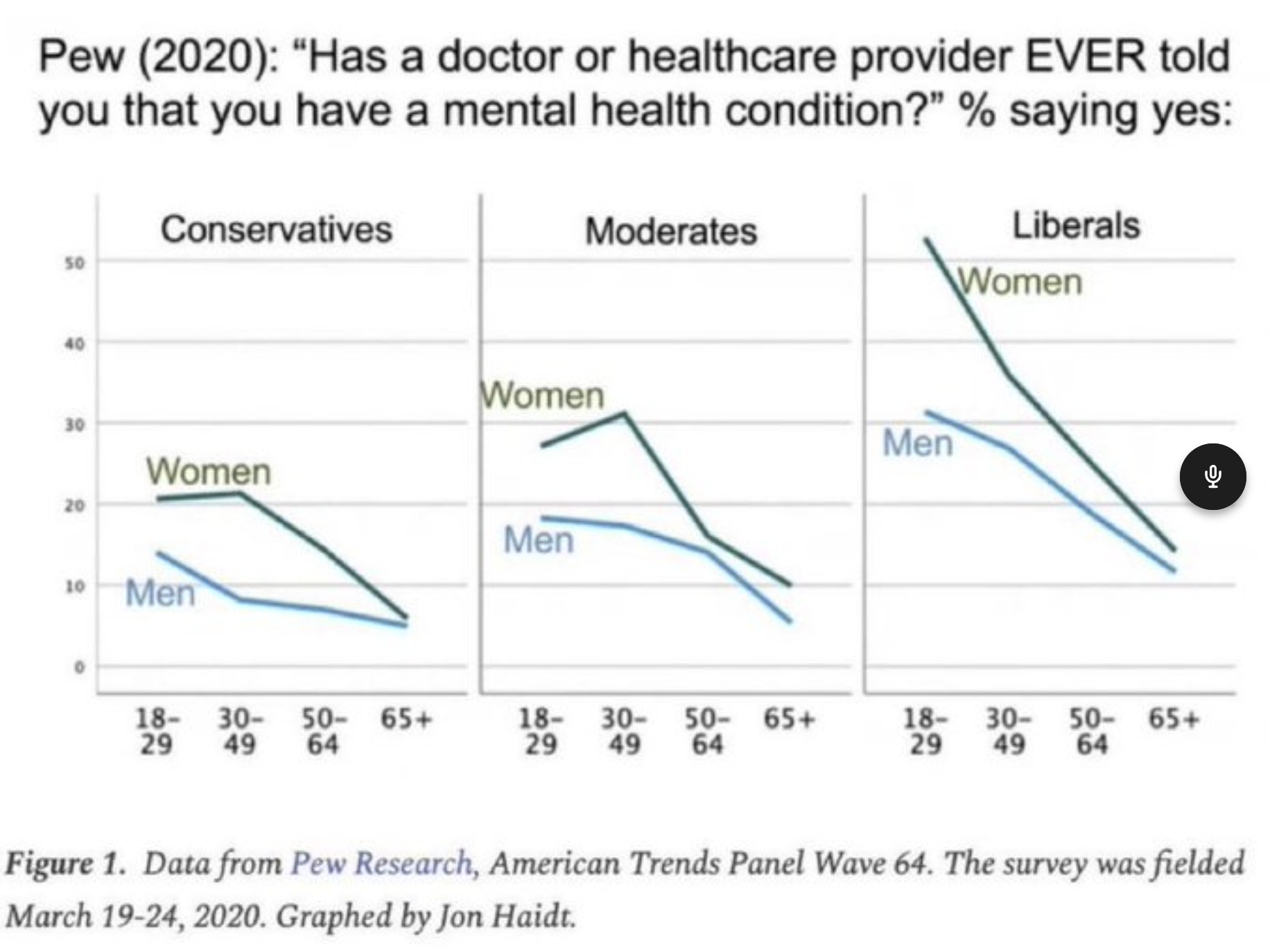
In this clip, Shrier mentions research showing "Boys in liberal families have higher anxiety than girls in conservative families."

In her book, Shrier states that obsessing about your inner depression and anxiety make those problems grow in you mind.

I have read excerpts from Shrier's book and heard several of her interviews. I asked Grok to summarize Shrier's main points on this topic and it did a great job:

In her book Bad Therapy: Why the Kids Aren’t Growing Up (published February 2024), Abigail Shrier argues that young adults who obsess over their mental health, particularly Generation Z (born 1997–2012), may worsen their condition due to a culture that overemphasizes therapy and emotional self-focus. Her key points on this issue, based on her investigation and interviews with psychologists, parents, teachers, and young people, include:

1. Encouraging Rumination: Shrier contends that excessive focus on feelings—encouraged by therapists, schools, and parenting trends like “gentle parenting”—leads young adults to ruminate on their anxieties and sadness. This rumination can trap them in cycles of depression and anxiety, as they dwell on perceived traumas or minor emotional setbacks instead of moving forward. For example, she cites therapy practices that prompt young people to constantly explore “what might be wrong,” which can amplify distress rather than resolve it.

2. Pathologizing Normal Emotions: Shrier argues that the mental health industry and societal trends label normal challenges of adolescence and young adulthood (e.g., sadness, stress, or social struggles) as mental health disorders. This overdiagnosis convinces young adults they are inherently fragile or damaged, creating a self-fulfilling prophecy where they expect to need professional help to cope. She notes that 42% of Gen Z have a formal mental health diagnosis, yet their mental health is worse than previous generations, suggesting overtreatment may harm rather than help.

Continue ReadingAbout Anxiety