Adult baby food

Dr. David Kessler has written a new book called "The End of Overeating: Taking Control of the Insatiable American Appetite." He was recently interviewed by Katharine Mieszkowski of Salon.com. You can also listen to their discussion here. I was intrigued by Kessler's notion that much of the food to which people become addicted is "adult baby food":

We're eating, in essence, adult baby food. Twenty years ago the average chews per bite was about 20, now it's two or three. The food goes down in a whoosh and it's very stimulating. It's layered and loaded with fat, sugar and salt. It's as if you have a roller coaster going on in your mouth. You get stimulated, it disappears instantly and you reach for more.

But it's not just the fat or the sugar. We dress up food really well here in the United States:

We make food into entertainment. We make it into a food carnival. Go into a modern American restaurant: the colors, the TVs, the monitors, the music. You do it with your friends. We've taken sugar and added all these multiple levels of stimuli. What do we end up with? Probably one of the great public health crises of our day.

Go visit Salon for the entire article. Lots of worthy observations. For instance, he discusses why people get fat (it's not because fat people enjoy eating more than skinny people). Also, there is no body "set point" to protect you from gaining weight. Kessler offers lots of ideas for not allowing your brain to get hijacked by high calorie food. On a related note, I've had to constantly monitor my own eating and exercise to keep myself where I need to be (I'm now 5' 11" and 170), and I use a variety of techniques I described here, especially the need to avoid refined carbohydrates and to constantly aim for whole grains and lots of vegetables and whole fruits (not juice).

Continue ReadingAdult baby food

Medicating the kids . . .

As a parent, I have participated in many discussions regarding the medication of kids for a variety of reasons. I have friends who have kids with serious problems for whom medication has been a godsend, allowing them to function with relative normalcy. Kids who were unable to participate in a typical classroom for one behavioral issue or another. We've also had many discussions about the problem of over-medicating children, and how some schools push for difficult children to receive behavioral meds, whether they truly need them or not. How some of those adult medications should perhaps not be so quickly prescribed for children. We've talked about education reform, changes in teaching methods and school culture and administrative philosophies that would allow for wider ranges of learning styles. I've heard parents rant about how unfair it is for their well-behaved child to not receive the same level of attention as the "problem kid" in the class commands, and I've seen them answered by the parents of said problem kids with an invitation to trade shoes, just for a day.

Continue ReadingMedicating the kids . . .

Ballpark food lighting up our Pleistocene taste buds.

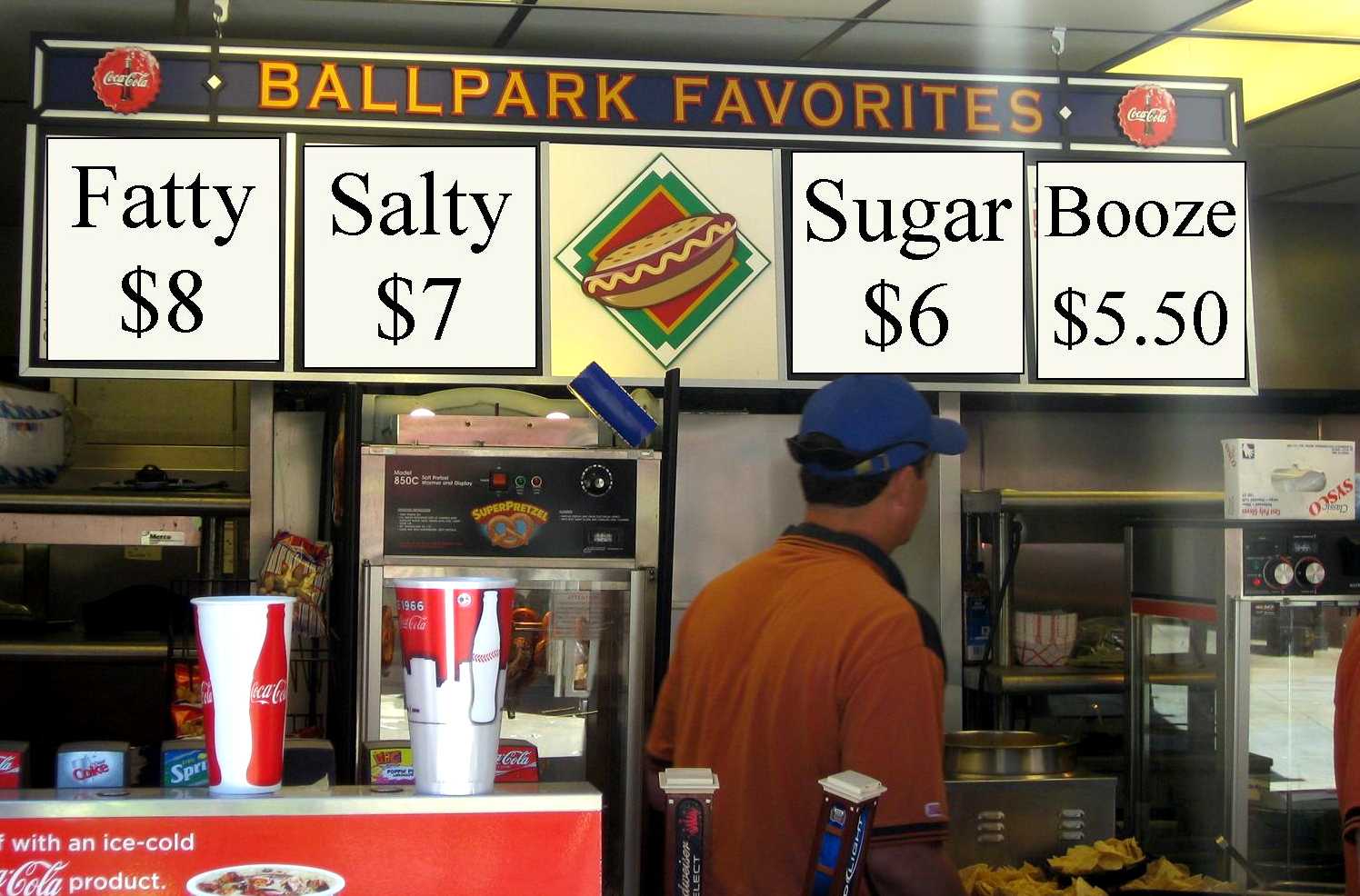
What is it about ballpark food that makes it so delicious? I think that these new truth-in-marketing signs at the ballpark pretty well sum it up. Photo (etc) by Erich Vieth These stadium food vendors truly excel in offering superstimuli for our not-ready-for-modern-times stomachs and eyes. What should we do about this mismatch between our pleistocene cravings and our modern abilities to pump out this life-shortening quality-of-life-diminishing fare? That's the question raised by Dr. David Kessler, former Commissioner of the FDA:
Fifty years ago, the tobacco industry, confronted with the evidence that smoking causes cancer, decided to deny the science and deceive the American public. Now, we know that highly palatable foods—sugar, fat, salt—are highly reinforcing and can activate the reward center of the brain. For many people, that activation is sustained when they're cued. They have such a hard time controlling their eating because they're constantly being bombarded—their brain is constantly being activated.

For decades the food industry was able to argue, "We're just giving consumers what they want." Now we know that giving them highly salient stimuli is activating their brains. The question becomes what do they do now?

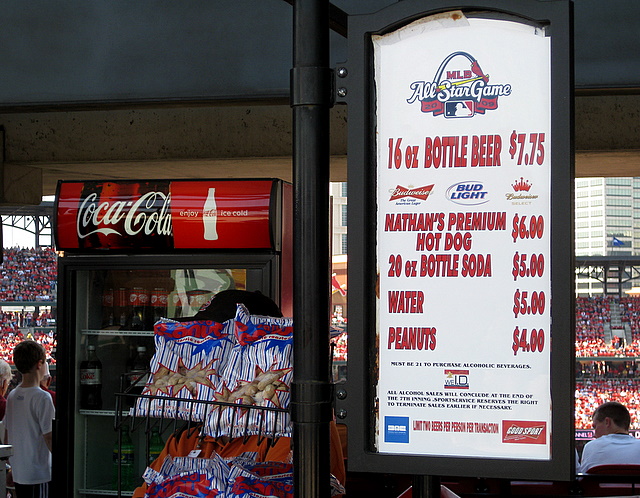
When I say "superstimulus, I mean it. I can't believe how many obese people I recently saw at the stadium. Half of them wore Albert Pujols jerseys, but none of them looked like Albert Pujols. Now, while we're still discussing stadium food, here's an untouched photo clearly demonstrating that the world is almost out of fresh water. After all, there's no other explanation for why anyone would pay twice as much for 20 ounces of drinking water than for a gallon of refined gasoline. image by Erich Vieth I can just imagine the conversation: Child: Daddy, can I have a few sips of water? Father: Billy, how many times have I told you that we can't afford to drink water!

Continue ReadingBallpark food lighting up our Pleistocene taste buds.