
Matt Taibbi: Free Julian Assange

From Matt Taibbi's latest article, "Why Julian Assange Must Be Freed."

[S]ecrets do not belong to governments. That information belongs to us. Governments rule by our consent. If they want to keep secrets, they must have our permission to do so. And they never have the right to keep crimes secret.

I’m an American. Many of you are from the U.K. In our countries, we’re building skyscrapers and huge new complexes to store our secrets, because we don’t have room to keep them all as is!

Why do we have so many secrets? Julian Assange told us why. From an essay he wrote:

'Authoritarian regimes give rise to forces which oppose them by pushing against the individual and collective will to freedom, truth and self realization. Plans which assist authoritarian rule, once discovered, induce resistance. Hence these plans are concealed by successful authoritarian powers.'

When governments become authoritarian, they inspire resistance. Techniques must then be developed to repel that resistance. Those techniques must then be concealed.

In short: the worse a country is, the more secrets it has. We have a lot of secrets now.

Julian Assange became famous as we were creating a vast new government-within-a-government, a system of secret prisons, extraordinary rendition, mass surveillance, and drone assassination. Many of these things we know about only because of Wikileaks. Ostensibly, all this secrecy was needed to fight foreign terrorism.

The brutal irony now is the architects of that system no longer feel the need to hide their dirty tactics. My government, openly, wants to put this man in jail for 175 years, mostly for violations of the Espionage Act. These include crimes like “conspiracy to receive national defense information,” or “obtaining national defense information.”

What is “national defense information?” The answer is what makes this law so dangerous. It’s whatever they say it is. It’s any information they don’t want to get out. It doesn’t even have to be classified. What is conspiracy to obtain such information? We have a word for that. It’s called journalism.

My government wants to put Julian Assange in jail for 175 years for practicing journalism. The government of this country, the U.K., is going to allow it to happen.

If they did this to Andrei Sakharov, or Nelson Mandela, every human rights organization in the world would be denouncing this as an intolerable outrage. Every NGO would be lining up to lend support. Every journalist would be penning editorials demanding his release.

But because our own governments are doing it, we get silence.

If you’re okay with this happening to one Julian Assange, you’d better be okay with it happening to many others. That’s why this moment is so important. If Assange is successfully extradited and convicted, it will take about ten minutes for it to happen again. From there this will become a common occurrence. There will be no demonstrations in parks, no more news stories. This will become a normal part of our lives.

Don’t let that happen.

Free Julian Assange.
Continue ReadingMatt Taibbi: Free Julian Assange

Why You Need to Know about Julian Assange of Wikileaks

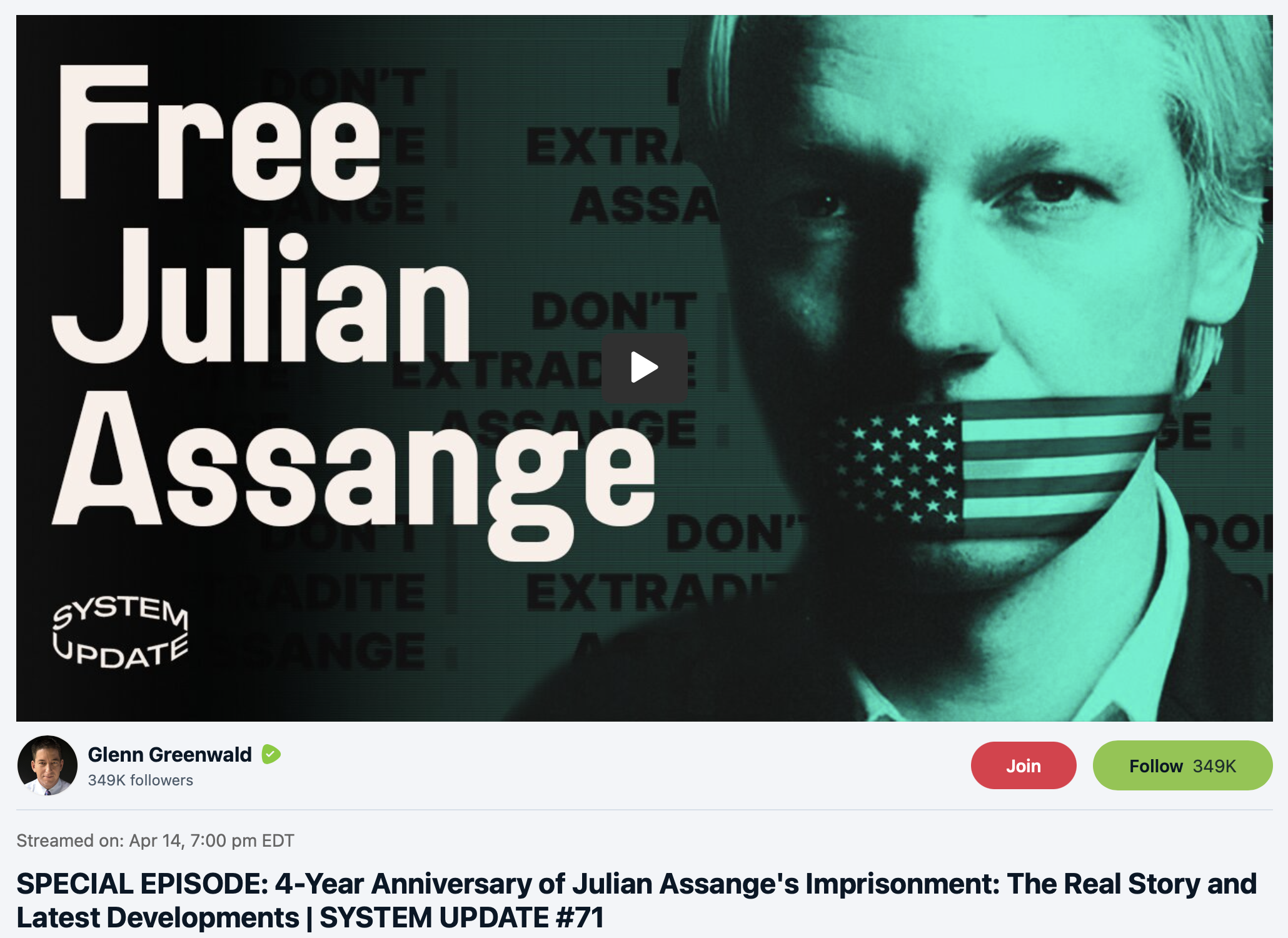
What you need to know about Julian Assange on the Fourth Anniversary of his Imprisonment. On Glenn Greenwald's System Update, the Free Speech Alternative to YouTube.

An excerpt of the transcript of this show from Glenn's site at Locals:

There's, I think, a very good strong case to make that Julian Assange is definitely one of the most consequential and intrepid journalists of the last, say, 50 years, if not the single most important pioneering journalist of his generation. He has almost certainly broken more major stories than almost every single employee of the mainstream media outlet combined. They don't hate Julian Assange, despite the fact that he's broken so many stories. They hate him precisely because of that – in part because he shined. He holds up a mirror showing what they really are. He is what they pretend to be.

While the mainstream media constantly publishes stories that they dress up as leaks but in fact are nothing more than propaganda messaging tasks given to them by the CIA and the FBI and Homeland Security, which pick up the phone and pick their favorite reporter and tell them what to go plant in the newspaper to disseminate propaganda to the American people, Assange never does that and never had to and never would. He shows the American people and the world the secrets the CIA and the FBI and the Pentagon and Homeland Security don't want you to see. And that's why those agencies hate him. And that's why the employees and the media outlets that serve those agencies also hate him. That is the reason that he's in prison.

Almost every single employee of The New York Times, The Washington Post, CNN and NBC, on a daily basis – you can pick up those newspapers or if you have the misfortune to listen to those networks, you will hear or read them saying – “anonymous officials told us” X, Y, and Z, they publish classified information all the time. But they don't end up like Julian Assange or Jack Teixeira – the 21-year-old member of the Massachusetts National Guard was hunted this week by The New York Times and The Washington Post and then arrested yesterday by the FBI because he is accused of having leaked classified documents.

The difference between the mainstream media on the one hand and Assange and Jack Teixeira and people like Edward Snowden on the other is that the mainstream media publishes leaks that are authorized, that the U.S. Security State wants you to see because they're forms of propaganda and that's why they're never punished. That's why they don't end up in prison. They get book deals; they get put on television and they're applauded by the U.S. government. The people who end up in prison are those who show you the secrets they want to hide. That's the main difference. It's the difference between being a propagandist and being a journalist. Julian Assange is a journalist, and that's the reason he's in prison.

Continue ReadingWhy You Need to Know about Julian Assange of Wikileaks

Hollowed-Out

I propose this as a metaphor for a large country whose institutions are being hollowed out.

Continue ReadingHollowed-Out

The Day Sam Harris Stopped Being a Skeptic

For many years I had listened to Making Sense, the podcast of Sam Harris. I admired Sam's ability to analyze many complex issues, including religion and cognitive science. I don't listen to him nearly as much any more. He has fallen off the tracks regarding COVID and censorship. I am also concerned that he has a bad case of Trump Derangement Syndrome - I describe TDS as a disgust of Trump that is so intense that one is willing to start with the premise that Trump cannot ever again be president, then to reverse-engineer government and media institutions that get in the way, disabling them if necessary, doing whatever is necessary to guarantee that Trump never again holds power.

Recently, I found myself wondering when it was that I first noticed that Harris fell off the rails on these topics. I think it was on his January 2, 2019 with Renée DiResta, who is described in the podcast notes as "Director of Research at New Knowledge and Head of Policy at the nonprofit organization Data for Democracy." I remember listening to this podcast several years ago, thinking that Sam was simply eating out of DiResta's hand, taking everything she said without exercising any meaningful skepticism or pushback. While I listened to that podcast, it seemed like a truly bizarre moment compared to other episodes of an otherwise excellent well-informed, highly-engaging podcast.

At minute 18 of the podcast, Sam seemed hypnotized into head-nodding as DiResta described "Russian Interference in the U.S. Presidential Election of 2016." When Harris asked whether we know this to be true, DiResta responded there is "no basis for doubt," that it is "crystal clear," "it happened" and an "incontrovertible truth." A claim like this should result in dozens of questions, including who, what, when, where, how and why.

But that was the day Sam-the-Skeptic died. At Minute 20, Sam assured DiResta that this Russian interference only went in one direction. It "was not a pro-Clinton campaign." DiResta explained to Harris that the Russian "Internet Research Agency" was growing "tribes" on social media, based on divisive issues having nothing to do with Trump, then somehow switching those tribes and disillusionment into pro-Trump propaganda. DiResta explained that this social media propaganda was organized around ideas of "pride" of Americans "to exploit feelings of alienation" on topics as diverse as Immigration, southern culture, LGBT, Bernie Sanders, religious rights, BLM and pro-police. And then the Russians started "weaving in their support for candidate Trump." Somehow those evil-doers converted people who allegedly found these to be topics of interest to channel their frustrations into votes for Trump. And somehow these social media posts (a mere "81 Facebook pages") swayed the outcome of a national American election where multi-millions of dollars were being spent by the candidates themselves. DiResta spun this spectacularly unconvincing story based on black-box "trust me" causation. She was allowed to sell this wild story without backing it up with any meaningful corroborating statistics or any psychological analysis of how this tactic could possibly work, yet Harris sat on his hands for the entire podcast drinking the Kool-Aid.

Now we know a lot more about Renée DiResta. According to Michael Shellenberger's recent article: "Why Renee DiResta Leads The Censorship Industry: How a former CIA fellow came to lead US government efforts to stamp out disfavored speech on the Internet."

DiResta’s rise to the highest levels of the U.S. intelligence community struck me back in December of last year as improbably meteoric. DiResta had repeatedly described her involvement in fighting disinformation as having started in 2013 when she became a new mom and grew concerned about spreading anti-vaccine information online. “In 2013,” she explained to Kara Swisher, “I had my first kid… You know, you have to do that preschool thing here, you’ve got to get them on a list a year early. I didn’t want to be in a preschool with a bunch of anti-vaxxers, candidly.” Two years later she was helping to fight ISIS online and by 2018 she was testifying before the U.S. Senate Intelligence Committee.

Continue ReadingThe Day Sam Harris Stopped Being a Skeptic