The spammers win one at the 9th Circuit

As I’ve indicated before, I would LOVE to sue the spammers who deluge this site with thousands of fake comments. I’m still researching whether that kind of suit would be possible under the law. Today, I was reminded of my own frustrations with spammers when I read a recent opinion by the 9th Circuit Court of Appeals, a case titled Gordon v. Virtumundo, Inc. L 2393433, 3 -4 (C.A.9 (C.A.9 (Wash.),2009), 2009 WL 2393433 In Gordon, a professional plaintiff tried to sue spammers based on the federal CAN-SPAM Act, which was enacted in 2004. The Court turned him down because A) he didn’t qualify as an Internet Access Service Provider, B) the Court did not consider him to be “adversely affected” by the statutory violations (the receipt of spam on his email accounts), and C) His state law claims failed because they were precluded by the Act's express preemption clause The "pro-marketing" forces, those who think that they should be allowed to trash my email accounts with special offers for penis enlargement techniques and a wide variety of drugs, are elated by this decision. Here is how the Court sees the overall legal landscape:

Continue ReadingThe spammers win one at the 9th Circuit

Government-Hating: An American Value

G.O.P. Chairman Michael Steele made a few remarkably in-your-face comments recently about the health care debate. Here, in his own words, is pretty much where he thinks the nation is going, why it shouldn't go there, and what the Republican Party stands for. This morning on NPR he tangled with Steve Inskeep, in particular over this. One quote in particular caught my eye: " Simply put, we believe that health-care reform must be centered on patients, not government." When you listen to the NPR interview it's clear that we're hearing another in the now decades-long tirades against the government which has become the hallmark of Right Wing politics in this country. In this country, in theory, the government is supposed to be us, the people. We elect our representatives, we tell them how we want them to vote, we change our minds, we are supposed to be in charge. In theory. Obviously, the reality is far from that. For one, we are not a full-fledged democracy, we are a republic, and while we elect those who operate the machinery of the republic on our behalf, we do not have a direct say in the running. Nor could we, really. it is simply too complex. We send our representatives to the various points of departure---state capitols, Washington D.C., county seats, city halls---to do that for us because it is a big, complex, often indecipherable melange of conflicting goals, viewpoints, and problems. We do not have the time to pay the necessary attention to do that work ourselves, so we pay people to do it for us. So why do we distrust it so much? Well, because we distrust each other.

Continue ReadingGovernment-Hating: An American Value

On the importance of disagreement

The beginning of thought is in disagreement - not only with others but also with ourselves. –Eric Hoffer Honest disagreement is often a good sign of progress. –Mohandas Gandhi Greetings all! I would like to introduce myself. My name is Brynn, and I'll be joining the fantastic stable of authors at Dangerous Intersection. I'm flattered that Erich asked me to be a part of what is being built here. Lots of very talented people are contributing their thoughts to the ongoing discussion generated on various topics, and I'm honored to be a part of that. I’ve been a regular reader of DI for about a year, and I’ve been impressed with the quality posts as well as the engaging discussion that often occurs in the comments following the post. One thing that is never shied away from is disagreement. Nor should disagreement be avoided. There is no party line here, there is no heresy. What is abundant is the type of quality discussion and debate that is the hallmark of a vigorous, open community.

Too often in contemporary American society, honest debate is stifled. Politicians have learned to speak in sound bites. Media commentators have learned to present insipid and truncated stories to a largely passive and apathetic audience. The constraints of time or column inches prevent a lengthy examination of any given issue. Talking points are adopted by the major parties’ respective constituencies as though they were absolute truth. The vehemence with which one holds an opinion has become a substitute for thoughtful reflection on the reasons why one holds an opinion.

This must change. The staggering array of challenges that face us demand a well-informed and engaged citizenry . . .

Continue ReadingOn the importance of disagreement

An army of 50,000 highly motivated citizens condemning health care reform

Who are all of those outspoken citizens attending the town hall meetings where health care reform is ostensibly being discussed? The Raw Story reports that 50,000 of them are not simply concerned citizens:

A spokesman for America’s Health Insurance Plans, the industry’s trade group, admitted in an article published Monday that as many as 50,000 industry employees are involved in an effort to fight back against aggressive healthcare reform . . . “The health-insurance industry is sending thousands of its employees to town-hall meetings and other forums during Congress’s August recess to try to counter a tide of criticism directed at the insurers . . . Employees of the health insurers have also been given talking points . . .
Question: Who is more motivated to show up and speak up at public meetings concerning health care? A) Ordinary citizens or B) Employees of health care insurers who are being PAID to show up and who are being provided talking points? The obvious answer is B), and they are contaminating discussions from coast to coast. The bottom line is that what is going on is not honest spirited debate out at town halls. Rather, what we are being subjected to is corrupted debate, to match the corrupted debate inside of Congress, where six highly paid health care lobbyists are assigned to each member of Congress, as reported by the LA Times:
Every one of those 534 members of Congress now has six (6!) lobbyists working on them -- and that's just for healthcare. A total of 3,300 lobbyists have registered to drive the sizzling healthcare issue in Washington -- three times the brigade of lobbyists representing the entire defense industry.
It makes you want to throw up your hands (and sometimes, just throw up), thinking that we are sending sheep to the wolves whenever we hope that regular folks would be able to make as much focused noise on the topic of health care reform (and especially health care insurance reform) against financially motivated and highly-trained armies who are not attending these meetings to do anything other than advocate the pre-determined positions of their employer corporations and to prevent any meaningful discussion. Based on what I am reading and hearing, the presence of these highly vocal and highly biased participants is all the worse because they aren't identifying themselves as such at public hearings. In most things, we ask people of bias to identify themselves, because we should downplay the positions of biased people, because they are less trustworthy. They should be impeached for their positions of biased, the way we impeach biased witnesses in courtrooms. But there is no practical way to identify these financially motivated people at town hall meetings. They are presenting themselves are neutral ordinary citizens when they are anything but. For me, this "health care" debate is increasingly turning into a question of how (or whether) we are able to have any meaningful national discussion where one of the sides is financially powerful. This is especially a concern where investigative reporting is disappearing (but thank you, LA Times).

Continue ReadingAn army of 50,000 highly motivated citizens condemning health care reform

Holland House: a real world place to enjoy life after you die.

All my life I’ve been fascinated with the way most people refuse to deal with death. Many people simply can’t stand to talk plainly about death. When Uncle Fred dies, they can’t bear to say “Uncle Fred died.” Rather, it's something like Uncle Fred “passed away” Or “Uncle Fred went to heaven,” even though no one is sure whether there is a heaven—or if there really were a heaven, no one knows how one would really know whether Uncle Fred really earned his way in. Regardless, whenever people die, most people talk as though they are sure the loved one is still alive and that they are absolutely certain that he or she didn’t go to hell. Further, when people speak of the death of loved ones, they usually speak in a strange voice and with strange facial expressions. It's difficult to say why people have such a difficult time talking plainly about death, but they do. I don't claim to have the entire answer, but I am intrigued by the insights of Terror Management Theory. People also talk this strange way when their pets die. A few months ago, an acquaintance told me that his 10 and 12 year old sons had been crying constantly, for several weeks, that their dog “passed away and went to dog heaven.” Good grief! Then again, we are also living at a time when Americans will go so far as to pay thousands of dollars for chemotherapy for their 15-year old dogs. Most of us just can't let go. As a teenager, I often noticed this discomfort with death and I wondered why so many people can’t shoot straight on such an important topic. Why can’t people plainly admit that within 150 years every person currently living on earth will be dead, and that this includes your parents, your children, everyone one of your friends and even those know-it-all preachers who so often assure you that you continue to live after you die? This fascinating topic of death came up vividly last week. A co-worker was telling me about a strange request being made by her 70-year old mother. Her mother has repeatedly raised the topic of her own (eventual) death and she has requested that when she dies, she wants her children to embalm her and place her body into a glass coffee table, lying on her back, with her eyes open. She wants to remain part of the family forever, as best she is able. My co-worker and her family were somewhat amused by this request until it became clear that her mother wasn’t kidding. Her mother really wants her dead body to remain in the living room of one of her adult children, where it will be plainly visible to her children and grandchildren (and presumably great-grandchildren, etc). Here mother claims to be figuring out how to make this glass coffee table entombment a reality.

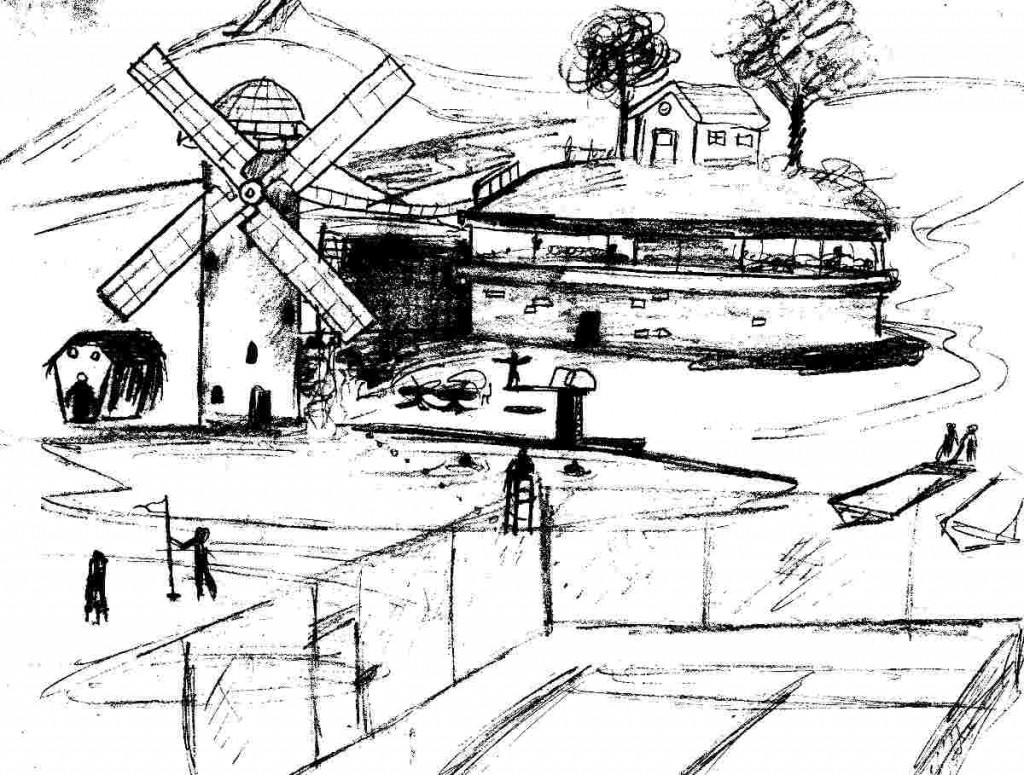
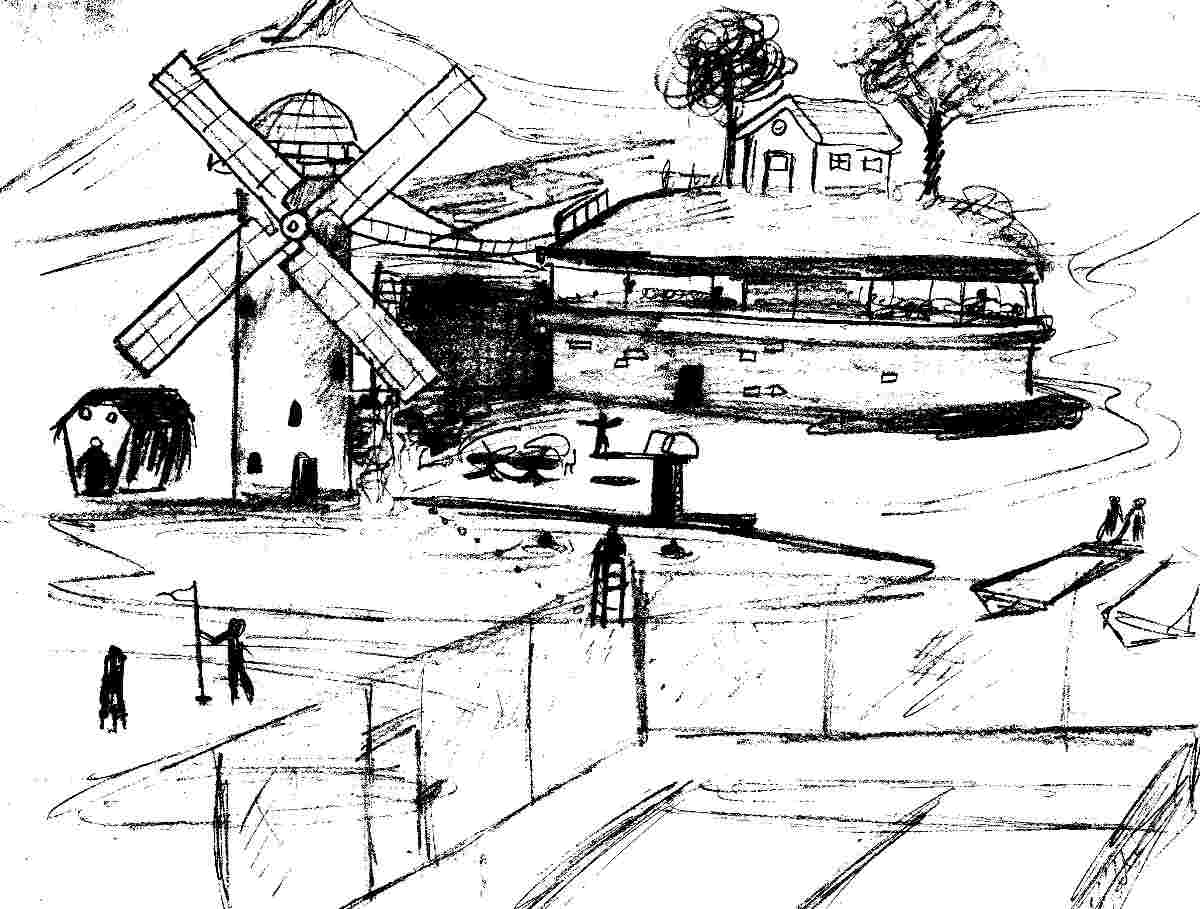
Hearing this story reminded me of a concept I co-developed with a buddy named Mike Harty back in high school (in 1974). Mike and I often discussed death back in high school. Many of our classmates found the topic to be disturbing, but it energized and entertained us. One day, we wondered what kind of potential market might exist for post-death “living” arrangements for families whose loved ones were now corpses. We called our concept “Holland House,” (I believe that we borrowed the named from this real life opulent estate). Our company slogan would be: “We think your loved ones should not be deprived of their earthly pleasures.” And also this one: Holland House: Open to all dead people from 7 to 70.” Mike even drew a photo of Holland House, which would offer wealthy families the finest in post-death community living:

[caption id="attachment_8651" align="aligncenter" width="445" caption="Art by Mike Harty"]holland-house-lo-res[/caption]

Holland House would be a large lavish resort for dead people, an alternative for families not willing to plop their dead loved ones into graves. Here's how we planned to market Holland House. Important announcement for bereaved families. Consider this alternative to burial or cremation. Simply send your loved ones to Holland House and we will carry on where the nursing home left off. Our attendants will start the day by taking your loved one’s corpse out of bed, dressing it and wheeling it to the breakfast table, where it would sit (admittedly stiffly and silently) in front of fresh food prepared by highly trained chefs. After breakfast, we will wheel your loved one to a wide variety of activities, including various classes and recreational activities. There would be visiting hours, where the families could come to talk to their dead loved ones—Holland House staff would wheel the corpse into a brightly lit visiting area, with tea and cookies, where the family could present an update about what was going on with the living members of the family. Our professional staff would update the family as to their loved ones' activities at Holland House. For instance, we might advise: "Yesterday we had a photography class and horseback riding. Tomorrow, we will have dancing classes--two attendants will assist each corpse--and shuffleboard." [caption id="attachment_8653" align="alignright" width="282" caption="Art by Mike Harty"]Art by Mike Harty[/caption] Holland House would have a photographer on staff to keep the family photo album updated with photos of everyone in the family, alive or otherwise. [I'm not recounting these ideas from pure memory. Mike and I wrote up an outline of the services to be offered by Holland House] Mike and I planned that Holland House would have private rooms for each of the guests, with a color TV in each room. We’d have an extensive library and a medical center (where we’d we well stocked in deodorant). We offer night classes too, including a favorite: “How to get the most out of life.”). There would be a dating service, where we’d match residents based on their accomplishments while they were alive. We’d have a high end clothes store, so that our residents were always wearing up-to-date fashions. Our foods would be naturally grown organic foods fertilized by former residents. Oh, and we'd be careful at Holland House that we'd never refer to our residents as "dead." Perhaps you're wondering how long would a corpse stay at Holland House? The answer is simple: as long as the family couldn’t bear to dispose of the corpse in some other way or until the family money ran out, whatever came earlier. I am offering this idea for free to anyone who wants to offer Holland House services to people with far too much money. Then again, perhaps post-death living might get so popular someday that Medicare would pick up the tab, which could lead to multiple generation families residing on entire wings of Holland House . . . Mike and I created all of this for our amusement many years ago, but this concept was all triggered by the fact that so many people can't acknowledge that dead people were really and truly dead.

Continue ReadingHolland House: a real world place to enjoy life after you die.