
Culture as a collective fabrication facilitating our quest for immortality
I often wonder how people are capable of simply going about their business, chatting about last night’s sporting event, working on crossword puzzles or thinking about buying a new car, despite the fact that they will be dead someday, maybe even someday soon. And for those with children, their children will also be dead a few decades later. How can we possibly live with those dreaded thoughts hanging over us? In fact, every person now living will likely be dead in 150 years. How can we engage in mundane things like gossiping, consuming, traveling and amusing ourselves when every person on the planet is facing annihilation? How do we put death out of our minds so easily?
Ernest Becker would suggest that I have it all backwards. According to Becker, people intensely amuse and distract themselves, and immerse themselves in culture, because they are anxious about death. They are not necessarily consciously aware of their impending deaths, but they feel it deeply, and their minds grind and sputter on this topic, under the surface, unconsciously.
We do the best we can to deal with this terrifying thought that we will all be dead, and the best we can think of doing is to distract ourselves with the many bright and shiny bigger-than-us, bigger-than-life things offered by culture. We put these things on a pedestal and then we cling to them as if they were life preservers. We embellish our cultural treasures with accolades recognizing their “eternal” significance. “Strawberry Fields Forever,” Babe Ruth, stamp collections, being a trivia pursuit star, triathlons, Michelangelo’s David. And for some of us, Jesus Christ loves us and He will let us live with him forever in heaven. According to Becker, these cultural mainstays are important for keeping us steady, even while death (and the threat of death) lurks around every corner.
I recently had the opportunity to watch the highly acclaimed low-budget 90-minute 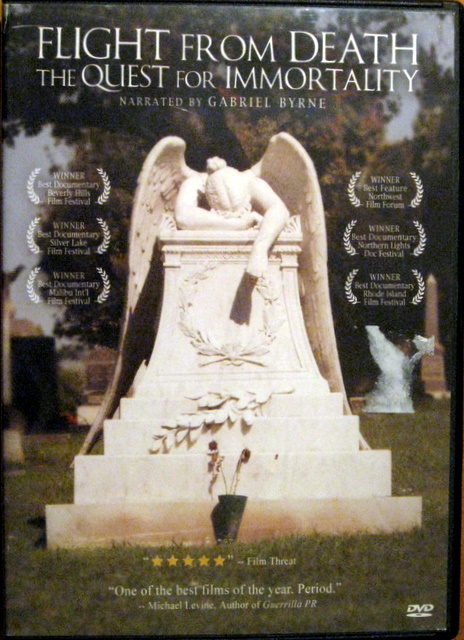 2005 documentary titled "Flight from Death: the Quest for Immortality,” produced by Patrick Shen and Greg Bennick. The film is based on the works of Ernest Becker’s “terror management theory,” (TMT) on which I’ve written several times (see here and here). Even though I was well acquainted with the works of Becker prior to viewing this video, I found the film to be transformative, in that it offers a schematic of underlying “hydraulics” that help us to understand many things that otherwise seem so puzzling about culture. I’d highly recommend “Flight from Death” whether or not you sometimes find it stunning that you live on a planet where mobile intestinal tracks scurry about, drive buses and even serve you meals at your local restaurant. Here’s the trailer.
Even though I was already familiar with Becker’s theory and many of the experiments substantiating Becker’s theory, I found the film illuminating. “Flight From Death” includes well-chosen imagery and music to accompany the interviews with thoughtful and eccentric people from a wide variety of backgrounds (including psychologist Sheldon Soloman and writer Sam Keen, among others).
[More . . . ]
2005 documentary titled "Flight from Death: the Quest for Immortality,” produced by Patrick Shen and Greg Bennick. The film is based on the works of Ernest Becker’s “terror management theory,” (TMT) on which I’ve written several times (see here and here). Even though I was well acquainted with the works of Becker prior to viewing this video, I found the film to be transformative, in that it offers a schematic of underlying “hydraulics” that help us to understand many things that otherwise seem so puzzling about culture. I’d highly recommend “Flight from Death” whether or not you sometimes find it stunning that you live on a planet where mobile intestinal tracks scurry about, drive buses and even serve you meals at your local restaurant. Here’s the trailer.
Even though I was already familiar with Becker’s theory and many of the experiments substantiating Becker’s theory, I found the film illuminating. “Flight From Death” includes well-chosen imagery and music to accompany the interviews with thoughtful and eccentric people from a wide variety of backgrounds (including psychologist Sheldon Soloman and writer Sam Keen, among others).
[More . . . ]