
Political boundaries

On my way home tonight, I listened to NPR’s Andrea Seabrook talk about “Politicians And Their Wives: What's Fair Game?” I recalled a political science class from the early 1980s and a professor who was examining the dignity of the office of Presidency…and how it was eroding. He related how when FDR got out of a vehicle, the media would turn their heads, examine their nails, look up at the birds, point their cameras away until he got in his chair and covered his legs. Regardless of the words, accusations, criticisms in print, the visual privacy – and dignity - was preserved. I also recalled the (comical to me at the time) formal morning coat of the 1981 inauguration, as Reagan wanted to restore the dignity that supposedly was lost when Carter walked the parade route and had a “People’s Inauguration.” I imagine the professor mentioned above would have been appalled at the television coverage of Reagan’s colon polyps a few years later and probably outraged at the media of today. So what changed? [More . . . ]

Continue ReadingPolitical boundaries

Chinks III

Since writing Chinks II, I’ve felt uneasy about calling the Vietnamese workers in that nail salon ‘racists’. It’s true that they pigeonholed an African-American patron as a lazy welfare recipient who was unwilling to get a job. They seemed to take pleasure in voicing all the hurtful stereotypes that could be applied to a total stranger. I found their behavior cruel, terrifying and ironic.

The barb at the heart of Chinks II was minority on minority hate. Yet I described their hate speech as “tittering... nonsensical verbal massaging.” Even if the taunting was meant to be indecipherable, wasn’t I being a bigot myself by writing about it this way?

I can’t think of more alternatives to the pronoun “them.” That’s probably because I don’t know much about the Vietnamese women who taunted a black woman that day. (Here again, I resort to the roughest of rough sketches: “that black lady”). I don’t know their names. I don’t know where they live, although it’s probably not far from my own neighborhood. They are caricatures precisely because I have so few details with which to draw my group character sketch. And what would my cartoon self-portrait look like?

Qipao1

On the day of Chinks II, I was the most socially normative minority in the room. Being light-skinned, speaking with an American accent, growing up in a solidly middle-class household and earning a professional degree all help me to appear more “white” and inviolable. Who knows? It could have been my blessed-in-every-way-second-generation-Chinese-American presence that precipitated the verbal attack that I describe so vehemently. It’s not that I think I am the center of every story; though this story - all the Chinks stories - are about me and my perception of race. Chinks II simply exemplifies the pervasive, insidious, contagious nature of bigotry. This is a barb that hasn’t stopped pricking.

Continue ReadingChinks III
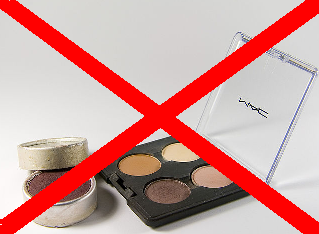
Read more about the article Makeup is the new girdle.
Original photo courtesy of Wikimedia Commons.

Makeup is the new girdle.

I stopped wearing cosmetics a few months ago, after about half a year of using the stuff only sparingly. I started weaning myself off makeup because I had come to hate the hassle of applying it, and because I hated fretting about my appearance. I was also beginning to think of makeup as old-fashioned, an antiquated 'modesty' that inspires shame in one's true appearance. The longer I go without a cosmetic product on my face, the more I believe that makeup needs to go the way of the girdle. The restrictive, uncomfortable, needless, obsolete girdle. How many undergarments are you wearing right now? I'm guessing two at most. Likewise, I only wear two small undergarments below my clothes, even on the most formal occasions. Interview? Presentation? Class? Wedding? A bra and underwear are always adequate. Since I've never had to wear more than two undergarments, I find it staggering that women used to wear massive bras, high-waisted underwear, girdles, pantyhose or stockings, garter belts, slips, and camisoles. I often wear less than that as a full outfit. Anyone who knows me in real life can confirm that I regularly step out in leggings and a t-shirt (plus two small undergarments beneath). I don't say this to titilate, just to illustrate, because I suspect my bare-bones attire is quickly becoming the norm. I've spent a lot of time on college campuses- big and small, public and private, Jesuit and blessedly godless. Everywhere I've seen legions of women and girls decked out in equal or greater states of undress than my own. Gone are the girdles. [More . . . ]

Continue ReadingMakeup is the new girdle.

The filtered Internet

It used to be that people were subject to the whims of old media, human gate-keepers who decided that type of information we should see. The Internet was supposed to change all of that, but we are now seeing startling examples that Facebook, Google, and Yahoo News among many other companies, are using algorithms to please us by giving us what they deem to be “relevant.” Author Eli Pariser, executive director of Moveon.org, asked several friends to search the same term (“Egypt”) in Google, and they received dramatically different results. It turns out that there is no longer any standard version of Google. The new version uses dozens of bits of information about you to give you what it thinks you want. Facebook also employs such relevance algorithms to weed out information, and even “friends” that it has decided that you don’t want. In the case of Pariser, whose politics are progressive, Facebook edited out information from his conservative “friends.” What would be the advantage to giving us what we want? Certainly, some of us want to live in a world where everyone appears to think the same. But such filtering would also have a commercial purpose—giving only “relevant” hits might facilitate Internet sales. In this excellent ten-minute TED talk, Pariser tells that the Internet is increasingly geared to giving us what we want to see rather than what we need to see. In this talk, Pariser has challenged the new Internet gatekeepers to make this ubiquitous filtering of information transparent and to give user control over it. We will all be better off, he warns, when we get information that makes us uncomfortable, and information that is important, as well as information that challenges us, rather than simply giving us what they think we want.

Continue ReadingThe filtered Internet

Frustrating Funeral

I have been to quite a few funerals in the last several years. Most of them were for elderly relatives. Some few of these funerals annoyed me because the master of ceremonies was a minister who apparently knew little of the departed, and so just delivered a half hour recruiting speech for his church, and called no other witnesses. This weekend I went to the funeral of a cousin by marriage, my own age, who suddenly dropped dead. The processional music was appropriate for the deceased: "Margaritaville." So I was looking forward to the service. A relative stood up at the lectern and said that this was to be a celebration of life. More hope rose. But what followed was twenty minutes of pious speech about how important it is for everyone to love Jesus, especially since this life is not the important one, but rather the next. Eventually he wound down and briefly mentioned a couple of actual details from the life nominally the topic of this occasion. I knew that his family partook of that popular death cult, Fundamentalist Christianity. But my few conversations with the suddenly departed never led me to believe that he took that afterlife very seriously. He seemed a live-life-to-the-fullest sort who embodied the Martin Luther quote: "Who loves not wine, women and song, Remains a fool his whole life long." So this service by someone who knew him did not strike me as entirely appropriate. Granted, it did match the services I'd attended for his elder relatives, and did not seem to discommode his closer family. I see there is a sociological purpose to sharing ridiculous claims, and of being reassured by authority figures that these absurdities are true, especially at times of stress. It is a form of claiming kinship, of affirming loyalty to an in-group. But to me, a funeral should be a celebration of a life, a sharing of a personality and experiences. It annoys me when the service primarily focuses on recruiting for a church, and as an aside, oh, yeah, this man also had an individual life.

Continue ReadingFrustrating Funeral