Excellent writing

I agree with this observation by Glenn Greenwald:

The highest compliment one can give a writer is not to say that one wholeheartedly agrees with his observations, but that he provoked — really, forced — difficult thinking about consequential matters and internal questioning of one’s own assumptions, often without quick or clear resolution.

Continue ReadingExcellent writing

Elementary Election Protest Too Muchedness

For the last few weeks I'd been receiving approximately daily post cards protesting the electric company considering a rate hike of more than a few percent in order to finance and build future power plants to replace some of the nearing dangerously obsolete ones. Some mailing came from a very liberal local politician with whom I generally agree. Someone is spending bales of money to encourage people to not-want to spend more for what they are already getting. Seems like sweeping the water downstream, to me. But I'm a Tanstaafl skeptic: Rebuilding infrastructure without incurring crippling debt does not seem like such a bad idea, my knee jerks. Also, local electric rates are lower than when I was in college, when adjusted for inflation, so it seems about time for a rate hike, anyway. Yesterday I finally got a rebuttal mailing that describes the finances behind this odd campaign: PAC affiliated with aluminum corporation at play in state Senate primaries. Yep, an aluminum company fears that it will have to raise prices, because a major part of the process of making it requires megawatts of electricity. Here's how aluminum is made, if you are at all curious: So now we know who has the profitability to outspend a huge power company on a campaign to make people do what they want to do anyway, and things are making sense, again.

Continue ReadingElementary Election Protest Too Muchedness

Another day, another BS U.S. drone strike story

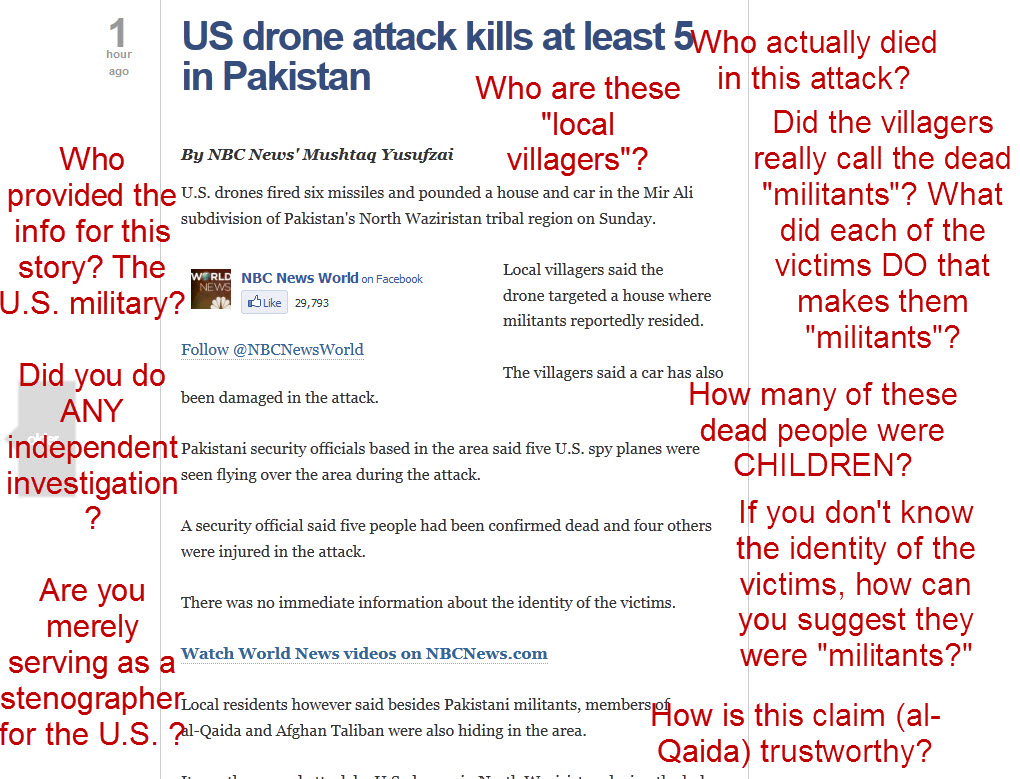
Yesterday I spotted another one the many U.S. drone strike stories--the story I read was published by MSNBC. These stories are incredibly predictable: U.S. drones launched an attack that killed a group of people from the Middle East who are presumed to be bad people despite the fact that we have no idea who these victims were. The witnesses and the victims are unnamed. The source of the entire story could well be the U.S. military, which has no idea who the dead people are and, in fact, has been repeatedly caught claiming that the dead people were threats to America (through the use of the word "militant") when many, if not all of them turned out to be innocent people, including children. And, of course, there is no information about how the local people acted. They should be outraged, because, according to the story, unknown people were killed from the sky by the U.S., which has repeatedly outraged the government of Pakistan for such conduct in the past. For all we know, this attack, like so many other attacks, has angered the people, causing them to swear revenge against the United States. But you'd have no idea of whether this attack advanced the interests of the U.S. or hurt U.S. interests. This is a prototypical sterile story about the U.S. using its high tech weaponry to preserve freedom, or so this immensely obeisant and gappy story suggests. The U.S. doesn't know who was killed, even long after the fact, because the U.S. doesn't care. If they cared, they would quickly announce who the dead people were and tell U.S. citizens the "bad" things these people did to deserve to die such a fiery death, often in the presence of their children. I'd like to give a lot of credit for what follows to Glenn Greenwald, who has repeatedly pointed out that these drone strikes are usually nothing but propaganda, and that the word "militant" is used as follows: Any person killed by a U.S. weapon. With Greenwald's guidance, I decided to mark up the opening lines of the MSNBC story as if I were an editor reacting to the reporter's first draft:  

Continue ReadingAnother day, another BS U.S. drone strike story

Judge Baltasar Garzon to lead WikiLeaks legal strategy

The following update is from Justice for Assange:

The Spanish judge, lawyer, and international jurist, Baltasar Garzón, will lead the legal team representing Julian Assange and WikiLeaks. The jurist met with Julian Assange at the Ecuadorian embassy in the United Kingdom recently. The purpose of the meeting was to discuss the new legal strategy which will defend both WikiLeaks and Julian Assange from the existing abuse of process; expose the arbitrary, extrajudicial actions by the international financial system which target Julian Assange and WikiLeaks specifically; and show how the secret US processes against Julian Assange and WikiLeaks have compromised and contaminated other legal processes, including the extradition process against Mr Assange. Despite been imprisoned, fiscally blockaded, and placed under house arrest for over 650 days, Mr. Assange has not been charged with an offense in any country.

Baltasar Garzón revolutionized the international justice system two decades ago by issuing an international arrest warrant for the former Head of State of Chile, Augusto Pinochet. His actions spearheaded the fight against impunity in Latin America and in the rest of the world. The judge has expressed serious concerns regarding the lack of safeguards and transparency whith which actions are being taken against Julian Assange, and the harassment he is being subjected to which has irreparable effects on his physical and mental wellbeing. The threats against his person are further aggravated by the complicit behaviour of the Swedish and U.K. governments, who are wrongfully abrogating his rights.

Continue ReadingJudge Baltasar Garzon to lead WikiLeaks legal strategy

Olympic-sized Intellectual Property Crackdown

This is not a humorous parody from The Onion. What follows is an excerpt from a serious news interview hosted by Amy Goodman of Democracy Now:

AMY GOODMAN: The Olympic Games are estimated to cost British taxpayers a staggering $17 billion. At the same time, Brits near the Olympic Park have been subjected to sweeping censorship laws enacted by their government at the behest of the International Olympic Committee. The laws limit the use of Olympic language and imagery to—strictly to official sponsors, such as Visa, McDonald’s, GE. . . . AMY GOODMAN: And a mock awards ceremony at the Olympic clock in Trafalgar Square descended into farce after police arrested six people taking part. Three people pretending to be corporate representatives from BP, Dow and Rio Tinto were awarded gold medals for being the worst corporate sponsors of the Olympics, before having small quantities of green custard poured over their heads. The good-natured performance took about 15 minutes. It was clearly amusing to a number of passersby, until 25 police officers arrived and arrested six people, including the three corporate representatives and people who were mopping up the small amounts of custard on the ground. Well, for more, we go to London, where we’re joined by Jules Boykoff, associate professor of political science at Pacific University, currently a visiting scholar at the University of Brighton. He was born in England since—he’s been in England since April following the build-up to the Olympics. He’s writing a book on dissent and the Olympics and played for the U.S. Olympic soccer team in international competition from 1989 to 1991. His recent piece in the New York Times is called "Olympian Arrogance." Jules Boykoff, welcome to Democracy Now! Well, tell us what you’re seeing there and why you titled your piece "Olympian Arrogance." JULES BOYKOFF: Well, what we’re seeing here are a lot of what you’ve outlined in terms of the intense militarization of the public sphere. And it really does go back to the International Olympic Committee, or the IOC. And that’s what we are getting at with "Olympian Arrogance." If you want to understand the crass commercialism of the Games, if you want to understand the intense militarization of the Games, it makes sense to start with the IOC. And the IOC has always been a privileged sliver of the global 1 percent. Going back to the 1890s, when it was started by Frenchman Pierre de Coubertin, he basically assembled a hodgepodge of counts and dukes and princes together to run the show. In the subsequent, basically it’s remained this basically old boys’ club. In fact, they started allowing wealthy business elites into the club. And only in 1981 did they start to allow women to be members of the IOC. And it’s not just the composition of the IOC that some might find a little bit problematic; it’s the dictates that they impose on host cities. So, for example, right before they make the final selection for who’s going to host the next Olympics, all the candidate city finalists have to sign a document that promises that they will follow all 33 of the IOC’s technical manuals down to a letter. A lot of that has to do with brand protection, which I’ll get to in a second. But it also has to do with creating new laws in the country and the host city that conform to the principles of the IOC. So, here in London, what they did was they passed the 2006 Olympic and Paralympic Act, which did all sorts of things. You mentioned it’s illegal to use the words "2012" and, say, "medals" for commercial purposes in any form, and you can receive a 20,000-pound fine. This all goes back to the IOC and what they set up and impose on host cities. And that’s why you’re seeing, when you look around—you said I was here since April, so I was here for the Jubilee, actually. And when the Jubilee happened for the queen, there were signs in windows, there were people celebrating, shops put little placards up and that sort of thing. Well, right now, during the Olympics, you’re really not seeing that very much, because people are afraid that they’re going to get cracked down on. Just a couple examples. A butcher put a bunch of sausages up in his window in the shape of the Olympic rings; he got asked to take them down. Somebody in Plymouth put up on their menu a "flaming torch breakfast baguette," and they were asked to take it off the menu. A florist was—put up a little display in the front of her store in the shape of the Olympic rings; again, told to take it down or face a 20,000-pound fine. So, the IOC is really where a lot of this starts.

Continue ReadingOlympic-sized Intellectual Property Crackdown