Commonalities Between Woke Culture and Religion

From a recent article by psychologist Valerie Tarico titled, "The Righteous and the Woke – Why Evangelicals and Social Justice Warriors Trigger Me in the Same Way."

It occurred to me recently that my time in Evangelicalism and subsequent journey out have a lot to do with why I find myself reactive to the spread of Woke culture among colleagues, political soulmates, and friends. Christianity takes many forms, with Evangelicalism being one of the more single-minded, dogmatic, groupish and enthusiastic among them. The Woke—meaning progressives who have “awoken” to the idea that oppression is the key concept explaining the structure of society, the flow of history, and virtually all of humanity’s woes—share these qualities.To a former Evangelical, something feels too familiar—or better said, a bunch of somethings feel too familiar.

Tarico then lays out many of the similarities in detail. The similarities include:

Righteous and infidels

Insider jargon

Born that way

Original sin

Orthodoxies

Denial as proof

Black and white thinking

Shaming and shunning

Selective science denial

Evangelism

Hypocrisy

Gloating about the fate of the wicked

Continue ReadingCommonalities Between Woke Culture and Religion

Real Numbers on Cancel Culture

Many people argue that people are not really at risk regarding cancel culture. John McWhorter offers some real numbers in his article in The Atlantic, "Academics Are Really, Really Worried About Their Freedom: Some fear for their career because they don’t believe progressive orthodoxies."

To the extent that the new progressives acknowledge that some prominent people have been unfairly tarred—including the food columnist Alison Roman, the data analyst David Shor, and the San Francisco Museum of Modern Art senior curator Gary Garrels—they often insist that these are mere one-off detours rather than symptoms of a general cultural sea change.

For example, in July I tweeted that I (as well as my Bloggingheads sparring partner Glenn Loury) have been receiving missives since May almost daily from professors living in constant fear for their career because their opinions are incompatible with the current woke playbook. Then various people insisted that I was, essentially, lying; they simply do not believe that anyone remotely reasonable has anything to worry about.

However, hard evidence points to a different reality. This year, the Heterodox Academy conducted an internal member survey of 445 academics. “Imagine expressing your views about a controversial issue while at work, at a time when faculty, staff, and/or other colleagues were present. To what extent would you worry about the following consequences?” To the hypothetical “My reputation would be tarnished,” 32.68 percent answered “very concerned” and 27.27 percent answered “extremely concerned.” To the hypothetical “My career would be hurt,” 24.75 percent answered “very concerned” and 28.68 percent answered “extremely concerned.” In other words, more than half the respondents consider expressing views beyond a certain consensus in an academic setting quite dangerous to their career trajectory.

So no one should feign surprise or disbelief that academics write to me with great frequency to share their anxieties. In a three-week period early this summer, I counted some 150 of these messages. And what they reveal is a very rational culture of fear among those who dissent, even slightly, with the tenets of the woke left.

Continue ReadingReal Numbers on Cancel Culture

About Cultural Revolutions

Then . . .

And now. Click on the photo for the story of this woman dining in DC, who was approached by BLM protesters, not satisfied to invade her while in a restaurant but insisting on the alleged need for compelled speech.

The woman dining in the restaurant is bravely exhibiting the correct approach when someone threatens you to make you say something you don't believe.  Here is a classic photo showing how to be brave.  Click on the photo for the story of the man who refused to salute Hitler.

Continue ReadingAbout Cultural Revolutions

The Topic of this Post is “Offensive”

[Note from Erich Vieth: Welcome to Bill Heath, our newest author at DI]

Greetings. I am, indeed, Bill Heath. I graduated Frostburg State University in 1970. I enjoyed the atmosphere of free exchange of ideas that the University promoted at the time. I have recently read the policy on posting at Lane University Center, and am disturbed. It appears unclear and and subject to abuse through capricious and arbitrary use. Specifically, " Postings that are deemed offensive, and/or that promote alcohol use, abuse, sale or distribution, will not be approved and are not permitted to be posted on LUC bulletin boards, with the exception of events approved by the University."

I have no problem with barring the alcohol-related content, nor the exception of University-approved events. I have a significant problem with "deemed offensive." The immediate questions are by whom, to whom, and under what standards?

I give a pass to postings and conduct that use a "reasonable person" standard, although I would prefer a "reasonable and prudent person" standard as that is better-defined in case law.

Under harassment policies, "Verbal/Written Assault includes verbal or written acts, including social media sites, which place a person in personal fear or which have the effect of harassing or intimidating a person...." authorizes the individual who believes he or she was offended, harassed or intimidated to set the standard, leaving the accused in a position of needing to prove his or her innocence. That policy cannot be reconciled with the University I attended, nor with my understanding of English Common Law and the U.S. legal practices descended from it. In short, without a revived office of the advocatus diaboli, or a Red Team with official sanction, the standards are clearly unconstitutional within a government entity such as FSU.A statement of policy is unlikely to be sufficient. Rather, action to affirm that the accuser's rights are not unlimited, nor are the accused's rights to be infringed.

I describe this example of a modern attempt to control speech to illustrate a wide and growing problem. For many additional examples courtesy of an organization that is willing to bring lawsuits against colleges and universities with over broad speech codes, see the website of FIRE, FOUNDATION FOR INDIVIDUAL RIGHTS IN EDUCATION.

Continue ReadingThe Topic of this Post is “Offensive”

Private Thought, Public Talk

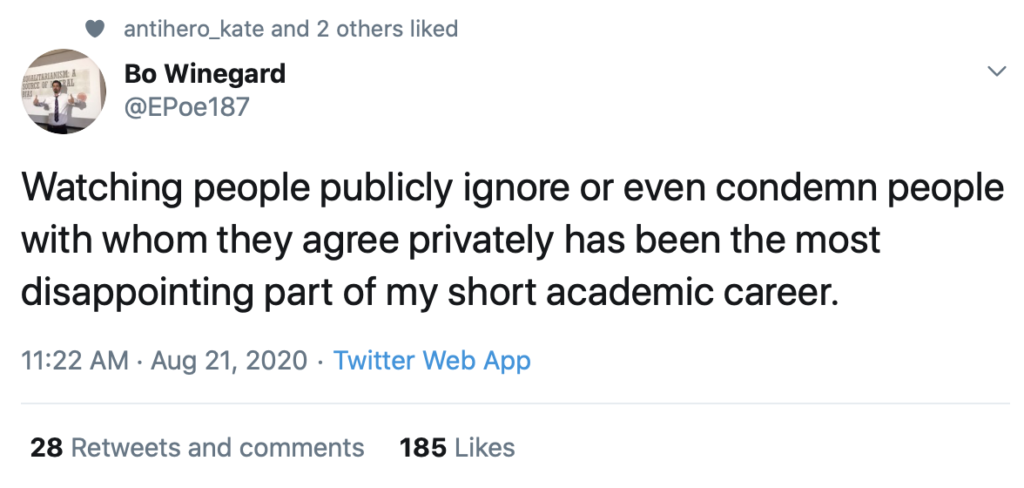
Tweet from Bo Winegard:

This public/private divide in honest communications is ubiquitous in the outside world too. If only we could force everyone to install devices on their heads that would, at random times throughout the day, broadcast their actual thoughts. We would take extra pains to make all people wear these devices in churches, political gatherings and wherever people feel pressure to please their in-groups.  Doing this would be revolutionary in our hypocrisy-permeated world. Mind-blowingly revolutionary. If we made people wear these devices for even a month this would train us to say what we are actually thinking and to clearly admit when we don't actually know things.

OK, yes. It this would also cause serious chaos as our hidden romantic/sexual secrets are made public at inopportune random times. This thought experiment is a work in progress . . .

Continue ReadingPrivate Thought, Public Talk