
The Effects of the FB Filter-Bubble re Attitudes of Trump Voters

On Facebook, I recently posed a Tweet by Chloe Valdary, a kind-hearted even-keel peace-making thinker who is most definitely not pro-Trump.  She is willing to call out problems on the political left as well as the political right. I find her opinions thoughtful and instructive.
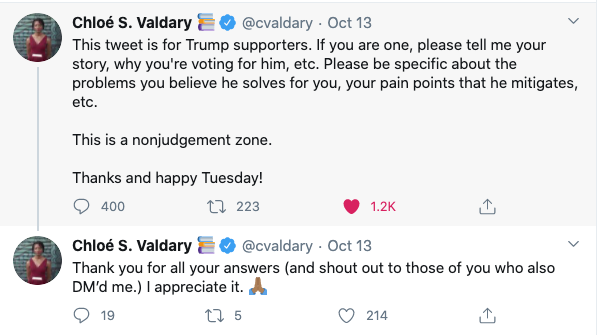
Here is how I introduced Chloe's Tweet (above) on FB:

I won't be voting for Trump, but I'm still concerned he might win re-election. I think many people feel similarly -- otherwise, why do so many people keep talking about the election and the polling? I've often wondered why so many people will vote for Trump, despite his many cataclysmic negative personal qualities. I'm glad that Chloe Valdary asked Trump voters to respond to her Twitter account by stating why they support Trump. She has received more than 300 responses that I found interesting to review. These responses don't change my mind about Trump, but I do see many Trump supporters in a different light.

In response, I saw a firestorm of anger from people on the political left. People who were angry with me that I would even consider what Trump voters think.  Many of them seem to be assuming that Trump voters are perfectly aligned with Trump. They vented at Trump voters as close-minded people who are, seemingly, identical to Trump in everything they think.

I see a big tent on on the right as well as on the left. Just as there are people who are going to hold their nose and vote for Biden, there are people on the right who are going to hold their nose and vote for Trump. I think it is a worthy project to ask those Trump supporters why they are voting for a man who I find to be so personally despicable. Yes, there are many Trump supporters who I do find deplorable (and some of those people on the left too), but there are many other people (some I know personally) who I like as human beings, who I disagree with on many issues, but who are going to vote for Trump.

Instead of curiosity in reaction to my FB post, I'm seeing lots of hostility for even asking the question, for inquiring. This unwillingness to be curious about the facts troubles me on many levels. In fact, this is self-defeating behavior suggesting an "analysis" that has been contaminated by roiling emotions. I understand the emotions and I understand the stakes of this election, but it seems that many of us could do much better. Rather than being smart, they are getting drunk on anger. They need to listen to Yoda:

“Fear is the path to the dark side. Fear leads to anger. Anger leads to hate. Hate leads to suffering.”

“Once you start down the dark path, forever will it dominate your destiny. Consume you, it will.”

Anger… fear… aggression. The dark side are they. Easily they flow, quick to join you in a fight. If once you start down the dark path, forever will it dominate your destiny, consume you it will, as it did Obi-Wan’s apprentice.

They also need to consider this idea by Sun Tzu, from the Art of War":

If you know the enemy and know yourself, you need not fear the result of a hundred battles. If you know yourself but not the enemy, for every victory gained you will also suffer a defeat. If you know neither the enemy nor yourself, you will succumb in every battle.
Continue ReadingThe Effects of the FB Filter-Bubble re Attitudes of Trump Voters

Sales, By the Book

At one point in my life, I was thinking of writing a non-fiction book. It's something I always wanted to do. My plan was to use some of the articles I've written for this website as a foundation.  But then I looked at the average sales of non-fiction books from this article:  "The 10 Awful Truths about Book Publishing." Ugh.

3. Despite the growth of e-book sales, overall book sales are still shrinking. After skyrocketing from 2008 to 2012, e-book sales leveled off in 2013 and have fallen more than 10% since then, according to the AAP StatShot Annual 2015. Unfortunately, the decline of print sales outpaced the growth of e-book sales, even from 2008 to 2012. The total book publishing pie is not growing—the peak sales year was in 2007—yet it is being divided among ever more hundreds of thousands of print and digital books.

4. Average book sales are shockingly small—and falling fast. Combine the explosion of books published with the declining total sales and you get shrinking sales of each new title. According to BookScan—which tracks most bookstore, online, and other retail sales of books (including Amazon.com)—only 256 million print copies were sold in 2013 in the U.S. in all adult nonfiction categories combined (Publishers Weekly, January 1, 2016). The average U.S. nonfiction book is now selling less than 250 copies per year and less than 2,000 copies over its lifetime.

5. A book has far less than a 1% chance of being stocked in an average bookstore. For every available bookstore shelf space, there are 100 to 1,000 or more titles competing for that shelf space. For example, the number of business titles stocked ranges from less than 100 (smaller bookstores) to up to 1,500 (superstores). Yet there are several hundred thousand business books in print that are fighting for that limited shelf space.

It's stunning to me that the total number of copies of non-fiction print books sold each year is less than the number of Americans.  Someday I might again reverse, but these numbers put the kibosh on my book-publishing passion.  For now, It's good to know that I have a website where I can publish my ongoing, evolving, thoughts on a number of topics.  I can write about anything that interests me.  At a minimum, it serves as a personal diary.  As a bonus, there is a fair amount of traffic coming to the site, which leads me to hope that some others are finding some of my thoughts to be useful.  I started this website in 2006 and it has served well as a platform for developing my ideas and interacting with others who show an interest.

I have a lot of new ideas I've been working on (including many dichotomies that I had intended to feature in my book). Most of these ideas concern cognitive science and philosophy. If my work life cooperates,  I'll be carving out more time in a typical day to work on my ideas - - I hope to publish more ideas to which I can lay personal claim, though everything I write is with a heavy debt to hundreds or thousands of other people I've encountered in person or through their writings.

Onward!

Continue ReadingSales, By the Book

Bertrand Russell’s Test: Is your Belief Based on Reason?

Bertrand Russell had this to say:

If you think that your belief is based upon reason, you will support it by argument, rather than by persecution, and will abandon it if the argument goes against you. But if your belief is based on faith, you will realize that argument is useless, and will therefore resort to force either in the form of persecution or by stunting and distorting the minds of the young in what is called ‘education.’This last is peculiarly dastardly, since it takes advantage of the defencelessness of immature minds. Unfortunately it is practised in a greater or less degree in the schools of every civilized country.
Human Society in Ethics and Politics - 1954

Continue ReadingBertrand Russell’s Test: Is your Belief Based on Reason?

Facebook Safe Usage Product Warnings

I recently watched the new documentary, "The Social Dilemma." which has inspired me to cut my usage of Facebook. Rather than simply scold myself to cut FB usage, I decided to create more detailed guidance for myself (and anyone else who finds this useful):

Facebook Safe-Usage Product Warnings

A. Use FB no more than 10 minutes per day (extra time allowed for posting content I create and for exchanging private messages). Set a timer. This limited use will function like the rule many people use for potato chips: Put a handful into a small bowl instead of gobbling them out from the full bag.

B. Before any FB session, remind myself that FB is a valuable and useful platform with serious hidden dangers. Thus, using FB is like using a dangerous consumer product where the manufacturer failed to attach necessary usage warnings.

C. Remind myself that FB has been meticulously designed as a highly-sophisticated manipulation engine. In the short run, FB is addictive. In the long run, FB encourages us to think like teams instead of as individuals and this it is ripping our communities apart.

D. Only use FB intentionally, never out of boredom, out of habit or thoughtlessly. Don’t use FB unless I’m using it consciously. Avoid using FB when I’m tired or fatigued, because these are times when I am especially prone to go down the FB rabbit hole.

E. Before using FB, always ask myself whether there is a better use of my time, such as directly reaching out to a friend or choosing my own next thought process.

F. Do not access FB from my phone.

G. Keep all FB notifications turned off, except for private messages.

H. Use FB for several defined purposes only. If I stray from these purposes, turn FB off.

1. Checking out what is up with people I know well. 2. Interacting with thoughtful people. 3. Reading and sharing interesting, inspiring and light-hearted posts. 4. Connecting with special-interest FB Groups that I have consciously chosen to join. 5. Keeping an eye on FB Events that I might want to attend. 6. Sharing my photography and articles I’ve written at Dangerous Intersection. 7. Sharing well-written articles that I have found outside of FB.

I. Whenever on FB, I should strive to use the same tone and degree of kindness that I use when communicating with someone in person.

J. My FB friends will mostly be feeding me a steady diet of articles that reenforce my existing opinions. Therefore, I need to remind myself to always look beyond FB to seek out diverse sources of information, including news sources that are not in my comfort zone.

K. Repeatedly remind myself that FB’s algorithms delude users into believing that those with differing opinions are idiots who we are entitled to treat rudely.

L. Whenever I sense that I am caught in a cycle of doom-scrolling, I should shut off FB.

M. Always vet articles for accuracy before sharing anything on FB.

N. Remind everyone I meet to watch the important new documentary: The Social Dilemma.

Continue ReadingFacebook Safe Usage Product Warnings