Suggested Rules for Running a Democracy

DataRepublican (small r) is making quite a splash on X these days, especially her work drawing connections and running data to assist Doge identity waste and fraud. I like her suggestions here:

It’s really that simple:

🔹Don’t censor opposing viewpoints

🔹Condemn political violence in all its forms

🔹Don’t call for mass sweeping arrests

🔹Don’t scheme to remove political leaders or parties

🔹Don’t overwrite the will of the people with backdoor policies like mass migration

🔹Realize regime change has cost countless lives and dollars

🔹Cutting off NGOs does not make one an enemy of democracy

🔹The people are the judge of norms and institutions. Not the other way around.

Continue ReadingSuggested Rules for Running a Democracy

Global Free Speech Threat

Michael Shellenberger explains that real progress is being made domestically to protect free speech, but the EU is actively working to impose its authoritarian speech controls over US social media:

Since taking office, President Donald Trump has moved swiftly to dismantle the federal censorship infrastructure. In his first week, he signed an executive order barring agencies from funding or facilitating the monitoring or removal of lawful domestic speech.

His administration has phased out censorship-related NSF grants, eliminated the State Department’s Global Engagement Center, which had coordinated with outside groups to shape online narratives, and shut down USAID, which funded censorship advocacy in Europe and Brazil.

And Trump’s 2026 budget proposes cutting $491 million from the Department of Homeland Security’s Cybersecurity and Information Security Agency, which oversaw election and Covid censorship in 2020 and 2021.

But the threat to free speech remains and has even grown stronger around the world, particularly in Europe. The UK is arresting 30 people per day for speech crimes. In Germany, 14 little-known state media agencies (SMAs) empowered by the 2020 “Media State Treaty” now monitor private journalists for compliance with vague “journalistic diligence” standards while exempting public broadcasters from the same scrutiny. French authorities want mandatory digital identification for users of social media platforms.

The European Commission appears to desire the power to ban or censor whole platforms, particularly Elon Musk’s X. And an Irish newspaper this week reported that the European Commission accused Ireland of “failing” to comply with laws regulating hate speech.

The wind remains at the back of free speech lovers. The change of government in the U.S. is already influencing Europe, where officials appear to be reconsidering some of the most aggressive censorship policies. In the UK, American negotiators have raised concerns about free speech tied to the Online Safety Act.

At the same time, in the EU, the Digital Services Act enforcement faces legal and logistical delays. France has drawn criticism for prosecuting satirical speech, and in Germany, a CBS 60 Minutes segment has fueled backlash against selective speech policing. Meanwhile, some in Brussels worry that the EU’s growing alignment with censorship risks its credibility as a champion of liberal democracy.

Even so, there is reason to be alarmed by what’s happening in Europe, says the Foundation for Freedom Online’s Mike Benz. “The most existential threats are now shifting around the international landscape and how that boomerangs back to the U.S.,” he said in a new podcast. American censorship leaders are working with European governments and NGOs to impose European censorship on social media platforms.

“The University of Cambridge Social Decisionmaking Lab works with the Global Engagement Center at the State Department,” he said. “It works with CISA at DHS. It works with the entire USAID network and USAID funds dozens of these funds — University of Cambridge’s censorship work, London School of Economics, King's College, Sheffield College, Oxford Internet Institute — the State Department and USAID fund all these. And they effectively are a foreign group that is paid for by taxpayers to subvert the agenda taxpayers voted for. It's an incredible scandal.”

And Europe is reacting to the Trump administration by seeking to replace the financing it cut for censorship. “Just this week,” Benz said, “the EU announced a a giant science research fund, $500 million, as an initial pool of funding and said they are actively recruiting researchers from the United States who USAID funded to come get their funds so they can continue their work by going to the EU. And this is happening in tandem with a tense standoff between the Trump administration and the EU over everything from Russia-Ukraine to tariff policy to tech regulation to you name it. And so the EU is basically pumping up the shadow diplomacy aspect of the US.”

All of this is happening at a time when the ruling parties in Germany, France, and Romania are resorting to increasingly undemocratic tactics in what appear to be desperate attempts to hold onto power as populist challengers surge in the polls. In Germany, the domestic intelligence service has officially labeled the AfD “extremist” a transparent response to the new government’s weakness and the AfD’s new status as the nation’s most popular political party. In France, prosecutors banned Marine Le Pen from running for president at a time where she too is polling first nationwide. And in Romania, the high court disqualified the leading opposition candidate from running for president, which most believe is a reaction to his opposition to a new NATO base in Romania.

“What's happening in Europe right now is simultaneously highly optimistic, white-pilling, inspiring, but also dark, twisted, sadistic, calamitous, catastrophic, and apocalyptic,” said Benz. Populist political success has caused NATO and the EU establishment to have “prosecutors and judges nullifying or barring candidates from running when they're winning, and prosecutors taking them out so they can't run again or can't make their voices heard or can't campaign because they're in prison or outright barred.”

Why is this happening? What can be done about it?

Continue ReadingGlobal Free Speech Threat

Wikileaks: Israel Sabotaged US Negotiations for Release of American Gaza Hostages

This on X, posted by Wikileaks:

“We’re the United States. We’re not an agent of Israel.”

— Adam Boehler

How Israel’s Actions Derailed Trump’s Hostage Return Deal

In December 2024, President Donald Trump appointed Adam Boehler as Special Presidential Envoy for Hostage Affairs. His mission: bring American hostages home.

Boehler’s immediate goal was the release of American-Israeli hostage Edan Alexander and the return of four others’ remains. With White House approval, he entered direct talks with Hamas in early 2025.

To widespread surprise, those talks showed rapid progress. Hamas offered to release the hostages within weeks, disarm, exit politics, and pursue a full prisoner exchange. “We’re close,” Boehler tweeted.

Israel discovered the negotiations via Unit 8200, its signals intelligence unit, according to journalist Ronen Bergman citing a senior U.S diplomatic source. Prime Minister Netanyahu and Strategic Affairs Minister Ron Dermer then launched what Bergman’s source called a “crazy campaign” to sabotage the talks.

News of the negotiations soon leaked to U.S. media and Republican circles. The White House initially backed Boehler. Press Secretary Karoline Leavitt affirmed that the President “fully backs and supports Boehler,” who “has the authority to talk to anyone.”

Boehler told reporters: “You could see something like a long-term truce—where we forgive prisoners, where Hamas lays down their arms, where they agree that they’re not part of the political party going forward. I think that’s a reality that’s real close.”

But by March 2025, Israel’s campaign to derail the talks escalated. Boehler became the target of coordinated attacks. One editorial called him Trump’s “complacent, confused, and dangerously naive hostage envoy.”

On March 15, Boehler withdrew as envoy. Secretary of State Marco Rubio dismissed the initiative, claiming the talks “bore no fruit.”

Three days later, Israel unilaterally ended the ceasefire with massive overnight bombings across Gaza, killing over 400 people. Former Israeli diplomat Alon Pinkas said the strikes had “zero military significance [and] no political end.”

A U.S. intelligence source told Bergman: “It became clear Netanyahu and Dermer are afraid it’ll suddenly be obvious who wants a deal and who doesn’t.”

“It’s a completely fucked up world if the administration has to fight off attempts by Netanyahu, Dermer, and the whole gang,” the official added. “Hard to believe, but we want to do more than the Israeli government to free the hostages.”

Boehler was reassigned to Afghanistan, where two U.S. hostages were freed on March 21 and 29. Meanwhile, the death toll in Gaza surpassed 52,000, and no further prisoner exchanges have taken place since Israel resumed bombing on March 18.

Continue ReadingWikileaks: Israel Sabotaged US Negotiations for Release of American Gaza Hostages

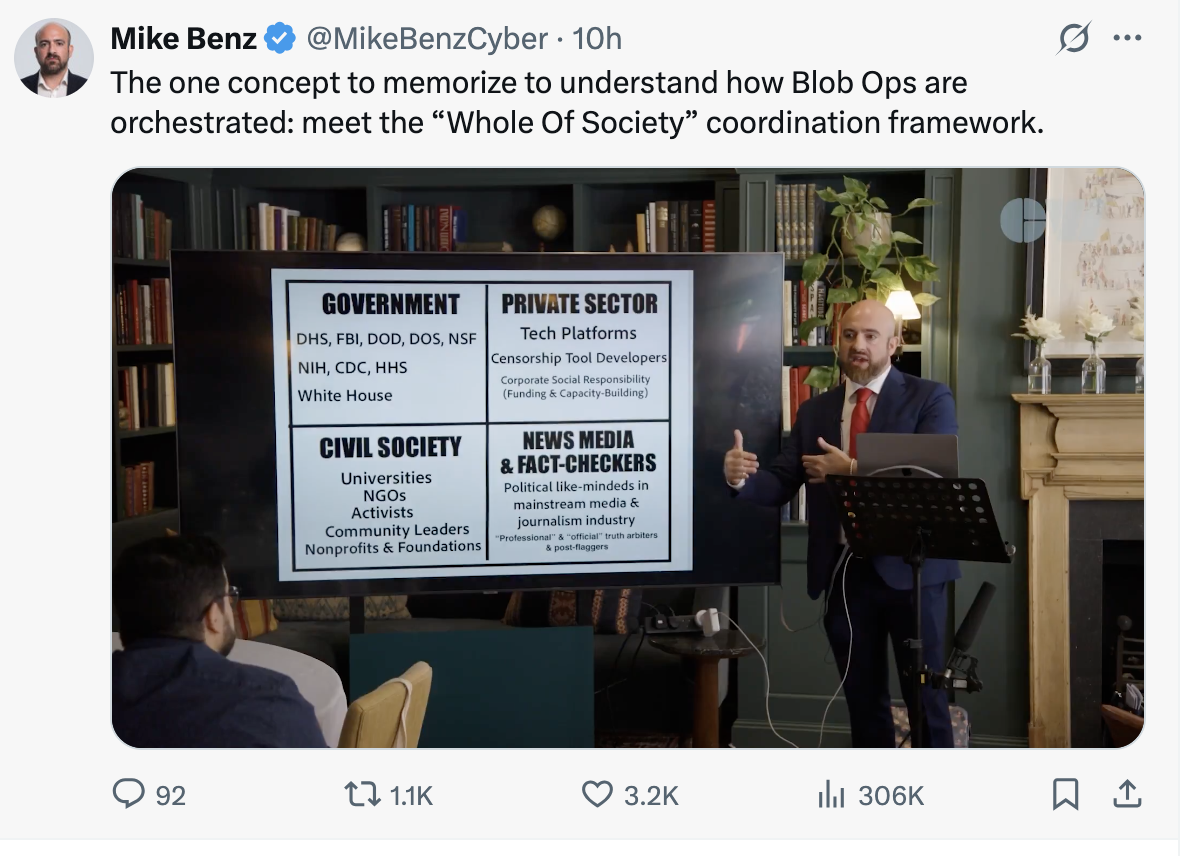
Mike Benz Explains “Whole of Society” Censorship

Excellent presentation by Mike Benz. Topic is "Whole of Society" Censorship.

To Supplement, I asked Grok to summarize "Whole of Society" Censorship. Here is Grok's answer:

The "whole of society" censorship approach refers to a coordinated effort involving government, private sector, academia, media, and civil society to control information and suppress certain narratives. It’s characterized by:

* Collaboration Across Sectors: Governments partner with tech companies, universities, NGOs, and media to monitor and restrict content deemed harmful or misleading, often bypassing legal constraints through informal agreements.

* Preemptive Narrative Control: Instead of just reacting to content, this approach shapes narratives proactively, promoting approved messages while marginalizing dissent through algorithms, fact-checking networks, and deplatforming.

* Broad Scope: It targets not only explicit misinformation but also "malinformation" (true information presented in ways that challenge official narratives), affecting political discourse, science, and public health.

* Examples: Documents like the Twitter Files revealed U.S. government agencies working with social media platforms to flag or remove content. The 2021 Stanford Virality Project, involving academics and tech firms, monitored vaccine-related content to counter skepticism. * Mechanisms: Include content moderation, shadowbanning, account suspensions, and funding "trusted" sources to dominate information ecosystems.

Critics argue it stifles free speech and centralizes narrative control, while proponents claim it’s necessary to combat disinformation at scale. The term gained traction in discussions about COVID-19 policy enforcement and election-related content moderation.

Continue ReadingMike Benz Explains “Whole of Society” Censorship

Free Speech Hypocrisy

Nico Perrino (of FIRE) sternly points out the rampant hypocrisy.

Do we actually believe in free speech?

Do we actually believe controversial speakers have a right to speak in America — free from government censorship?

For the past decade, I stood alongside conservatives who loudly — and justifiably — protested when speakers like Ben Shapiro and Charles Murray were prevented from speaking on college campuses, often under the guise of vague appeals to "safety."

Will those same voices rise up now that the boot is on the other foot?

Do we actually believe in free speech as a principle, or merely as an expedient argument when our side is censored?

Do we actually oppose cancel culture?

Do we actually oppose the heckler's veto?

Do we actually oppose vague security rationales for censorship?

I will work with anyone to defend free speech in any scenario, even if doing so means those same people — whether they are the canceled conservatives of the past or the canceled left-wingers of the present — will sometimes abandon free speech when it's their side doing the censoring.

Believing in free speech is as simple as the golden rule: "Do unto others as you would have them do unto you."

Nat Henthoff's book title comes to mind: "Free Speech for me, but not for thee."

Continue ReadingFree Speech Hypocrisy