Eight Stages of Critical Race Theory
Woke Temple has issued a new version of his "8 stages of Critical Race Theory, DiAngelosim and Kendiism (referring to the divisive, incoherent and unsubstantiated claims of Robin DiAngelo and Ibram X. Kendi).
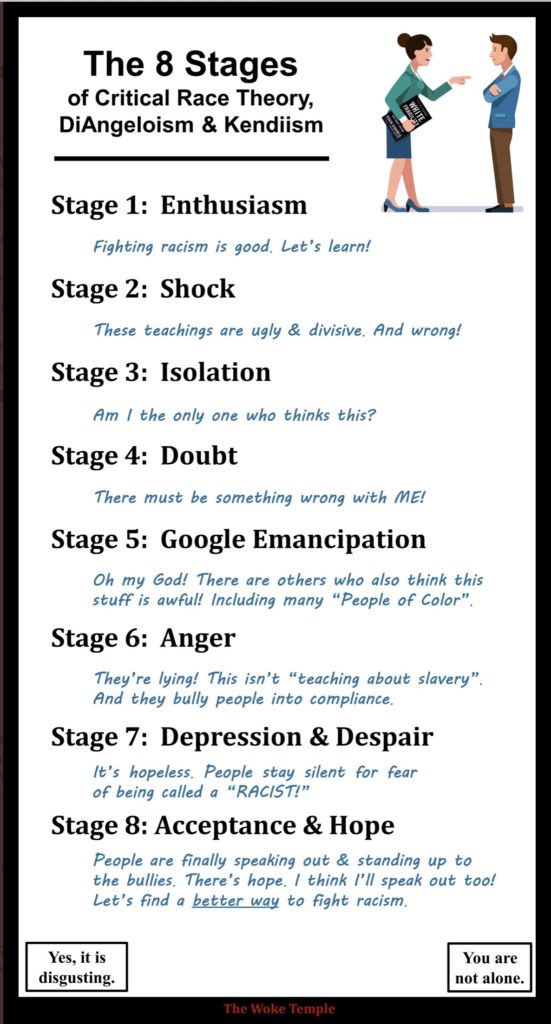

Woke Temple has issued a new version of his "8 stages of Critical Race Theory, DiAngelosim and Kendiism (referring to the divisive, incoherent and unsubstantiated claims of Robin DiAngelo and Ibram X. Kendi).
When I think of excellent popularizers, I first think of Carl Sagan (astronomy), but there are others, such as Thomas Sowell (economics). How difficult is it to be an excellent popularizer? Damned hard, according to (linguist) John McWhorter, an excellent popularizer in his own right. Sowell's work was the overall topic on this recent episode of The Glenn Show, featuring McWhorter and Glenn Loury, joined by Jason Riley of the Manhattan Institute. Here is what McWhorter had to say about difficult task of popularizers:
What people don't always know is that if you devote yourself to being a popularizer, to a certain extent, you're not taking the easy road. And I have never heard anybody say to me, as a linguist popularizer, that the popularizing isn't real work. So I'm not saying this out of some sort of pique. If anybody says that about me, and they must have, they've never said it to me. I get nothing but respect to my face, but I think a lot of people think popularizing isn't as hard as doing the real thing.
Having tried to popularize, it isn't just that you take away the detail and write stuff down. A lot of people who think "I could sit down and write a book in plain English, you know, explaining only what the ordinary person can understand. But I choose to do the real thing and write in tapeworm sentences and write with exquisite detail, etc." A lot of those people, I very humbly say, you have to have them sit down with, metaphorically, a blank piece of paper, and you are going to write about what you do. And this is the thing: Decide what you're going to put in terms of what the layman can understand, what is going to be a subtraction, what you're going to share with, you know, 55 specialists. But then not only write down what the layman can understand, but make it so that the layman will actually read it. It's one thing to put it on paper, but come up with a book that more than two people are going to read and then tell me that I'm just a "popularizer" and that I'm doing the easy thing because, frankly, not everybody can do that.
I know, there's some very noble popular linguistics books written by very smart and very nice people. But I must admit somewhere towards the middle, I find places where I think the reason that this book hasn't gotten around is because this person doesn't happen to have that particular knack. I remember one, I'm not going to mention it where he gets to a concept that is a little hard, you can get it across to people. But frankly, you'd have to know how. But he says, "Get some coffee. This is hard." And I thought "No, you don't tell them to get some coffee. You figure out how to get it across to them without them drinking any damn coffee!" That sort of thing. It means that you have to work at it. With Tom, it's hard work, what he's done, especially when you can read it as an ordinary person, I think.
Many people who call themselves liberal have written on FB that (and several told me in person) that they despise Trump voters and that they need not ever have a conversation with anyone who voted for Trump. Why? Many of them give this as the entire reason: "Trump voters are racist."
This reasoning is distressing to me because I (I identify as an independent) communicate with more than a few people who voted for Trump. I voted for Clinton and Biden. I acknowledge that there are some racists in the Republican party (I also believe that there are many racists among woke liberals), but to sum up that the entire motivation of every Trump voter as "racism" is over-simplistic and usually false. That's why I found this Tweet Thread by Darryl Cooper interesting. Is there any reason other than "racism" for being a MAGA voter? Cooper offers many such reasons. It's too bad many liberals refuse to take time to consider these before launching attacks on Trump voters. Glenn Greenwald offered an introduction to Cooper's thoughts. Here's an excerpt:
[W]e asked Cooper to elaborate on his influential thread, with a focus on what led him to these observations about prevailing MAGA sentiments and why he believes they are important for people to understand. As Cooper notes, he does not share all of the perceptions and beliefs he is conveying, although he shares many of them. Instead, based on the recognition that most media outlets are incapable of understanding let alone accurately describing the views of a group of people they view with little more than unmitigated contempt, condescension and scorn, he believes it is imperative that people understand the actual reality of what is motivating so many Trump voters in their views, perceptions and beliefs — regardless of whether each particular belief is accurate or not.
We also believe this understanding is vital, which is why we are happy to publish Cooper’s essay. It should go without saying that, as it true of all of our articles published on Outside Voices -- which we treat as an op-ed page -- our publishing of this article does not signify agreement with all of its claims, but only our belief that it is a viewpoint worth airing.
Here are a few excerpts to Cooper's analysis. You can read the entire thread here and here. You can listen to it here:
Trump supporters know - I think everyone knows - that Donald Trump would have been impeached and probably indicted if Robert Mueller had proven that he’d paid a foreign spy to gather damaging information on Hillary Clinton from sources connected to Russian intelligence and disseminate that information in the press. Many of Trump’s own supporters wouldn’t have objected to his removal if that had happened. Of course that is exactly what the Clinton campaign actually did, yet there were no consequences for it. Indeed, there has been almost no criticism of it.
Trump supporters had gone from worrying the collusion might be real, to suspecting it might be fake, to seeing proof that it was all a scam. Then they watched as every institution - government agencies, the press, Congressional committees, academia - blew right past it and gaslit them for another year. To this day, something like half the country still believes that Trump was caught red-handed engaging in treason with Russia, and only escaped a public hanging because of a DOJ technicality regarding the indictment of sitting presidents. Most galling, conservatives suspect that within a few decades liberals will use their command over the culture to ensure that virtually everyone believes it. This is where people whose political identities have for decades been largely defined by a naive belief in what they learned in civics class began to see the outline of a Regime that crossed not only partisan, but all institutional boundaries. They'd been taught that America didn't have Regimes, but what else was this thing they'd seen step out from the shadows to unite against their interloper president?
Cooper is not making a case that all of these things are true. His mission was to understand the mindset of MAGA advocates. It's too bad that so many people who identify as "liberal" would rather simplify MAGA voters as racist without considering any of these things. They would rather attack straw men. For those people like me who fear for our democratic project, this approach is dysfunctional and unproductive.
Isaac Newton summed it up: ""If I have seen further it is by standing on the shoulders of Giants." Humans are at their best when they use each others' good ideas. Every human being "steals" hundreds of others' good ideas every day. It amazes me how this concept has been turned on its head by pissy woke scolds. Bill Maher comments on this issue and other dysfunctions on full display at this year's Olympics.
"There is no swifter route to the corruption of thought than through the corruption of language." George Orwell