The Rate at which Children Learn New Words

The evolutionary psychologist Robin Dunbar notes that by age 3 an average child can use about 1,000 words (double Kanzi’s bonobo world record); by age 6, around 13,000; and by age 18, some 60,000: ‘that means it has been learning an average of 10 new words a day since its first birthday, the equivalent of a new word every 90 minutes of its waking life.

FREE SPEECH: Ten Principles for a Connected World, Timothy Garton Ash (2017)

Continue ReadingThe Rate at which Children Learn New Words

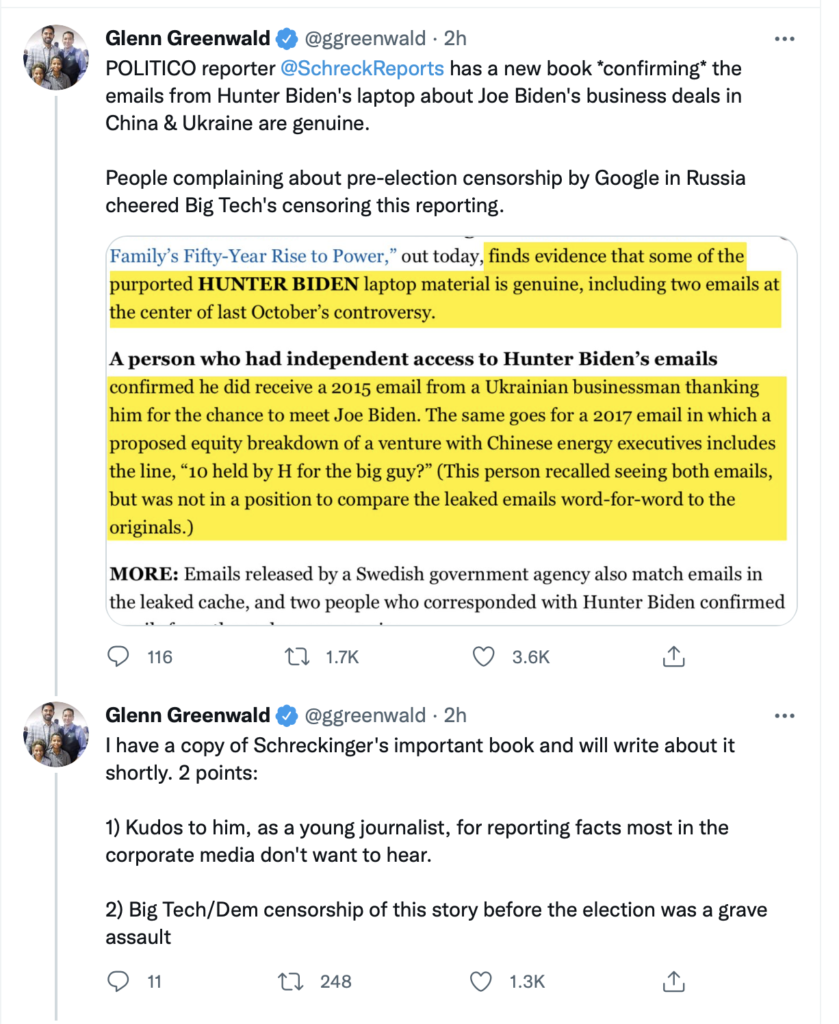
Politico Comes Full Circle on Hunter Biden Laptop Archive: Provides Window into Massive Corruption by News Media

Now that the presidential election is over, Politico's reporter has admitted that many documents found on Hunter Biden's laptop were authentic. This finding reverses the pre-election position of Politico, and is not a mere factoid. Rather, this admission corroborates Glenn Greenwald's analysis and evidence that left-leaning media was corrupt and complicit with the deep state leading up to the election. In sum, reporters refused to do their jobs as reporters and it led to fake news. I used to hate that term, but I can no longer deny that large swathes of our "news" is concocted . . . fake (e.g., several years of hysterical fact-free reporting on alleged Trump-Russia connection). The motivation was always clear - - left-leaning legacy news outlets hated Trump and made it their mission to avoid four more years of Trump.

Do I need to repeatedly write that I voted for Hillary Clinton and Joe Biden and that I find Trump deranged, incompetent and dangerous? My concern in this post is not about who would make the better president. My concern is that the news media should always do its job, publishing important facts regardless of who the evidence helps or hurts, allowing the voters to decide what is important. The opposite of that happened regarding Hunter Biden's laptop, part of a growing trend. In the new way of discussing important national issues, one denies or hides evidence that conflicts with one's preferences. Proud and arrogant confirmation bias is the way many of us make decisions now, instead of relying on Enlightenment values. These are sad days, indeed. It reminds me of how we formerly ridiculed Pravda, the official newspaper of the communist party of the USSR.

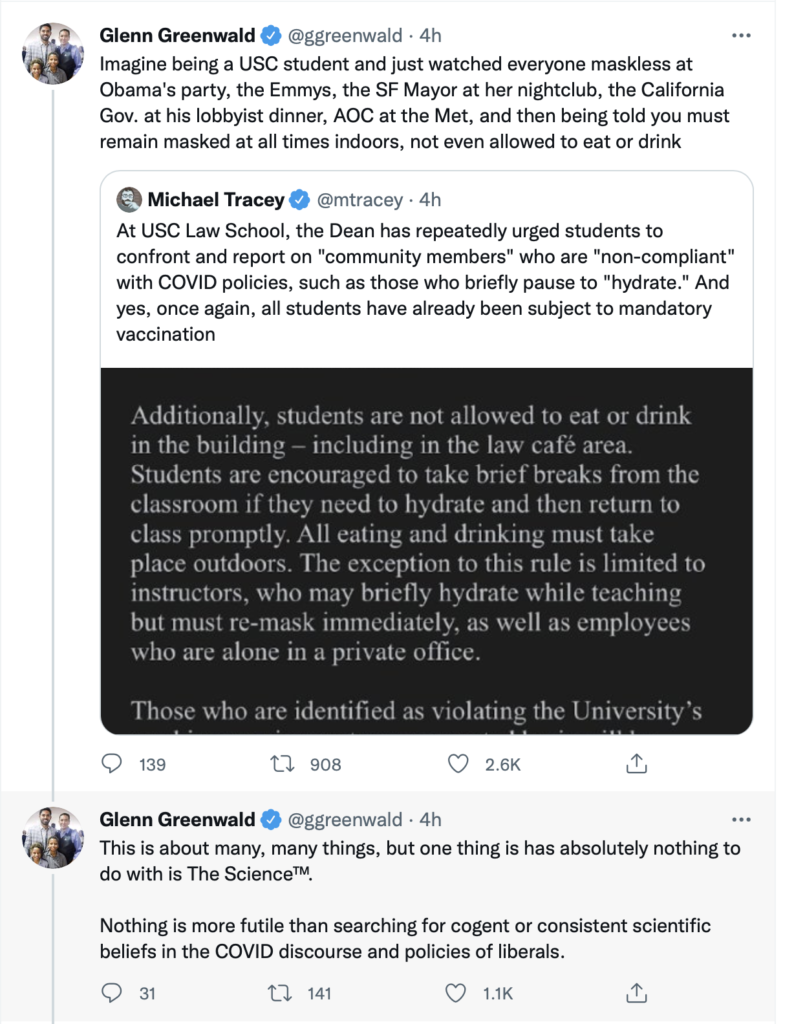
Greenwald's Tweet on the Politico reversal is the first of a long thread that makes an airtight case against the news media. I highly recommend the entire thread:

Continue ReadingPolitico Comes Full Circle on Hunter Biden Laptop Archive: Provides Window into Massive Corruption by News Media

NPR Incoherently Lashes Out at “Free Speech”

Matt Taibbi's latest article, with which I completely agree: "NPR Trashes Free Speech. A Brief Response: In an irony only public radio could miss, "On the Media" hosts an hour on the perils of "free speech absolutism" without interviewing a defender of free speech." An excerpt:

The guests for NPR’s just-released On The Media episode about the dangers of free speech included Andrew Marantz, author of an article called, “Free Speech is Killing Us”; P.E. Moskowitz, author of “The Case Against Free Speech”; Susan Benesch, director of the “Dangerous Speech Project”; and Berkeley professor John Powell, whose contribution was to rip John Stuart Mill’s defense of free speech in On Liberty as “wrong.”

That’s about right for NPR, which for years now has regularly congratulated itself for being a beacon of diversity while expunging every conceivable alternative point of view.

I always liked Brooke Gladstone, but this episode of On The Media was shockingly dishonest. The show was a compendium of every neo-authoritarian argument for speech control one finds on Twitter, beginning with the blanket labeling of censorship critics as “speech absolutists” (most are not) and continuing with shameless revisions of the history of episodes like the ACLU’s mid-seventies defense of Nazi marchers at Skokie, Illinois.

The essence of arguments made by all of NPR’s guests is that the modern conception of speech rights is based upon John Stuart Mill’s outdated conception of harm, which they summarized as saying, “My freedom to swing my fist ends at the tip of your nose.”

Because, they say, we now know that people can be harmed by something other than physical violence, Mill (whose thoughts NPR overlaid with harpsichord music, so we could be reminded how antiquated they are) was wrong, and we have to recalibrate our understanding of speech rights accordingly.

This was already an absurd and bizarre take, but what came next was worse. I was stunned by Marantz and Powell’s take on Brandenburg v. Ohio, our current legal standard for speech, which prevents the government from intervening except in cases of incitement to “imminent lawless action”:

"MARANTZ: Neo-Nazi rhetoric about gassing Jews, that might inflict psychological harm on a Holocaust survivor, but as long as there’s no immediate incitement to physical violence, the government considers that protected… The village of Skokie tried to stop the Nazis from marching, but the ACLU took the case to the Supreme Court, and the court upheld the Nazis’ right to march.

POWELL: The speech absolutists try to say, “You can’t regulate speech…” Why? “Well, because it would harm the speaker. It would somehow truncate their expression and their self-determination.” And you say, okay, what’s the harm? “Well, the harm is, a psychological harm.” Wait a minute, I thought you said psychological harms did not count?"

This is not remotely accurate as a description of what happened in Skokie. People like eventual ACLU chief Ira Glasser and lawyer David Goldberger had spent much of the sixties fighting the civil rights movement. The entire justification of these activists and lawyers — Jewish activists and lawyers, incidentally, who despised what neo-Nazi plaintiff Frank Collin stood for — was based not upon a vague notion of preventing “psychological harm,” but on a desire to protect minority rights . . . .

.

If you are wondering whether Taibbi is accurately portraying this NPR discussion, I invite you to listen to it here. NPR's conversation is stunningly muddled and incoherent. None of the guests show any meaningful familiarity with the work of John Stuart Mill. None of the participants demonstrate a working understanding of the First Amendment or the case law interpreting it. The result is that most of the discussion is aimed at straw men. And fully in line with what NPR has done, it stirred in a discussion of the "implicit bias" test in this free speech discussion, the perfect cherry on top for NPR's increasingly woke audience. This is what passes for a meaningful discussion at NPR.

Continue ReadingNPR Incoherently Lashes Out at “Free Speech”

The Importance of Free Inquiry at the Academy

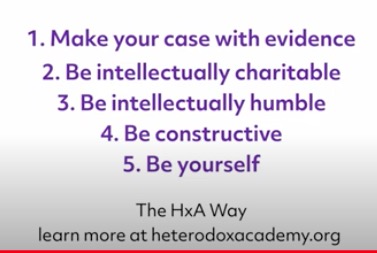
Heterodox Academy has released this 3-minute video arguing for something that 20 years ago would have puzzled most people.

This video advocates for

  • Free Inquiry at the Academy
  • Encouraging the Life of the Mind, and
  •  The Use of Evidence when taking positions, rather than relying on mere feelings.

But this is 2021, and we are, in many places, continuing our descent into a new Dark Ages where an increasingly acceptable way to win an argument is to silence one's opponents, using economic threats and brute force if necessary, even at the Academy.

I fully support the following ideas of Heterodox Academy:

.

I fully support the above ideas in my role as a law professor and in my personal life. As an attorney affiliated with Foundation for Individual Rights in Education (FIRE), I am willing to push back against persons and organizations violating these principles where they involve violations of civil rights, including violations of the First Amendment.

In fact, FIRE has now established a Faculty Legal Defense Fund to protect the speech of faculty members.  Here is how it works:

Public college and university faculty who face a threat of sanction by their institution or have been punished for expressive activity—whether it’s instruction, scholarship, or speaking on issues of public concern—can submit matters for FLDF consideration. They can do so through FLDF’s dedicated 24-hour Hotline at 254-500-FLDF (3533), or submit a case online. Our staff quickly review the matter and, if it falls within FLDF’s mandate, connect the faculty member with one of the experienced nearby lawyers in the FLDF network for assistance.

Continue ReadingThe Importance of Free Inquiry at the Academy