
The Best System for Determining What is True

I'm reading The Constitution of Knowledge by Jonathan Rauch (2021). Rauch has written an extraordinary book offering a detailed airtight case for why we need each other in order to determine what is true. We need a mediated social system in order to filter out the despots and crackpots, but who will mediate such a system? The incredible answer is no one in particular. The system powers the process, but the system cannot function in the absence of three prerequisites. The following passage sums up what we need to get the job done:

An epistemic regime—that is, a public system for adjudicating differences of belief and perception and for developing shared and warranted conclusions about truth—should provide three public goods.

First, knowledge. The system should be competent at distinguishing reality from non-reality, and at building on previous discoveries so that knowledge accumulates, thereby generating even more knowledge.

Second, freedom. The system should encourage rather than repress human autonomy, creativity, and empowerment. It should welcome and exploit human diversity, especially diversity of opinion, and it should not allow any person or faction to use force or intimidation to control what others say or believe.

Third, peace. The system should reward social conciliation, maximize the number of disagreements which are resolvable, and compartmentalize and marginalize disagreements when it cannot resolve them. It should inculcate intellectual values which abhor violence and bullying, and it should establish institutions and norms which tolerate and even embrace disagreement and doubt.

No one should expect any knowledge-producing system to be perfect, or close to it. Still, many centuries of history show that the liberal system—the reality-based community—comes closer to perfection than any other human social invention.

Next, we need two rules (p. 89):

The fallibilist rule: Ho one gets the final say. You may claim that a statement is established as knowledge only if it can be debunked, in principle, and onlyinsofar as it withstands attempts to debunk it. That is, you are entitled to claim that a statement is objectively true only insofar as it is both checkable and has stood up to checking, and not otherwise. In practice, of course, determining whether a particular statement stands up to checking is sometimes hard, and we have to argue about it. But what counts is the way the rule directs us to behave: you must assume your own and everyone else’sfallibility and you must hunt for your own and others’errors, even if you are confident you are right. Otherwise, you are not reality-based. The Constitution of Knowledge

The empirical rule: No one has personal authority. You may claim that a statement has been established as knowledge only insofar as the method used to check it gives the same result regardless of the identity of the checker, and regardless of the source of the statement. Whatever you do to check a proposition must be something that anyone can do, at least in principle, and get the same result. Also, no one proposing a hypothesis gets a free pass simply because of who she is or what group she belongs to. Who you are does not count; the rules apply to everybody and persons are interchangeable. If your method is valid only for you or your affinity group or people who believe as you do, then you are not reality-based.
Continue ReadingThe Best System for Determining What is True

Being “Smart” Does Not Protect You from Being Duped.

Jonathan Rauch has written an excellent new book, "The Constitution of Knowledge" (2021). His analysis is deep and unrelenting. Here's a passage that provides a warning: Being "smart" does not protect a person from being duped:

On the more abstract moral and intellectual questions which so often preoccupy and divide us, reasoning, argues Haidt, is like a press secretary whose goal is to justify whatever position her boss has already taken. “Intuitions come first, strategic reasoning second,”writes Haidt. Moreover, in conversations about matters which arouse strong moral reactions, “people care a great deal more about appearance and reputation than about reality.”They care more about looking right than being right. “Our moral thinking,”says Haidt, “is much more like a politician searching for votes than a scientist searching for truth.” Maybe Socrates would rather be right than popular, but most of us prefer to maintain our good standing with our tribe, a reasonable call when one considers that Socrates was executed by his fellow citizens.

Besides being useful for persuading others, the ability to construct reasons is useful for persuading ourselves. Persuading others is easier, after all, if we believe what we say. The old political saw holds that if you can fake sincerity, you’ve got it made; but that is not quite right, because the best way to seem sincere is to be sincere. Detecting trustworthiness is a basic life skill in small groups which depend on sharing and reciprocity, and so people have developed good bullshit detectors. The best way around other people’s bullshit detectors is to believe what you say. If your social reputation and group identity depend upon believing something, then you will find a way to believe it. In fact, your brain will help you by readily accepting and recalling congenial information while working to bury and ignore uncongenial information.

That is why intelligence is no defense against false belief. To the contrary, it makes us even better at rationalizing. Super-smart people, as Haidt notes in The Righteous Mind, are more skilled than others at finding arguments to justify their own points of view. But when they are asked to find arguments on the opposite side of a question, they do no better than anyone else. Brainpower makes people better press secretaries, but not necessarily better at open-minded, self-critical thinking.

Continue ReadingBeing “Smart” Does Not Protect You from Being Duped.

The (Old) Solution to our Two Dominant Troll Cultures

From The Constitution of Knowledge, by Jonathan Rauch (2021):

We are in for a fight against two insurgencies: the spread of viral disinformation and alternative realities, sometimes called troll culture, and the spread of enforced conformity and ideological blacklisting, sometimes called cancel culture. One is predominantly right-wing and populist, the other predominantly left-wing and elitist. One employs chaos and confusion, the other conformity and social coercion. But their goals are similar, and often, weirdly, they act as de facto allies.

What troll culture and cancel culture have in common is that they are techniques of what propaganda experts often call information warfare. Rather than using rational persuasion to seek truth, they manipulate the social and media environments for political advantage. They may appear marginal, disorganized, or unhinged, but they are aggressive, expansionary, and rooted in a sophisticated understanding of human cognitive and emotional vulnerabilities. They have captured commanding institutional heights, including (for four years) the White House and substantial parts of academia. They exploit the capabilities of digital technology to amplify their speed and reach. But they have also engendered encouraging pushback, as awareness of the methods they use and the dangers they pose has grown.

How do we protect ourselves from these trolls? We need to sustain and defend our most maligned and most important principle: Free Speech. Rauch explains:

The miracle is how robust free expression and liberal science have proved to be, despite unremitting attacks from every direction over hundreds of years. The idea that obnoxious, misguided, seditious, blasphemous, and bigoted expressions deserve not only to be tolerated but, of all things, protected is the single most counterintuitive social principle 'A Terrible Statement Unless He Gets Away with It”

In all of human history, every human instinct cries out against it, and every generation discovers fresh reasons to oppose it. It is saved from the scrapheap of self-evident absurdity only by the fact that it is also the single most successful social principle in all of human history. Those of us who favor it, and also our children, and also their children and their children, will need to get up every morning and explain and defend our counterintuitive social principle from scratch, and so we might as well embrace the task and perform it cheerfully.

Constitution of Knowledge, pp 17-19.

Continue ReadingThe (Old) Solution to our Two Dominant Troll Cultures

Questioning the NYT COVID Narrative

Glenn Greenwald offers Jeremy Beckham's look at the official NYT COVID narrative. That NYT narrative tries to make the case that COVID vaccine resistance is largely a politically partisan problem and that Trump voters are the villains. An excerpt:

The corporate media has worked very hard to propagate the liberal-pleasing narrative that COVID has become a partisan disease due to vaccine hesitancy on the right, often ignoring the inconvenient truth that large percentages of politically diverse groups, principally African-Americans and Latinos, remain resistant to vaccination. Recent reporting from The New York Times serves to further this distorted narrative, dubbing the positive correlation between support for Donald Trump and COVID death rates “Red COVID," and brandishing it as evidence of a partisan pandemic. But the Times’ report misleads readers through statistical manipulation and data games, as illustrated by this meticulous analysis, presented in an Outside Voices contribution by Jeremy Beckham . . .

Continue ReadingQuestioning the NYT COVID Narrative

“News Media” Continues its Role as Unabashed Advocate

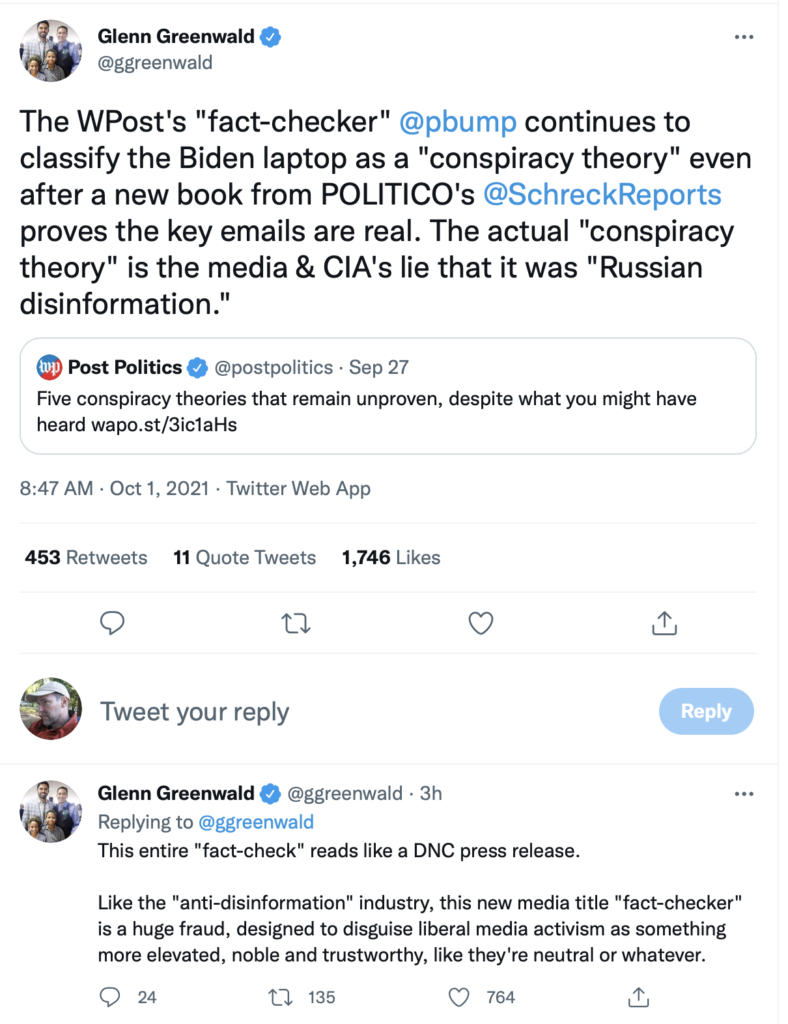
From Glenn Greenwald. This is disgraceful behavior by the Washington Post "Fact-Checker."

Much of our legacy news media has proudly decided that its role is no longer to let the fact fall where they may, letting readers decide who they will vote for. Rather, the new role is to tell readers who to vote for, consciously and premeditatedly withholding evidence that puts their favorite candidate into a bad light. What's really amazing is that this disinformation is being shoveled to readers in plain view. It's as if the WP is simply daring people like Greenwald to call them on their journalistic malpractice (which he repeatedly does). But they don't care, because they have a bigger megaphone than he does at the moment.

So much of what I see today reminds me of Brandolini's Law:

Brandolini's law, also known as the bullshit asymmetry principle, is an internet adage that emphasizes the difficulty of debunking false, facetious, or otherwise misleading information:"The amount of energy needed to refute bullshit is an order of magnitude larger than to produce it.

Continue Reading“News Media” Continues its Role as Unabashed Advocate