Nicolas Hulscher Discusses the Journal Cartel

Is there a journal cartel? Nicolas Hulscher says yes and claims it is rife with corruption in this post on X:

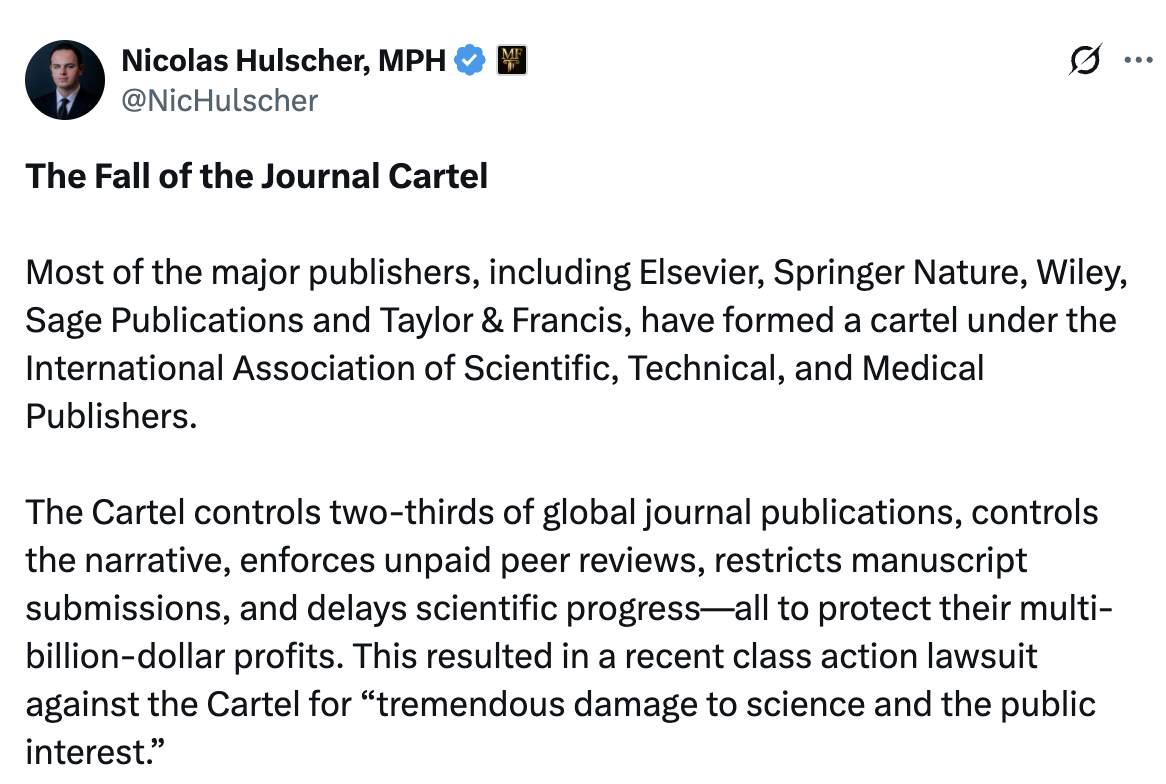
The Fall of the Journal Cartel

Most of the major publishers, including Elsevier, Springer Nature, Wiley, Sage Publications and Taylor & Francis, have formed a cartel under the International Association of Scientific, Technical, and Medical Publishers.

The Cartel controls two-thirds of global journal publications, controls the narrative, enforces unpaid peer reviews, restricts manuscript submissions, and delays scientific progress—all to protect their multi-billion-dollar profits. This resulted in a recent class action lawsuit against the Cartel for “tremendous damage to science and the public interest.”

Nearly half of medical journal editors have financial conflicts of interest with pharmaceutical companies. Moreover, 59% of peer-reviewers for major medical journals received more than $1 billion from drug companies from 2020 to 2022.

The widespread corruption embedded within the nearly closed system of the Journal Cartel operates in a way that resembles a high-entropy state, as described by the second law of thermodynamics.

According to this principle, isolated systems naturally progress toward greater disorder, a state of entropy that ultimately becomes unsustainable and leads to system collapse.

In the case of the academic publishing industry, the compounded effects of internal corruption, lack of transparency, unethical censorship, and growing public awareness act as catalysts, pushing the system toward inevitable instability. Consequently, unless radical structural reforms are introduced, the Journal Cartel will face eventual collapse under the weight of its own entropy.

The Cartel’s unsustainable global monopoly on science will fall in due time, in accordance with natural laws. Until then, we can and will continue to battle against them and publish with journals outside the Cartel’s influence in our best attempt to advance scientific knowledge and protect public health.

Truth always prevails in the end.
Continue ReadingNicolas Hulscher Discusses the Journal Cartel

New Converts to Free Speech

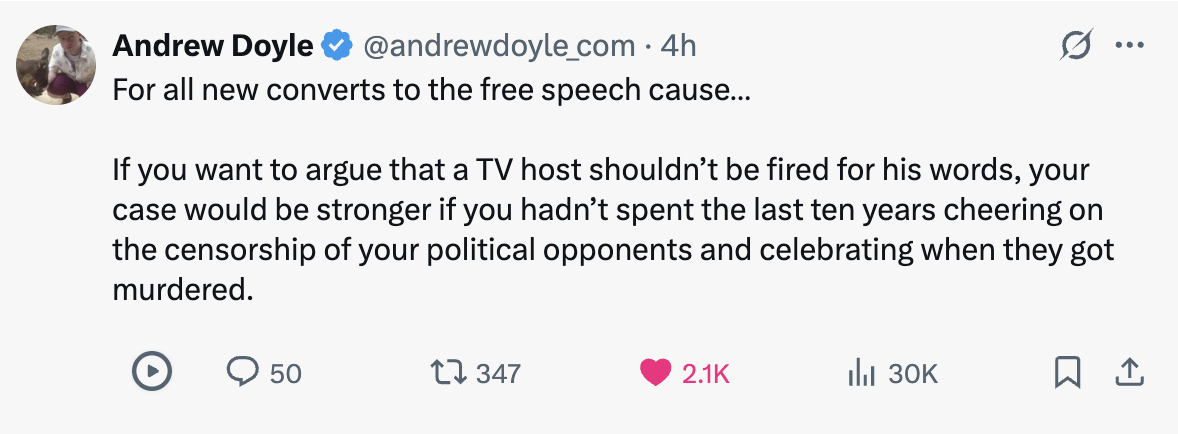
Andrew Doyle:

For all new converts to the free speech cause…

If you want to argue that a TV host shouldn’t be fired for his words, your case would be stronger if you hadn’t spent the last ten years cheering on the censorship of your political opponents and celebrating when they got murdered.

Continue ReadingNew Converts to Free Speech

The Downside of Agreeableness

What is it to be (or not be) "agreeable"?

Michael Malice:

Michael Malice:

I score a zero or close to it on agreeableness Meaning, it makes little sense to me to say things or act in a certain way simply to accommodate others I view it as a form of dishonesty and long-term disaster If you are high-agreeableness, how would you explain it to me?

Question to Grok: With regard to the Big Five trait of agreeableness, what is the consequence of being extremely agreeable? What is the opposite of Agreeableness?

Consequences of Being Extremely Agreeable

ExtremeAgreeableness, a trait characterized by high levels of compassion, cooperation, and a desire to maintain harmony, can have both positive and negative consequences:Positive Consequences:Strong Relationships:

- Highly agreeable individuals are often well-liked, fostering trust and positive social bonds due to their kindness and empathy.

- Conflict Avoidance: Their tendency to prioritize harmony can de-escalate conflicts and promote group cohesion.

- Team Collaboration: They excel in cooperative settings, making them effective in team-oriented environments.

Negative Consequences:Difficulty Asserting Needs:

- Extreme agreeableness may lead to suppressing personal needs or opinions to avoid conflict, resulting in unmet needs or resentment.

- Vulnerability to Exploitation: Highly agreeable people may be taken advantage of, as they are less likely to confront manipulative behavior.

- Reduced Leadership Effectiveness: Excessive agreeableness can hinder decision-making or assertiveness, making it challenging to take charge in competitive or high-stakes situations.

- Neglect of Self-Interest: Constantly prioritizing others can lead to burnout or diminished self-esteem if their own goals are consistently sidelined.

Opposite of Agreeableness

The opposite of agreeableness in the Big Five personality framework is low agreeableness, often described as antagonism or disagreeableness. Individuals with low agreeableness exhibit traits such as:Competitiveness: Prioritizing personal goals over group harmony, often thriving in competitive environments.

- Skepticism or Cynicism: Being less trusting and more critical of others’ intentions.

- Assertiveness or Aggressiveness: Willingness to confront others, express disagreement, or pursue self-interest, sometimes at the expense of relationships.

- Lower Empathy: Less concern for others’ feelings, which can manifest as bluntness or insensitivity.

While low agreeableness can lead to conflicts or strained relationships, it can also be advantageous in situations requiring tough decision-making, negotiation, or standing firm on principles.

Continue ReadingThe Downside of Agreeableness

The Fear of Shame Leads to Tyranny

Unfortunately, decent people often cower to avoid strategically-imposed shame. This allows loud unruly minorities to inflict censorship and tyranny. Eli Steele presents an illustrative article written by his father, black conservative Shelby Steele:

Eli Steele: "Before Charlie Kirk, my father spoke at countless universities and colleges, often for nominal pay, and the verbal abuse he suffered was beyond the pale. It is a sign of how much our culture declined, from screaming to the bullet."

Excerpt: The Loneliness of the "Black Conservative"

by Shelby Steele

"I realized that I was a black conservative when I found myself standing on stages being shamed in public. I had written a book that said, among many other things, that black American leaders were practicing a politics that drew the group into a victim-focused racial identity that, in turn, stifled black advancement more than racism itself did. For reasons that I will discuss shortly, this was heresy in many quarters. And, as I traveled around from one little Puritan village (read "university") to another, a common scene would unfold.

"Whenever my talk was finished, though sometimes before, a virtual militia of angry black students would rush to the microphones and begin to scream. At first I thought of them as Mau Maus but decided this was unfair to the real Mau Maus, who, though ruthless terrorists, had helped bring independence to Kenya in the 1950s. My confronters were not freedom fighters; they were Carrie Nation-like enforcers, racial bluenoses who lived in terror of certain words. Repression was their game, not liberation, and they said as much. "You can't say that in front of the white man." "Your words will be used against us." "Why did you write this book?" "You should only print that in a black magazine." Their outrage brought to light an ironic and unnoticed transformation in the nature of black American anger from the sixties to the nineties: a shift in focus from protest to suppression, from blowing the lid off to tightening it down. And, short of terrorism, shame is the best instrument of repression.

"Of course, most black students did not behave in this way. But the very decency of the majority, black and white, often made the shaming of the minority more effective. So I learned what it was like to stand before a crowd in which a coterie of one's enemies had the license to shame, while a mixture of decorum and fear silenced the decent people who might have come to one's aid. I was as vulnerable to the decency as to the shaming since together they amounted to shame. And it is never fun to be called "an opportunist," "a house slave," and so on while university presidents sit in the front row and avert their eyes. But this really is the point: The goal of shaming was never to win an argument with me; it was to make a display of shame that would make others afraid for themselves, that would cause eyes to avert. I was more the vehicle than the object, and what I did was almost irrelevant. Shame's victory was in the averted eyes, the covering of decency."

Continue ReadingThe Fear of Shame Leads to Tyranny