About Sticks and Stones

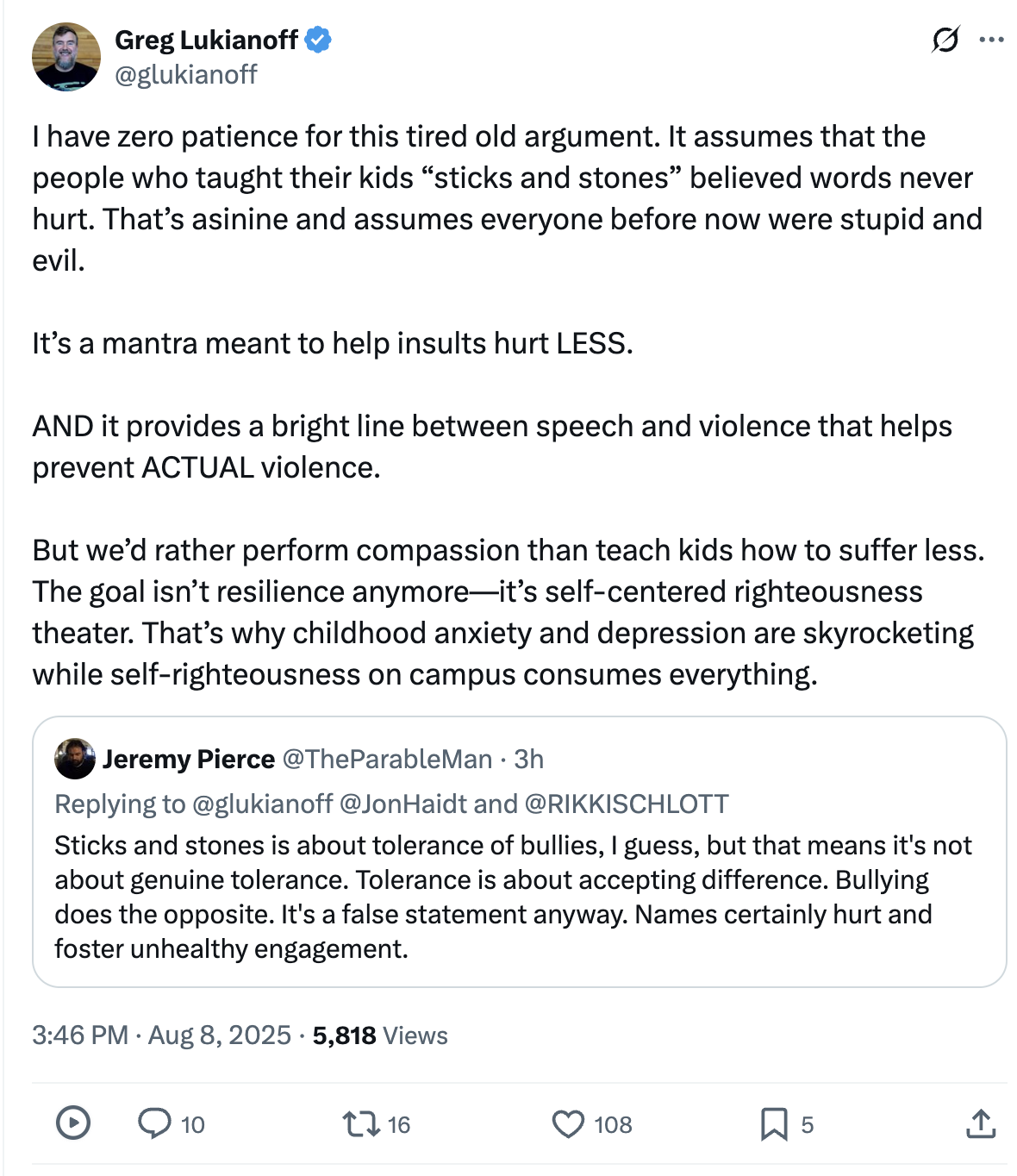
"Sticks and stones will break my bones but names will never hurt me." We used to say this often. We need to say it more. Greg Lukianoff explains why it is not an excuse for tolerating bullies:

I have zero patience for this tired old argument. It assumes that the people who taught their kids “sticks and stones” believed words never hurt. That’s asinine and assumes everyone before now were stupid and evil.

It’s a mantra meant to help insults hurt LESS.

AND it provides a bright line between speech and violence that helps prevent ACTUAL violence.

But we’d rather perform compassion than teach kids how to suffer less. The goal isn’t resilience anymore—it’s self-centered righteousness theater. That’s why childhood anxiety and depression are skyrocketing while self-righteousness on campus consumes everything.

Continue ReadingAbout Sticks and Stones

Are You in a Cult?

James Lindsay suggests how to tell if you are in a cult:

I was asked in an interview yesterday what some signs are that you're in a cult. Here are the three best signs:

1) Ask yourself if you can support or defend someone the group doesn't like without fear. If not, you're in a cult.

2) Ask yourself what would happen if you left the group. If you'll be punished, shunned, and ostracized, you're in a cult.

3) Ask yourself what would happen if you expressed a moderating opinion within the group. If you'd be punished, bullied, or shamed, you're in a cult.

Most cults today aren't Jonestown or the Moonies. They're online phenomena headed by "influencers." By failing to recognize where and how cults form in the era of social media, we leave ourselves very vulnerable to their malicious tactics."

Continue ReadingAre You in a Cult?

It’s Time for NPR to Earn Its Own Funding With Respectable Reporting

I don't want to forced to fund NPR any more than want to be forced to fund Fox News. Uri Berliner served as the senior business editor at NPR from 1999 until his resignation in April 2024. What follows is an excerpt from his article, "Happy Independence Day, NPR." Anyone who has been paying attention knows that he not exaggerating the far-left slide of NPR:

Once fairly evenly divided between liberals, moderates, and conservatives, NPR’s news audience shifted sharply to the left. And by 2023, liberals outnumbered conservatives more than six to one. True to the tote bag cliché, NPR became an accessory for Whole Foods shoppers. Which is sad, because in another era, NPR, and public radio more broadly, developed some of the most creative and entertaining programming anywhere, from Car Talk to This American Life, Planet Money, Radiolab and A Prairie Home Companion.

Thanks in part to this ideological transformation, NPR botched major stories—and damaged its bond with the American people.

To name a couple of prominent examples: It repeatedly insisted that the lab leak theory of Covid had been debunked and it refused to cover Hunter Biden’s laptop. NPR’s reporting on the most contentious issues of the day—climate change, youth gender medicine, and the war in Gaza—leaned on moralizing and emotional certitude more than on rigorous factual analysis.

Embracing the mantras of the Great Awokening, NPR became a caricature of itself with headlines like these:

Microfeminism: The Next Big Thing in Fighting the Patriarchy

Which Skin Color Emoji Should You Use? The Answer Can Be More Complex than You Think

Black Women’s Groups Find Health and Healing on Hikes, But Sometimes Racism, Too

Bringing Diversity to Maine’s Nearly All-White Lobster Fleet

Diet Culture Can Hurt Kids. This Author Advises Parents to Reclaim the Word ‘Fat’

These Drag Artists Know How to Turn Climate Activism into a Joyful Blowout

Continue ReadingIt’s Time for NPR to Earn Its Own Funding With Respectable Reporting

Whitney Webb: What to Do About the Puppetmaster

Whitney Webb argues that the general public is unaware of the power structure of oligarch networks and their connection to the national security state. She argues that the CIA, created by Wall Street bankers with ties to organized crime, has historically served corporate interests. She calls for individuals to disengage from big tech companies, which are heavily interconnected with intelligence agencies and have unsavory associations. She advocates for independence from these systems to avoid being controlled by them, emphasizing the need for personal responsibility and action rather than relying on the political system. Transcript of Whitney Webb:

What I attempt to do. I mean, basically, at the end of the day, this into these entities and this power structure had been successful because people have not really been aware of what, what's been going on, and how interconnected a lot of these oligarch networks ultimately are, and how connected they are to our national security state. Because a lot of people, you know, if we're just talking about, back to my point earlier, talking about Mossad, talking about the CIA, who does the CIA work for? Who does Mossad work for?

In the case of the CIA, it's very clear that it was created by Wall Street bankers who entered into questionable alliances with organized crime, and bankers and organized crime are both ultimately interested in expanding their their rackets and is making as much money as possible. And so eventually you have certain economic networks and court you know, the this, these, these alliances dominated what is now corporate America, the multinational corporation that's who the CIA has throughout most of its history, conducted coups on behalf of so we have to go a level up if we really want to know what's going on and Look beyond CIA and Mossad and see, you know, who's really, at least at the scale up a key part of the power structure that's really running the show, because, you know, it's important for them that the public doesn't really look that high up, because then it just seems like We can't really do anything about it, but I think people ultimately can.

What I've argued a lot for a long time is that people need to try and extricate themselves from the biggest iteration of what this mob is today, which is really big tech, which is, again, connected to a lot of it. Connect a lot of these CEOs connected to figures like Epstein or other questionable associations, and also almost all of the big Silicon Valley companies today have their have origins or funding tied to the CIA or to DARPA or to entities like that and that.

We should boycott them as much as possible, and not use their services as much as possible, and not be dependent on these entities. Because if we're dependent then, you know, they can do whatever they want to us. Yeah, and so you know the best way to not give up is to work to be as independent of those systems as possible. Because if we're dependent on them you're basically a slave to these people at the end of the day, which is what I think most Americans do not want.

There's a lot of efforts being made to sort of keep people in in the box of where they think, Oh, well, if I vote for this party or this politician and this candidate, I don't have to do anything to ensure my independence from the system. I can remain dependent on the system and hope that politician XYZ will magically, you know, save the day and fix the country and, you know, ends this ruling power of 80 plus years of, you know, intelligence and organized crime. Yeah, I think it's really something that has to be sort of done on an individual level, and people need to take individual responsibility if they don't want to be part of the system, particularly as we move into this increasingly digital future that these very small handful of companies are going to completely control.

In sum, here is what we can do:

  • Boycott and avoid using services from big tech companies that have ties to the CIA and DARPA.
  • Encourage others to become more independent from the current power structure and not be dependent on the system.
  • Raise awareness about the interconnected nature of oligarch networks, intelligence agencies, and multinational corporations.
Who is Whitney Webb?  According to Grok:

[More . . . ]

Continue ReadingWhitney Webb: What to Do About the Puppetmaster