The Words that Cultivate Free Speech

Samual Abrams:

“It’s a free country” signals that disagreement is permissible. “Everyone’s entitled to their own opinion” acknowledges dignity in dissent. “Sticks and stones” reminds us to meet speech with speech, not violence or censorship. Without such reminders, the civic muscle memory that protects a free society begins to atrophy. That last idiom in the table — “Address the argument, not the person” — may be the most telling of all. Only 30% of Americans even recognize it, and barely 1 in 10 say it often.

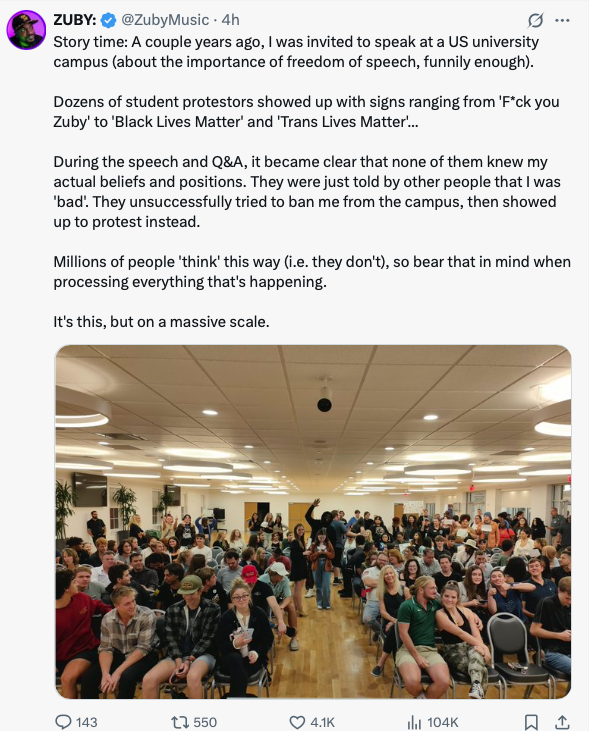
This absence shows up everywhere: in the pile-ons of cancel culture, the readiness to attack a person’s character rather than engage their reasoning and in why viewpoint diversity is so hard to come by on many college campuses. If you never learn the habit of separating people from their ideas, disagreement becomes personal and dissenters become enemies to be silenced.

And in their place? New slogans, often adversarial and absolutist. We hear “words are violence” or “speech is harm” far more than “defend to the death your right to say it.” The FIRE/NORC survey found that a quarter of Americans now say the “words are violence” framing describes their own view “mostly” or “completely.”

Samuel J. Abrams is professor of politics at Sarah Lawrence College and a senior fellow at the American Enterprise Institute.

Continue ReadingThe Words that Cultivate Free Speech

Don’t Cancel the Cancelers

Adam Goldstein of FIRE:

Time and time again, we resort to this mob mentality when tragedy strikes. When Barbara Bush died. When the Queen died. Rush Limbaugh. Otto Warmbier. George Floyd. After 9/11. After October 7. The attempted assassination of Donald Trump.

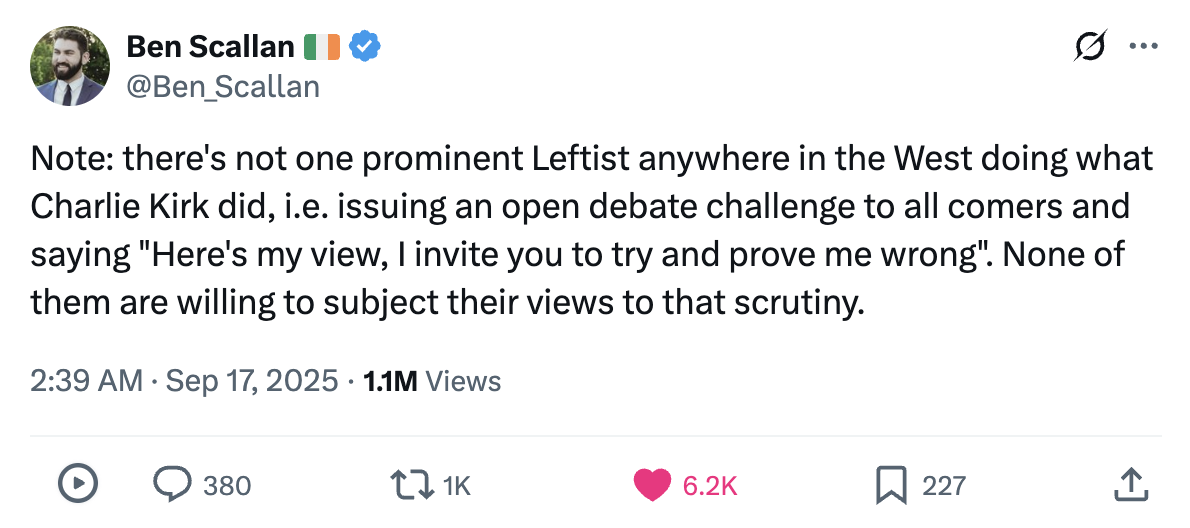
As free speech advocates, it places us in a painful position. Charlie Kirk’s assassination was an attack on free speech and open discourse. In a free society, we must not be afraid to express our views, no matter how strongly some might oppose them. That’s the point of free speech. But it is precisely for that reason why we must not respond to mockery of Kirk’s assassination by canceling everyone who offends us: because that too creates a society where people are afraid to express themselves.

Continue ReadingDon’t Cancel the Cancelers

FIRE Survey: College Violence is On The Upswing

Nico Perrino, the Executive VP of the Foundation for Individual Rights and Expression (FIRE) has authored "Charlie Kirk's assassinationViolence must never be a response to speech."

Unfortunately, since 2021, we’ve seen a steady rise in support for violence in response to speech on campus. Earlier this week, we released our finding that one in three students express some support for the use of violence to stop a campus speech. That’s up from 20 percent only three years ago. While we do not know the identity of the gunman, what happened yesterday is indicative of a broader cancer in our body politic that we must address.

But it must not be addressed with censorship.

For more than 25 years, FIRE has challenged colleges that use speculative and amorphous security rationales to justify censoring controversial speakers. Through public records requests and other means, we’ve often found these rationales serve as a pretext to shut down debate and capitulate to demands for censorship. Indeed, according to our Deplatforming Database, Kirk was the subject of at least 14 attempts to stop him from speaking on campuses since 2021. Over the years, FIRE has repeatedly written to colleges that sought to silence Kirk’s organization and supporters.

The philosopher Alfred North Whitehead once observed: “The purpose of thinking is to let the ideas die instead of us dying.”

Continue ReadingFIRE Survey: College Violence is On The Upswing

About “You”

If you are not aggressively doubting, investigating and fighting for your personal autonomy every hour, you are no longer the author of "your" thoughts. As Soloman Asch warned us, if you aren't pushing back hard against your own people, you will become a mere sock puppet.

For much more, see Robert Malone's new book, PsyWar. I'm half-way thorugh. This summary is by Grok (though I've tweaked it a bit:

* Robert W. Malone MD, MS, an mRNA technology pioneer and physician-scientist, and Jill Glasspool Malone PhD. Psywar delves into the mechanisms of modern psychological warfare, or "PsyWar," which the authors define as government-orchestrated campaigns using propaganda, censorship, and psychological operations (psyops) to manipulate public opinion and behavior.

* The book focuses on how these tactics have been deployed against the American people, drawing from historical contexts to contemporary applications. It argues that PsyWar is a tool for enforcing a "New World Order" through techno-totalitarianism and global control structures. Specifically addressing 5th generation psyops—often tied to fifth-generation warfare—the text explores asymmetric, information-based conflicts that blend psychological manipulation with technology, surveillance, and behavioral control to achieve dominance without traditional military engagement. Malone, known for his critiques of COVID-19 policies and vaccine mandates, frames these as examples of psychological bioterrorism and administrative state overreach.

* Key topics covered include:

* - **Propaganda and Behavioral Control**: Techniques for shaping public perceptions and actions through media and information manipulation.

* - **Psychological Bioterrorism**: The use of fear-based psyops in health crises to enforce compliance.

* - **Deep State Censorship and Surveillance Capitalism**: How government and corporate entities collaborate to monitor and suppress dissent.

* - **Fifth-Generation Warfare**: Non-kinetic strategies emphasizing psyops, cyber elements, and hybrid threats to undermine societies.

* - **PsyWar Tactics and Techno-Totalitarianism**: Modern tools like AI-driven censorship and data exploitation for totalitarian ends.

* - **The New World Order and Global Control**: Visions of centralized power structures enabled by these warfare methods.

* The authors emphasize the critical role of free speech in countering these threats, advocating for a return to constitutional principles to resist totalitarian creep and restore personal sovereignty. The book has been discussed in podcasts and reviews as a call to action against perceived government psyops, particularly in the context of recent global events.

Continue ReadingAbout “You”

Greg Lukianoff Discusses Free Speech at TED

Greg Lukianoff began his TED talk with this: "2023 and 2024 were the two worst years for mob censorship and shout downs on record."

He then offered these Four Truths about free speech:

1. You are not safer for knowing LESS about what people really think.

2. Free Speech Cures Violence (Free Speech is the best alternative to violence).

3. Free Speech protects the powerless (free speech is the best check on power ever invented).

4. Even "bad" people can have good ideas (and good people aren't always right). ("Just because I hate your guts doesn't mean you are wrong.") ("The way we figure out truth ... doesn't work if you just talk to people your already agree with.").

Greg ended his talk with this gem:

"To understand the world it's crucial to know what people really think . . . For that, we need free speech."

Continue ReadingGreg Lukianoff Discusses Free Speech at TED