SCOTUS: The Function of Free Speech is to Invite Dispute and Stir People to Anger

The next time someone tells you that you need to be silenced because your speech is offending them, mention this quote from the U.S. Supreme Court opinion of Terminiello v. Chicago (1949), reversing a disturbing-the-peace conviction of a hate-monger. Justice Douglas wrote the opinion, which included these gems:

The vitality of civil and political institutions in our society depends on free discussion. As Chief Justice Hughes wrote in De Jonge v. Oregon, 299 U.S. 353, 365, 260, it is only through free debate and free exchange of ideas that government remains responsive to the will of the people and peaceful change is effected. The right to speak freely and to promote diversity of ideas and programs is therefore one of the chief distinctions that sets us apart from totalitarian regimes.

Accordingly a function of free speech under our system of government is to invite dispute. It may indeed best serve its high purpose when it induces a condition of unrest, creates dissatisfaction with conditions as they are, or even stirs people to anger. Speech is often provocative and challenging. It may strike at prejudices and preconceptions and have profound unsettling effects as it presses for acceptance of an idea. That is why freedom of speech, though not absolute, Chaplinsky v. New Hampshire, supra, 315 U.S. at pages 571-572, 62 S.Ct. at page 769, is nevertheless protected against censorship or punishment, unless shown likely to produce a clear and present danger of a serious substantive evil that rises far above public inconvenience, annoyance, or unrest. See Bridges v. California, 314 U.S. 252, 262, 193, 159 A.L.R. 1346; Craig v. Harney, 331 U.S. 367, 373, 1253. There is no room under our Constitution for a more restrictive view. For the alternative would lead to standardization of ideas either by legislatures, courts, or dominant political or community groups.

Continue ReadingSCOTUS: The Function of Free Speech is to Invite Dispute and Stir People to Anger

The Importance of Free Inquiry at the Academy

Heterodox Academy has released this 3-minute video arguing for something that 20 years ago would have puzzled most people.

This video advocates for

  • Free Inquiry at the Academy
  • Encouraging the Life of the Mind, and
  •  The Use of Evidence when taking positions, rather than relying on mere feelings.

But this is 2021, and we are, in many places, continuing our descent into a new Dark Ages where an increasingly acceptable way to win an argument is to silence one's opponents, using economic threats and brute force if necessary, even at the Academy.

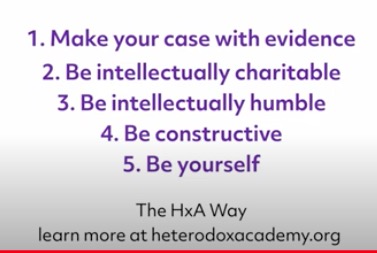
I fully support the following ideas of Heterodox Academy:

.

I fully support the above ideas in my role as a law professor and in my personal life. As an attorney affiliated with Foundation for Individual Rights in Education (FIRE), I am willing to push back against persons and organizations violating these principles where they involve violations of civil rights, including violations of the First Amendment.

In fact, FIRE has now established a Faculty Legal Defense Fund to protect the speech of faculty members.  Here is how it works:

Public college and university faculty who face a threat of sanction by their institution or have been punished for expressive activity—whether it’s instruction, scholarship, or speaking on issues of public concern—can submit matters for FLDF consideration. They can do so through FLDF’s dedicated 24-hour Hotline at 254-500-FLDF (3533), or submit a case online. Our staff quickly review the matter and, if it falls within FLDF’s mandate, connect the faculty member with one of the experienced nearby lawyers in the FLDF network for assistance.

Continue ReadingThe Importance of Free Inquiry at the Academy

John McWhorter joins Firing Line’s Margaret Hoover on PBS to discuss “Critical Race Theory.”

John McWhorter joins Firing Line's Margaret Hoover on PBS to discuss "Critical Race Theory."

A few excerpts:

Margaret Hoover:

what are they rallying against? What are they teaching that is objectionable?

John McWhorter:

here's the here's the issue. And I wish all of them would be more specific there two things. One is practically lining all the kids up against the wall and teaching the white people, our oppressors, black people are oppressed, and that the white kids need to know it, and the black kids need to know it. And what however you present it, that is some strong stuff to be giving to eight year olds to teach that whiteness is potentially evil and that blackness means that you have to constantly be on guard against it.

Then the second thing is a basic idea that battling power differentials, and specifically racism, often is supposed to be not just one of many things, not just one of many things in the meal, but the center, the fulcrum of all intellectual, artistic and moral endeavor. That's what is being taught at many schools. It's not just whether or not you teach people that there was slavery, that there was redlining and that racism can be subtle. It's making all of these schools antiracist boot camps. That's the problem these days.

After last summer, there was this educational opportunity many of these people saw where you could start saying that you needed to do this within this racial reckoning. And if you don't do it, you're a racist. Now, if anybody had tried to pull that, say, 15 years ago, it wouldn't have work. But now we have Twitter, so if you go against them, you get called a racist in the public square. For nine out of 10 people, that's enough to make them follow along, because most of us are buying groceries and raising our kids, but the result of this has been truly dangerous.

Margaret Hoover:

So you just introduced a new term into this conversation, anti racism. And your next book is entitled, Woke Racism: How a New Religion has Betrayed Black America. Explain what is the relationship between anti racism and critical race theory?

John McWhorter:

Well, anti racism as a fashionable word these days, but what it means in practice, you know, who knows what its definition in the dictionary is, but what it means in practice is that if there is some kind of imbalance between white and black people, the reason is something called racism, either bigotry, or some raw deal that black people have been done as the result of it and probably a mixture of the two. And that therefore, what we're going to do is we're going to battle that racism. That's what anti racism means in our current context. And the problem with it is that, often, what we're seeing as, quote unquote, racist isn't. So the common idea that you get nowadays, black kids tend not to do as well on standardized tests. Well, instead of saying, "How do we get black kids to do better on them?" which is something that has happened in the past, the new idea is that you say, "Let's just get rid of the test, because the test must be racist." You don't have to specify how, but if the black kids don't do as well on it, the test is a racist practice. That's a real leap. That is a hyper-radical way of looking at things that I think most people presented with the mechanics of the argument would think of as rather cruel, frankly, to black kids. That's not the way to run a society., most of us would think. Some people might be able to make a case for it, but most of us wouldn't agree with that. But instead, we're being taught that if you're not an antiracist, you're bad. And we're gonna embarrass you on Twitter. And as a result, many people end up pretending to agree with ideas like this.

Margaret Hoover:

There are local school board meetings across the country, getting national attention with parents using the word indoctrination about anti racism curriculum. You say that you've been contacted by parents and teachers and principals from all over the country on a daily basis? What are people who reach out to you telling you

John McWhorter

Well, people who reach out to me are telling me is that they are extremely disappointed and are angry that this is suddenly happening in their school. And the regular theme is that they understand what racism is, but they don't want their kids being taught what to think as opposed to how to think. And then also, they're scared. They are so deeply afraid of being tarred as racists in public. And these people just they want their children to be taught not that there's no racism. They don't want their children to be taught Beaver Cleaver as America, but they don't want want their children to be going to antiracist academies. The idea that that represents progress that nobody should stand athwart is one of the most sclerotic ideas I had ever seen becoming mainstream in my entire existence.

Continue ReadingJohn McWhorter joins Firing Line’s Margaret Hoover on PBS to discuss “Critical Race Theory.”

Why We Need to Re-Teach the Importance of Free Speech to Each Generation

Jonathan Rauch, author of The Constitution of Knowledge, discussing free speech with Andrew Sullivan:

Books like mine, I hope, and work like yours [Sullivan's], will sound the alarm and show the way out, show that our arguments are strong, that pluralism is really the only path to a peaceful, productive and knowledgeable society. What the purists have to argue is only eternal warfare, in which arguments are not resolved. And the casualties are either physical human bodies, or ostracism, or ignorance, or chilling.

Even if we don't win that argument right now, I keep pointing out to people: Remember the notions of free speech and free thought and all the rigors of science? These things are profoundly counterintuitive. The idea that speech is blasphemous, heretical, wrongheaded, offensive--add your adjectives--that speech is like that? That ideas like that should not only be allowed, but affirmatively protected, is the strangest and weirdest, and probably the craziest social idea that was ever invented. And it's only rescued by the fact that it's also the most successful social idea that was ever invented by a country mile. I would argue that it put an end to the creed wars. It gave us knowledge. It gave us finally some peace. And the result of that counter-intuitiveness is that you and I and our children, metaphorically, and our grandchildren and their grandchildren, will have to get up every morning and defend these ideas from scratch against a new generation that, for whatever new reason, emotional safety-ism or critical race theory or something else, that they don't get it. And we just have to be cheerful about that because, historically speaking, we've done incredibly well for about two and a half centuries. This is a template in the history of the human species.

Continue ReadingWhy We Need to Re-Teach the Importance of Free Speech to Each Generation