
Two Worlds

When I first heard about the irresolvable blue dress versus brown dress dispute, I assumed it was an outlier. I didn't realize that it was the template for every social issue going forward.

We now have a world where many of us see decades of commendable racial progress based on MLK's urge that we treat each other based on content of character, not color of skin. On the other side are many other people who consider themselves to be "white" who claim to have experienced an epiphany over the past year. They see themselves as drenched in guilt because they have been blindly perpetuating the mentality of slave-holders. Is there any possible way to bridge this gap?
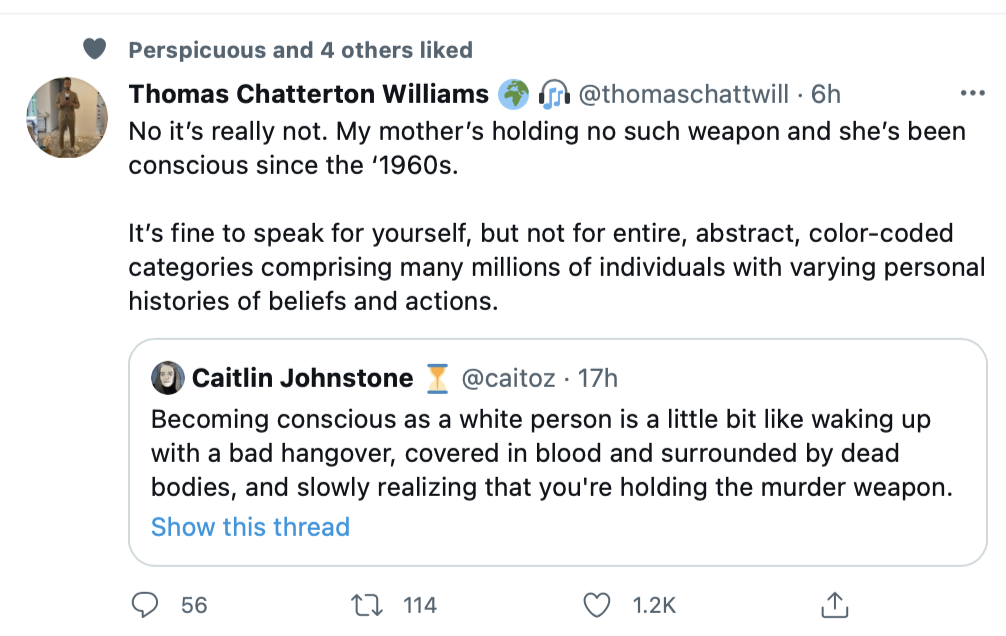
I believe that Thomas Chatterton Williams has nailed it: Speak only for yourself based only on your own life, your own choices and your own experience. If you've been a lifelong closet racist, such as Robin DiAngelo, then, yes, it's time to come clean. I suspect there are more than a few such people But don't pretend that you can speak for anyone else. Don't pretend that it has been impossible to treat everyone else as individuals.Don't pretend that it is a rare thing. Don't pretend that everyone else inevitably sees people as "colors" and treats them in stereotypical ways. If you recently had a revelation that you are a racist, go fix yourself and quit projecting your dysfunctional mindset onto everyone else. As part of your healing process, you might want to read Thomas Chatterton Williams' excellent book: Self-Portrait in Black and White: Family, Fatherhood, and Rethinking Race.
Continue ReadingTwo Worlds

Wide Open Classroom Discussion

A professor at Duke has convinced his students to open up classroom discussions. The project could not happen in the absence of trust. An excerpt from the WSJ:

To get students to stop self-censoring, a few agreed-on classroom principles are necessary. On the first day, I tell students that no one will be canceled, meaning no social or professional penalties for students resulting from things they say inside the class. If you believe in policing your fellow students, I say, you’re in the wrong room. I insist that goodwill should always be assumed, and that all opinions can be voiced, provided they are offered in the spirit of humility and charity. I give students a chance to talk about the fact that they can no longer talk. I let them share their anxieties about being socially or professionally penalized for dissenting. What students discover is that they are not alone in their misgivings.

Having now run the experiment with 300 undergraduates, I no longer wonder what would happen if students felt safe enough to come out of their shells. They flourish. In one class, my students had a serious but respectful discussion of critical race theory. Some thought it harmfully implied that blacks can’t get ahead on their own. Others pushed back.

My students had an honest conversation about race, but only because they had earned each other’s trust by making themselves vulnerable. On a different day, they spoke up for all positions on abortion. When a liberal student mentioned this to a friend outside class, she was met with disbelief.

Continue ReadingWide Open Classroom Discussion

Bari Weiss Discusses the Importance of Publicly Airing Disagreements

On FB I have repeatedly posted on the need for free and robust speech. Often, someone will post a comment that I must be a conservative, that conservatives are full of shit, that only true ideas must be heard, that censorship is OK for the bad guys and "You seem to have fallen off the rails." I try to respond to these comments, but it takes a lot of patience and some days my patience runs low. Bari Weiss definitely gets it. I support her writings at Substack and recommend that you check our her articles. Here's an excerpt from her most recent article, "The Books Are Already Burning: The question is only: How long will decent people stand by quietly and watch it happen?"

You do not need to agree with [Abigail] Shrier about whether or not children should be able to medically transition genders without their parents’ permission (she is opposed), or for that matter with Weinstein and Heying’s bullishness about ivermectin (I had never heard of of the drug before they put it on my radar). That’s not the point. The point is that the questions they ask are not just legitimate, they are of critical importance. Meantime, some of the most powerful forces in our culture are conspiring to silence them.

That is precisely the reason it is so important to stand up and say: no. To say: progress comes only when we have the freedom to disagree. To say: It is outrageous that tech platforms are censoring such debates and that some journalists are cheering them on. To say, in public: enough. In my case, that means making sure to publish those voices who have been shut out of so many other channels that ought to be open to them.

Continue ReadingBari Weiss Discusses the Importance of Publicly Airing Disagreements