
Stanford Declares “The Science” instead of Engaging in the Scientific Method

This is an excerpt from article by highly regarded Stanford Researcher, Dr. Jay Bhattacharya, whose account was shut down by Twitter, recently restored. An excerpt:

About a year later, after historian Phil Magness made a FOIA request, I learned a part of the story of how the U.S. government-sponsored propaganda campaign against the GBD came into being. Four days after we wrote the GBD, Francis Collins, the geneticist and lab scientist who was then the head of the U.S. National Institutes of Health, wrote an email to Anthony Fauci, the immunologist and lab scientist who is the head of the National Institute of Allergy and Infectious Diseases. In the email, Collins called Martin, Sunetra, and me “fringe epidemiologists” and called for a devastating public takedown. The attacks on the three of us, aided by the cooperation of supposedly private social media platforms like Twitter, were launched shortly after Collins sent that email.

But this is not an article about the ethics of social media companies whose profits depend to a large extent on the friendliness of government regulators and whose employees may see themselves as partisan political activists. This is a critique of our best universities, which are supposed to be dedicated to the pursuit of knowledge—yet which turn out to be no different than government propagandists and private corporations in their self-seeking, amoral behavior.

. . . .

Stanford failed to meet the higher standard of positive academic freedom, which would have required it to promote an environment where faculty members engage with each other respectfully despite fierce disagreement.

. . . .

The irony in this idea of “science” as a set of sacred doctrines and beliefs is that the Age of Enlightenment, which gave us our modern definitions of scientific methodology, was a reaction against a religious clerisy that claimed for itself the sole ability to distinguish truth from untruth. The COVID-19 pandemic has apparently brought us full circle, with a public health clerisy having replaced the religious one as the singular source of unassailable truth.

The analogy goes further, unfortunately. The same priests of public health that have the authority to distinguish heresy from orthodoxy also cast out heretics, just like the medieval Catholic Church did. Top universities, like Stanford, where I have been both student and professor since 1986, are supposed to protect against such orthodoxies, creating a safe space for scientists to think and to test their ideas. Sadly, Stanford has failed in this crucial aspect of its mission, as I can attest from personal experience.

The title to the article: "How Stanford Failed the Academic Freedom Test: For America’s new clerisy, scientific debate is a danger to be suppressed."
Continue ReadingStanford Declares “The Science” instead of Engaging in the Scientific Method

Greg Lukianoff Recommends Martin Gurri’s “The Revolt of the Masses”

I just spotted this review of The Revolt of the Masses by Greg Lukianoff." Greg's review has convinced me to order my own copy of The Revolt of the Masses.

Excerpts:

“The Revolt of the Public” explains that the shifts in media technologies that we believe accelerated American political polarization and played havoc with young people’s mental health were actually part of a much larger global transformation that Gurri calls “The Fifth Wave.” Essentially, the empowerment of vast multitudes of people to communicate directly with the world and with each other has genuinely transformed society. Unfortunately, in its current state, this media revolution has only been able to tear things down; institutions, ideas, and yes, even people (a.k.a. cancel culture). This idea is what Gurri calls “negation.”

. . . . Gurri shows how this manifested in the 2011 Arab Spring and how it has had ripple effects in Spain, Israel, and the American Occupy Wall Street movement. Gurri also argues that these movements generally were rich with targets: people, institutions, and ideas that needed to be torn down, but those same movements were often very hesitant to offer constructive solutions or realistic reforms. This hopeless point of view amounted to a kind of nihilism, according to Gurri—usually not the kind of nihilism of the philosophers, but a de facto nihilism in which nothing constructive is proposed to replace what needs to be torn down.

You can see this in American society in everything from “End the Fed,” to “abolish the police,” to cancel culture on both the right and the left, and to the absolute negation of all assumptions represented by the QAnon conspiracy.

One thing that must be said about the “crisis of authority” we find ourselves in due to the overwhelming power of negation is that very often what critics have discovered is that our existing “knowledge” was truly based on some pretty thin evidence, bad assumptions, and sometimes not much more than the pieties of some elites. Understanding the crisis of authority as only being wrongfully destructive of expertise is to miss that, frankly, we are often asking far too much of expertise and experts, and oversight itself has not been all that rigorous. Negation is indeed tearing things down that needed to be torn down; unfortunately, it seems to be taking everything else with it.

Continue ReadingGreg Lukianoff Recommends Martin Gurri’s “The Revolt of the Masses”

Martin Gurri: The Elites Battled the Peripheries at Twitter

Michael Shellenberger and Leighton Woodhouse interview Martin Gurri in their article, "Former Top CIA Analyst Condemns FBI For Censorship & Misinformation "Joe McCarthy would have loved to have that kind of control," says Martin Gurri, author of the seminal 2018 book, "The Revolt of Public," about government influence over Twitter." Here is an excerpt:

For some perspective, we reached out to former CIA analyst Martin Gurri. In 2018 Gurri published a major book, The Revolt of the Public, which argues that the Internet is disrupting modern society and politics as much as the printing press did in the 15th Century. The book influenced us so much that we named our Substack publication after it. (Above, you can see a video that one of us, Leighton, made about it.)

The Internet in general, and social media in particular, argues Gurri, mean that the elites can no longer control the public conversation as they once could. They struggle to “manufacture consent.” Anybody can start a Substack or Twitter account, and anybody can go viral. That technological revolution is resulting in political revolutions.

“What you’re seeing [in the Twitter Files] is a reaction to the revolt of the public,” said Gurri, who concludes that the United States needs a truth and reconciliation commission, similar to the one used in South Africa, to get to the bottom of what happened.

In the end, Gurri doesn’t believe we can return to the pre-Internet era of information control. But the Twitter Files, he notes, reveal just how hard they’ve been trying.

Continue ReadingMartin Gurri: The Elites Battled the Peripheries at Twitter

The Lies Told by Governments and their Allies

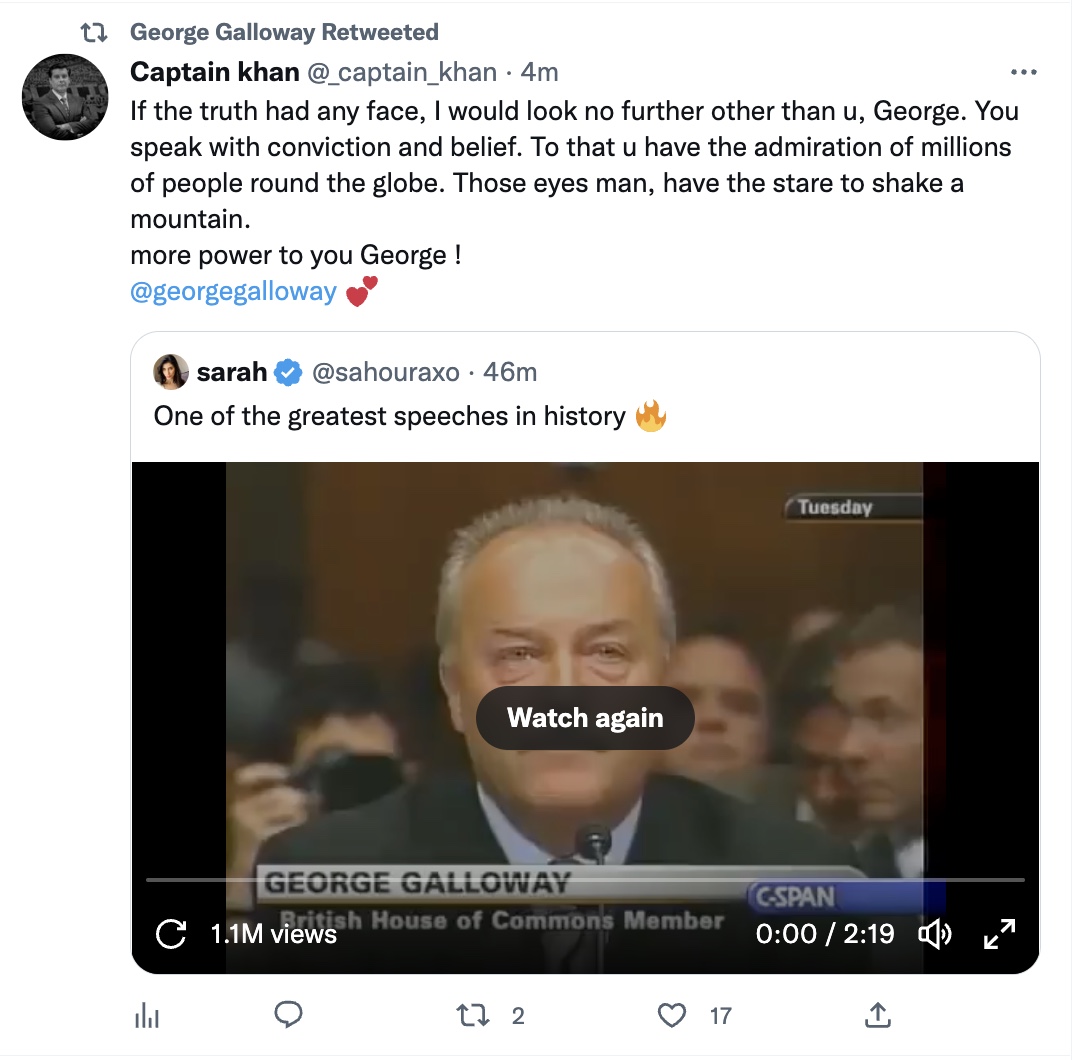
George Galloway eloquently states the facts about the about the 2003 invasion of Iraq, smashing the official lies, one by one. Who told these lies? Governments in bed with weapons contractors and people who pretended to be journalists, who actually served as their stenographers. For those thinking that such a big lie is not possible, here's your proof. It's possible for powerful people to tell a big lie in broad daylight and never be called out on it. Or maybe not for 20 years, when it is too late to save hundreds of thousands (or millions) of lives.

The lies we heard regarding Iraq should make us pause whenever a government official looks us straight in the eyes and tells us to trust them. It's possible that they are telling the truth, but governments and their newspapers have a long history of misleading us. We need to always keep this in mind. The Twitter Files are blowing up more big government/corporate/media lies every week and the official silence is deafening and telling.

Continue ReadingThe Lies Told by Governments and their Allies

An Inert People is “the Greatest Menace” to our Republic

Voting is obviously important. But as citizens of these United States, one of our most sacred obligations is to work hard between the elections.  We need to talk with each other or else we will not be a united community, but only an ugly place were "factions" fight each other. For the Founders factions were one of their biggest fears.  Here are Madison's words from "The Federalist No. 10":

Among the numerous advantages promised by a well constructed Union, none deserves to be more accurately developed than its tendency to break and control the violence of faction. The friend of popular governments, never finds himself so much alarmed for their character and fate, as when he contemplates their propensity to this dangerous vice. He will not fail therefore to set a due value on any plan which, without violating the principles to which he is attached, provides a proper cure for it. The instability, injustice and confusion introduced into the public councils, have in truth been the mortal diseases under which popular governments have every where perished . . .

By a faction 1 understand a number of citizens, whether amounting to a majority or minority of the whole, who are united and actuated by some common impulse of passion, or of interest, adverse to the rights of other citizens, or to the permanent and aggregate interests of the community. ...

There are two methods of curing the mischiefs of faction: the one, by removing its causes; the other, by controlling its effects....

The latent causes of faction are thus sown in the nature of man; and we see them every where brought into different degrees of activity, according to the different circumstances of civil society. A zeal for different opinions concerning religion, concerning Government and many other points, as well of speculation as of practice; an attachment to different leaders ambitiously contending for pre-eminence and power; or to persons of other descriptions whose fortunes have been interesting to the human passions, have in turn divided mankind into parties, inflamed them with mutual animosity, and rendered them much more disposed to vex and oppress each other, than to co-operate for their common good. So strong is this propensity of mankind to fall into mutual animosities, that where no substantial occasion presents itself most frivolous and fanciful distinctions have been sufficient to kindle their unfriendly passions, and excite their most violent conflicts. But the most common and durable source of factions, has been the various and unequal distribution of property.

Madison viewed "pure democracy" as a dangerous thing.

[More . . . ]

Continue ReadingAn Inert People is “the Greatest Menace” to our Republic