
The U.S. Government: Generating Fear and Job Security at the Expense of Democracy

Consider the haunting opening lines to the 2010 BBC documentary, "The Power of Nightmares":

In the past, politicians promised to create a better world. They had different ways of achieving this. But their power and authority came from the optimistic visions they offered to their people. Those dreams failed. And today, people have lost faith in ideologies. Increasingly, politicians are seen simply as managers of public life. But now, they have discovered a new role that restores their power and authority. Instead of delivering dreams, politicians now promise to protect us from nightmares. They say that they will rescue us from dreadful dangers that we cannot see and do not understand.

Ten years ago, I found this intense documentary online. Over the years, the links to the documentary keep breaking and I have fixed them at least twice. You can now view the entire work here. Also here is the full script.

What would motivate a phalanx of high-paid government-financed experts to protect us from a never ending procession of alleged nightmares? How about job security. More specifically, now that Middle East terrorism is no longer looming as a threat to Americans, how about drumming up the new threat of misinformation/malinformation/dysinformation? How about funding huge bureaucracies of highly paid experts to protect us from each other? Notice that they have now turn our suspicions and paranoia toward each other, a disgraceful tactic in a country founded on the principle that we the citizens are in charge and it is our duty as self-rulers to interact and negotiate with each other to find solutions to complex problems. To feed their coffers, they have found a gift that keeps on giving, the concept of "misinformation," ignoring that this concept is comically vague, in other words, perfectly suited for instigating Americans to form circular firing squads.

See the latest example, “They're searching for fears to tap into," article at Public by an excellent journalist, Lee Fang. Here is an excerpt:

Smith: So when you're talking about this mission creep, do you think that this is just an example of the government just trying to grab power increasingly or do they seem to have some sort of position that they're creeping towards intentionally, if that makes sense, like some sort of policy or what?

Fang: Bureaucracies tend to be self-perpetuating. We see this in a number of areas. The military is certainly an example of this. It's difficult to wind down major military programs to cancel or roll back major military conflicts. Even with wars ending and conflicts ending and winding down in Iraq and Afghanistan, oversized military budgets seem to only grow and grow. There's no peace dividend when these conflicts end. And the same is the case with the Department of Homeland Security. This agency has grown and grown.

And even as the threat of Islamic terrorism from Al-Qaeda or ISIS has radically waned in recent years, has gone down, this agency needs to justify its existence. So it's searching for new threats, searching for new fears to tap into, and coming up with new justifications for this enlarged bureaucracy and variety of government contractors. It's shifting from protecting against overseas terror threats to focusing on social media censorship. And that seems like a radical progression, but it helps justify the duration and expansion of these agencies.
Continue ReadingThe U.S. Government: Generating Fear and Job Security at the Expense of Democracy

Dr. Peter McCullough Discusses COVID-19 Vaccine Injury Syndromes

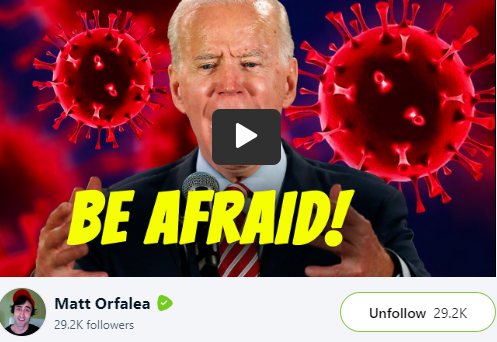
Why have I (and many other Americans) lost so much faith in American public health officials and institutions? Well, there was the official narrative that we heard from government officials, something like, "The vaccine is safe. Take it. Or else you will be socially ostracized, perhaps fired from your job." Matt Orfalea's mashup illustrates that official narrative:

On the other hand, consider the testimony of Dr. Peter McCullough in the Pennsylvania Senate. You will learn about massive conflicts of interest among public health institutions, including the CDC and the FDA. You will hear that there was no independent organization dedicated to patient safety of the vaccines, which is ghastly.  McCullough discusses the VAERS risk signal associated with the vaccines, which has been corroborated by subsequent studies.

McCullough testifies that 5% of Americans have suffered permanent disability, primarily stroke and neurologic disability as a result of taking the mRNA vaccine (min 27). He discusses the use of therapeutics for those detrimentally affected by the mRNA vaccine, including the use of the supplement called Nattokinase and other natural substances that seem to dissolve the spike protein that is already in the human body (discussed at min 27). Throughout this video you will hear his descriptions of a hubristic network of government "experts" and pharmaceutical manufacturers who are withholding data and refusing to enter into wide-open no-limits discussions regarding potential adverse affects of the COVID vaccines.

Why are some Americans having adverse affects regarding the vaccines while others are not? McCullough cites to a new R-Squared analysis study tracing problems to certain batches of the vaccines (and not others) (min 22). About 1/3 of people who received Batch 1 and report no side effects. Almost 2/3 of of people took Batch 2 and had side effects, but very few serious side-effects. About 4.2% of Americans received Batch 3, the bad batches and about 75% of those people receiving the bad batch have health issues related to the vaccine. Why? McCullough suggests that there was a "product manufacturing problem."  Either hyper-concentrated lipid nano-particles with an excessive amount of messenger RNA or CDNA contamination or other types of contamination.

I am not an expert, so I have no ability to evaluate McCullough's claims, but I listened closely as he cited to recent studies. What he is saying very much concerns me. At a minimum, how was it that experimental vaccines that never received standard testing labeling (with package inserts) were foisted (often under duress) on Americans via the Emergency Use Authorization?

And again, why are we not seeing wide discussion of these issues?  Why, instead, are we seeing suspicious activities by public health officials, things like this?

Continue ReadingDr. Peter McCullough Discusses COVID-19 Vaccine Injury Syndromes

Meaningful Conversation is Like Sex

Last week Bret Stephens gave a talk on the culture of free speech at the University of Chicago. I often don't agree with Stephens, but I think he's on target with this commentary Here is an excerpt:

I hope you do, whether you choose to lead a private or a public life. And I hope you do so by writing your own version of “The Joy of Argument” — which is like a similarly titled book from 50 years ago, updated for an era that has become curiously and depressingly afraid of both. The joy of argument is not about “owning” or “destroying” or otherwise trying to disparage, caricature or humiliate your opponent. On the contrary, it should be about opposition and mutuality, friction and delight, the loosening of inhibitions and the heightening of concentration, playfulness and seriousness, and, sometimes even, a truly generative act.

Yes, I am comparing great arguments to great sex. But the analogy bears a brief follow-through because, in the last analysis, the only way in which we are going to create institutions in which independent thought and free expression flourish isn’t through a declaration of principles, however well constructed it may be — at best, those principles can only lay the ground for what we are trying to achieve. Nor can it be on account of some worthy but abstract goal, like the health of democracy — which, again, is wonderful, but rarely motivates people to action.

We are going to succeed at the task only when we persuade others, and ourselves, that these things you’ve all been doing at the University of Chicago for the past few years — discussing and debating and interrogating and doubting and laughing and thinking harder and better than you ever did before — aren’t the antithesis of fun. They are the essence of it. They make up the uniquely joyful experience of being authentically and expressively and unashamedly yourself and, at the same time, having a form of honest and intimate contact with others who, in their own ways, are being authentically and expressively and unashamedly themselves.

He is well aware that many of us don't speak up. Why? He lists four reasons:

1. "First, the problem isn’t that people aren’t smart. It’s that they are scared."

2. Some arguments that sound persuasive are severely defective. "Will you be able to notice the underlying flaw in an idea when the arguments for it sound so persuasive?

3. It's pleasurable to bask in the emotional warmth of one's tribe: "They go along to get along, because the usual emotional companion to intellectual independence isn’t pride or self-confidence. It’s loneliness and sometimes crippling self-doubt. Is that a price you are willing to pay?"

4. Our culture fails to protect those willing to earnestly participate in wide-open conversations: "Does the culture of a society, or of an institution, encourage us to stand out or to fit in; to speak up or to bury our doubts? Does it serve as a conduit to groupthink, or as an obstacle to it?"

Continue ReadingMeaningful Conversation is Like Sex

New Study Regarding Tribalism in Politics

New study by Bernstein, Zambrotta, Martin, & Micalizzi on political tribalism. Disturbing and not surprising to anyone who has eyes and ears. Title is: "Tribalism in American Politics: Are Partisans Guilty of Double-Standards?"

Here is the discussion section:

Across experiments, we found strong evidence for the existence of political tribalism and the application of double-standards. In Study 1, we found that tribalism occurs for the perceived legitimacy of hypothetical election outcomes. When asked whether Donald Trump or Joe Biden would be the legitimate president under three different scenarios, Republicans viewed Trump as more legitimate than Biden while Democrats viewed Biden as more legitimate than Trump. Similarly, in Study 2 Part 1, Republicans supported identical presidential policies and actions more under Donald Trump than Barack Obama while Democrats supported identical policies and actions more under Barack Obama than Donald Trump.

A noteworthy element this study is that each item was, in fact, true under both Presidents, which highlights the study’s real-world importance and is an important contribution over prior experiments. In Study 2 Part 2, we showed that Republicans viewed identical statements attributed to Bill Clinton as more bigoted than those attributed to Donald Trump while Democrats viewed the statements as more bigoted when attributed to Trump instead of Clinton. Further, Republicans viewed a statement advocating colorblindness to be generally not racist when attributed to either Dr. Martin Luther King (MLK) or Donald Trump (though racism scores were slightly higher in the latter condition); Democrats also viewed the statement as low in racism when attributed to MLK, but the racism score increased drastically when attributed to Trump. Taken together, these studies suggest that tribalism permeates many aspects of political life and discourse. Policy agreement differs according to the person enacting the policy. Perceptions of racism and xenophobia depend on the person who utters the statement. Alarmingly, even the perceived legitimacy of elections is dependent upon the winner; that is, people assign different standards for election legitimacy depending upon whether their preferred candidate wins or loses. Moreover, some of these effects are rarely seen in the social or cognitive sciences (e.g., Fs>250 when sample size <150), which suggests that tribalism plays a large role, at least in certain contexts.

Our main interest was in documenting if bias exists among each side of the political aisle. However, the study does invite us to ask which side exhibits greater tribal bias . . . To the degree that our results can help weigh in on this question, there was some indication that bias is higher among Democrats, which we call “left-leaning asymmetry”

Continue ReadingNew Study Regarding Tribalism in Politics